 how-to
What Happens If a Spray Foam Roof Gets Punctured
Last Updated: November 4, 2026
Quick Summary
A puncture lets water into a spray foam roof, where it can spread beneath the coating and stay trapped for months. Exposed foam also breaks down from UV light and moisture, so the hole tends to grow over time. Prompt inspection and repair of wet foam limit the damage to the roof deck and insulation.
- Water can migrate sideways beneath the coating and collect where no one checks.
- Closed-cell foam resists water absorption better than open-cell foam.
- Exposed foam breaks down from UV light and water, so the breach can widen over time.
- Thermal imaging maps likely trapped moisture, but a moisture meter or test cut must confirm it.
- Never patch over foam that still feels damp, because trapped water keeps spreading.
Table of Contents
- How Punctures Happen on a Spray Foam Roof
- Why a Small Puncture Can Cause Major Hidden Damage
- Spray Foam Roof Leak Detection: Finding Damage You Cannot See
- How to Fix a Hole in a Spray Foam Roof
- Spray Foam Roof Coating Repair and Recoating Options
- Spray Foam Roof Maintenance to Prevent Future Punctures
- Booking a Roof Inspection With Sun Flex Home Improvement
- Frequently Asked Questions
Spray foam roofs are tough, but they are not indestructible. A puncture can look small from the ground and still let water work its way into the roof system for months before anyone notices.
Spray foam roofing is a seamless system of polyurethane foam sprayed onto the roof deck, then coated for protection. Because it has no seams to open up the way shingles do, a single puncture is a break in the only barrier between the weather and the building.
How Punctures Happen on a Spray Foam Roof
Most punctures come from something ordinary. A hailstorm, a dropped tool, or a crew member walking the roof without the right footwear can break through the coating and expose the foam beneath. The cause matters because it tells you what to look for and how to prevent a repeat.
Mechanical damage from hail, foot traffic and debris
Hail is a common culprit in the region. Large stones can crack the protective coating and dent or split the foam itself. Foot traffic causes trouble too, especially around HVAC units, vents and roof hatches where people stop to service equipment.
A common mistake is assuming that only deep holes matter. Surface scrapes and cracks in the coating can let water reach the foam, and foam that stays wet loses its performance over time.
Closed-cell vs. open-cell foam: why the type matters
Spray foam roofs use one of two foam types, and they respond to damage differently.
- Closed-cell foam is dense and rigid. It resists water absorption well, so moisture tends to stay on the surface rather than soak deep into the foam. It is the most common choice for roofing.
- Open-cell foam is softer and more porous. It absorbs water more readily, so a small breach can spread moisture through a larger area.
Knowing which foam is on your roof helps you judge how serious a puncture might be. Closed-cell foam usually confines the problem better, but a breach still needs prompt attention.
Why a Small Puncture Can Cause Major Hidden Damage
The biggest risk is not what you can see. A pinhole that looks harmless can allow water to travel sideways beneath the coating and collect in places no one checks. What separates a minor repair from a major restoration is how long the breach stays open and what the foam does once it is exposed.
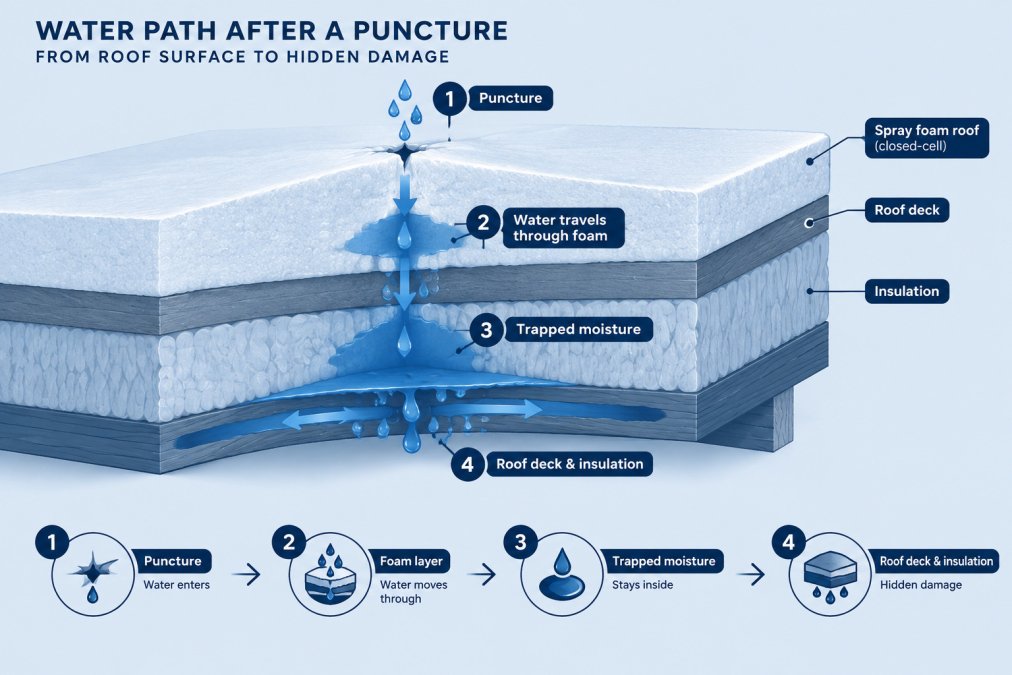
Water migration and trapped moisture
Water follows the path of least resistance. Once it enters through a puncture, it can move across the foam layer and settle against the roof deck, insulation or the building's interior ceiling.
Moisture trapped under a roof coating does not dry out on its own. Learn how waterproof spray foam really is and what happens once water gets past the surface.
Chemical degradation: what UV and water do to exposed foam
This is the part most puncture advice skips. Spray foam is not designed to be exposed. The protective coating, typically an acrylic, silicone or polyurethane elastomer, is what blocks ultraviolet light and sheds water.
- UV degradation. Ultraviolet light attacks the polymer structure of the foam itself. Exposed polyurethane foam chalks, becomes brittle and develops a crumbly surface. The degraded layer no longer sheds water and can wick it inward.
- Hydrolysis and moisture attack. Water in contact with foam and the roof deck drives slow chemical breakdown and supports biological growth. Closed-cell foam resists absorption better than open-cell, but neither is immune once the coating is gone.
The practical result is that the hole gets larger over time even if nothing else hits the roof. The foam around the puncture erodes, the coating edge lifts, and the breach widens.
Roof rot, insulation failure and structural effects over time
Persistent moisture leads to several problems:
- Wood roof decking can soften and rot, and fasteners can corrode where water sits against them.
- Insulation loses its R-value when it gets wet, which raises heating and cooling costs.
- Mold can grow in concealed spaces, affecting indoor air quality.
- Repeated freeze-thaw cycles can stress the foam and widen the damage.
Over years, these problems can affect the structural integrity of the roof, not just its surface. That is why a puncture should be treated as a building issue, not a cosmetic one, and why the cost of waiting is usually measured in decking and insulation, not in foam.
Watch out: A puncture that looks dry on the surface can still be holding moisture at the deck. Probing the foam around the hole, not just the hole itself, is the only way to know whether the damage has spread.
Spray Foam Roof Leak Detection: Finding Damage You Cannot See
Finding a puncture is only half the job. You also need to find the water that has spread beyond it. Start with simple checks and move to more advanced methods when the answer is unclear.
Visual signs and moisture meter checks
Look for these warning signs from inside and outside the building:
- Stains, bubbling or soft spots on interior ceilings
- Cracks, blisters or discolored patches in the roof coating
- Pooling water that lingers after rain stops
- Musty smells in the attic or top floor
A moisture meter can confirm what the eye cannot. Pin-type meters read moisture at the surface; pinless meters scan a wider area without penetrating the coating. Readings that stay high in dry weather point to a problem that needs repair.
Thermal imaging for locating trapped moisture
How the inspection actually works:
- Timing matters. Inspectors usually scan in late afternoon as the roof cools, or early morning as it warms, when the temperature gap between wet and dry areas is largest. Midday sun flattens the contrast and can hide the pattern.
- The camera maps, it does not confirm. A thermal image shows where moisture is likely present. It does not measure moisture content or identify the source.
- Follow-up confirms. Suspect areas are checked with a moisture meter or a small test cut before any repair is planned.
Thermal imaging can help locate moisture on foam roofs, where the wet area can sit far from the puncture with no visible connection.
Watch out: A thermal scan taken in direct sun or right after rain can produce false readings.
The table below summarises the main leak-detection signs and tools the article describes for finding moisture that is not visible on the surface.
| Method | What it shows | Key note |
|---|---|---|
| Visual signs | Stains, bubbling, soft spots, blisters | Check inside and outside the building |
| Pin-type moisture meter | Surface moisture readings | Reads moisture at the surface |
| Pinless moisture meter | Moisture across a wider area | Does not penetrate the coating |
| Thermal imaging | Likely location of trapped moisture | Maps moisture, does not confirm it |
| Best scan timing | Largest wet/dry temperature contrast | Late afternoon or early morning |
| Follow-up check | Confirms suspect areas | Moisture meter or small test cut |
How to Fix a Hole in a Spray Foam Roof
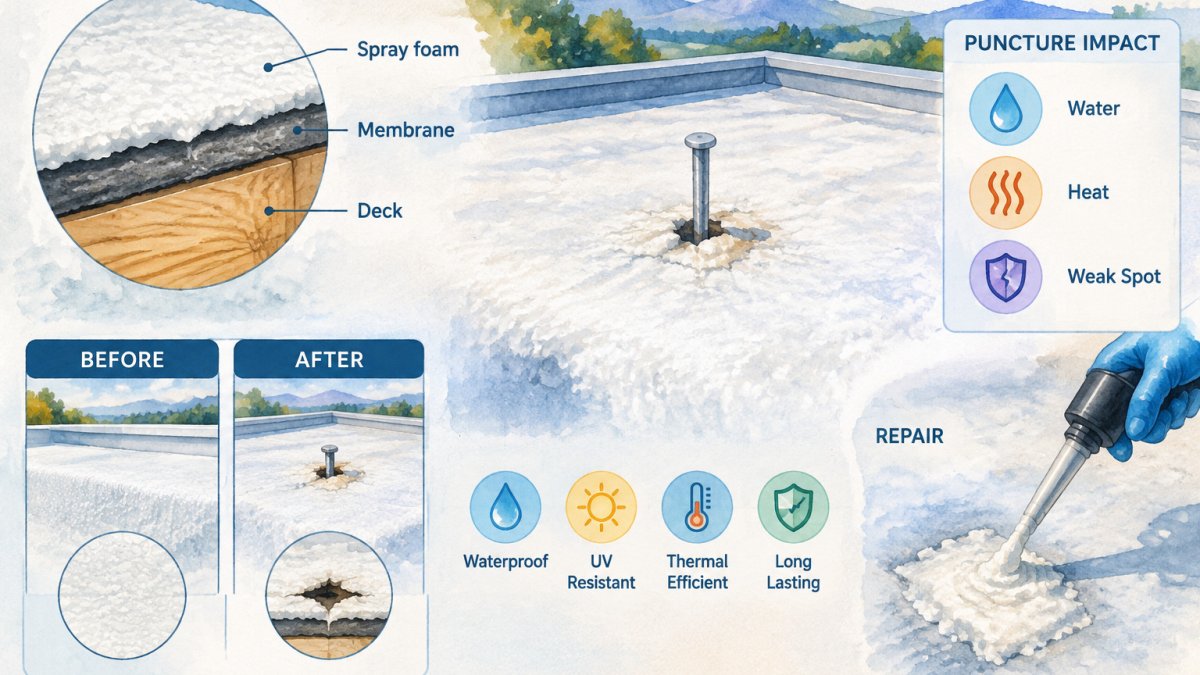
A proper repair removes the wet material, restores the foam and seals the surface. Patching over damp foam traps the water and makes the problem worse. Here is the general process, though the details depend on the size and location of the damage.
Preparing the damaged area and removing wet foam
- Clean the area. Remove debris, dirt and loose coating from around the puncture. See how to clean spray foam roof coating step by step before you start patching.
- Cut out wet foam. Remove foam that is soft, discolored or holds moisture. Cut back to dry, firm material.
- Let the area dry. Surfaces must be completely dry before new foam or coating goes on. Rushing this step traps moisture again.
Watch out: Never patch over foam that still feels damp. Trapped water will keep spreading under the new repair. Check the warranty coverage and exclusions before deciding whether to repair the roof yourself.
Patching and recoating the surface
- Fill the void. Spray new foam into the cut-out area and build it up to match the surrounding roof.
- Let the foam cure. Allow it to set fully before moving on.
- Apply a protective coating. Cover the repaired area and blend it into the existing roof so the seam disappears.
For a clean finish, plan the repair so the new coating overlaps the old by a few inches. This creates a continuous barrier that sheds water.
Spray Foam Roof Coating Repair and Recoating Options
A repaired spot is not the same as a restored roof.
Recoating restores the protective layer across the entire roof. It is often the better choice when the coating shows wear from years of sun and weather, or when repairs have left a patchwork surface.
The right option depends on the roof's condition. A localized puncture may need only a spot repair, while widespread coating breakdown usually calls for a full recoat. A professional inspection helps you choose.
Spray Foam Roof Maintenance to Prevent Future Punctures
Prevention costs far less than repair. A few habits protect the roof and catch problems early.
- Schedule regular inspections, ideally once a year and after major storms.
- Limit foot traffic and use designated walkways where possible.
- Keep equipment, tools and debris off the roof.
- Trim overhanging branches that could scrape or drop material onto the surface.
- Clear drains and gutters so water does not pool on the roof.
A well-maintained spray foam roof can serve for many years. Regular checks turn surprise leaks into scheduled repairs.
Booking a Roof Inspection With Sun Flex Home Improvement
If you suspect your spray foam roof has been punctured, the sooner it is inspected, the less damage you are likely to face. Sun Flex Home Improvement can help assess your roof and recommend a repair or recoating plan for your building.
If your roof has taken a hit, book a roof inspection with Sun Flex Home Improvement to find out what is happening beneath the surface. For a broader view of protecting your roof from future storms, you can also read how to protect a roof from hail damage.
Frequently Asked Questions
Does spray foam damage a roof?
Spray foam itself does not damage a roof when it is properly installed and coated. The risk comes from mechanical damage such as hail, foot traffic or dropped tools that breaks the protective coating or the foam surface. Once the foam is punctured, water can enter and become trapped beneath the coating. Regular inspections and prompt repairs prevent most long-term problems.
Can a puncture in a spray foam roof cause a leak?
Yes. A puncture breaks the seal that keeps water out of the closed-cell foam. Water can then migrate through the foam layer and reach the roof deck, insulation or interior ceiling, sometimes well away from the visible hole. Leaks caused by punctures often show up as stains or soft spots long after the damage occurred, so a professional inspection is worth scheduling after any impact.
How do you fix a hole in a spray foam roof?
Repairs typically start by cleaning the area and removing any wet or damaged foam. The surface is then patched with new spray foam, allowed to cure, and sealed with a compatible elastomeric coating. Small holes may be manageable for experienced DIY owners, but larger punctures, suspected moisture entrapment or flashing problems should be assessed by a professional before work begins. Pricing depends on the size and location of the damage; contact Sun Flex Home Improvement for a free estimate.
How long does spray foam last on a roof?
A well-maintained spray foam roof with a healthy protective coating can remain in service for decades. Lifespan depends on climate, foot traffic, the foam type and how quickly punctures and coating wear are addressed. Montana and Northern Wyoming winters and hail storms make periodic inspection and recoating especially important.