 how-to
Does Spray Foam Roofing Require a Building Permit?: A Montana Guide
Last Updated: November 9, 2026
Quick Summary
It depends on your location and the scope of the work, because permit rules are set mostly by local building departments rather than one national standard. Spray foam roofing and spray foam insulation are different jobs, so ask your local building department which category your project falls under before starting any work.
- Local building departments, often called the authority having jurisdiction, usually make the final permit decision.
- Full spray polyurethane foam installation is the most likely roof project to need a permit and inspection.
- Ask whether the work is a repair, alteration, or new roof, and get that classification in writing.
- Permit approval does not replace code compliance, so keep product documentation showing fire and thermal provisions are met.
- Do not treat a passed rough inspection as final approval until the permit is formally closed out.
Table of Contents
- Why Spray Foam Roofing Permit Rules Are Not One Standard
- Spray Foam Roofing Versus Spray Foam Insulation: Why the Distinction Matters for Permits
- Permit Triggers: Roof Coating, Re-Covering, and Full Spray Polyurethane Foam Installation
- Step-by-Step: Verifying Permit Requirements With Your Building Department
- Preparing a Spray Foam Roofing Permit Application and What Inspectors Check
- Roofing Permit Inspection Process and Common Reasons for Failed Inspections
- What Roofing Permit Costs Typically Involve and What Unpermitted Work Can Cost You
- Scheduling Your Spray Foam Roof Project With Sun Flex Home Improvement
- Frequently Asked Questions
Why Spray Foam Roofing Permit Rules Are Not One Standard
Does spray foam roofing require building permits? The honest answer is that it depends on where your building sits and what the work involves. There is no single national rule that applies to every roof job.
Permit rules are set mostly at the local level. Your local building department, sometimes called the building official or authority having jurisdiction, decides what needs a permit under the building code it enforces. Many jurisdictions adopt model codes, but they often amend them (The International Building Code).
- Local building departments usually make the final call.
- State rules can set minimum standards that cities or counties must follow.
- Commercial and residential projects can face different requirements.
- Scope matters as much as location.
Spray Foam Roofing Versus Spray Foam Insulation: Why the Distinction Matters for Permits
Spray foam roofing and spray foam insulation are related, but they are not the same job. Spray foam insulation is often applied to walls, attics, or crawl spaces to improve thermal performance.
That difference matters because roof assemblies are tied to weather protection and structural performance. Many permit offices review roofing work more closely than interior insulation work.
Do not assume insulation rules cover roofing. Ask your building department which category your project falls under before you start.
Permit Triggers: Roof Coating, Re-Covering, and Full Spray Polyurethane Foam Installation
Different roof projects tend to trigger different levels of review. The exact answer still depends on your jurisdiction, but this general breakdown helps you ask better questions:
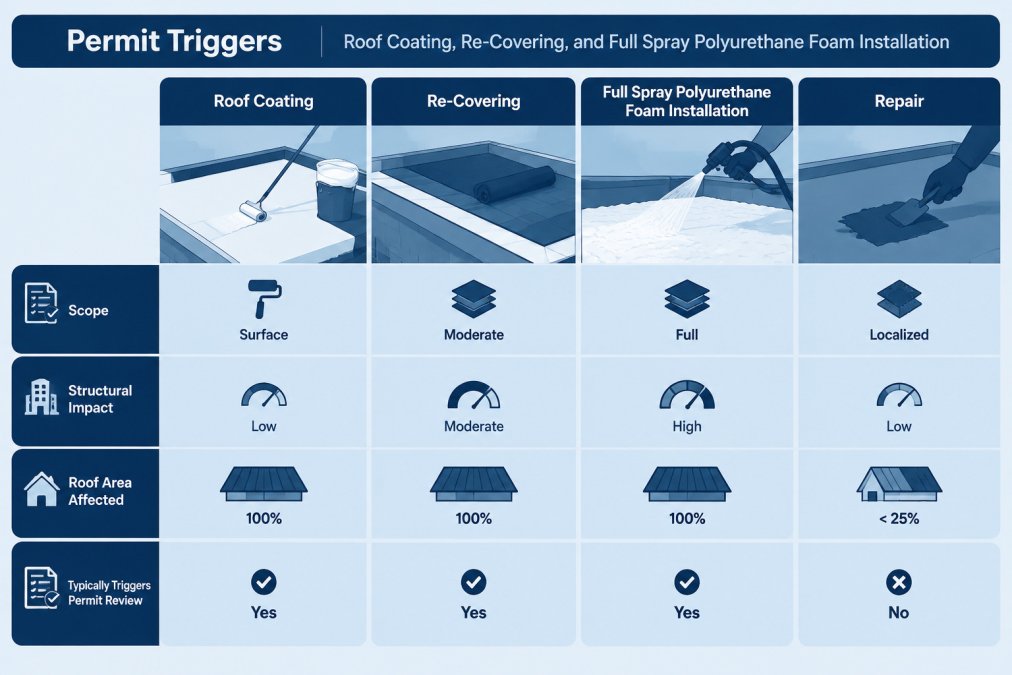
- Roof coating: Often treated as maintenance, but some jurisdictions still require a permit if the coating changes the roof system.
- Re-covering: Adding a new layer over an existing roof is more likely to need a permit, especially if the roof area or load changes.
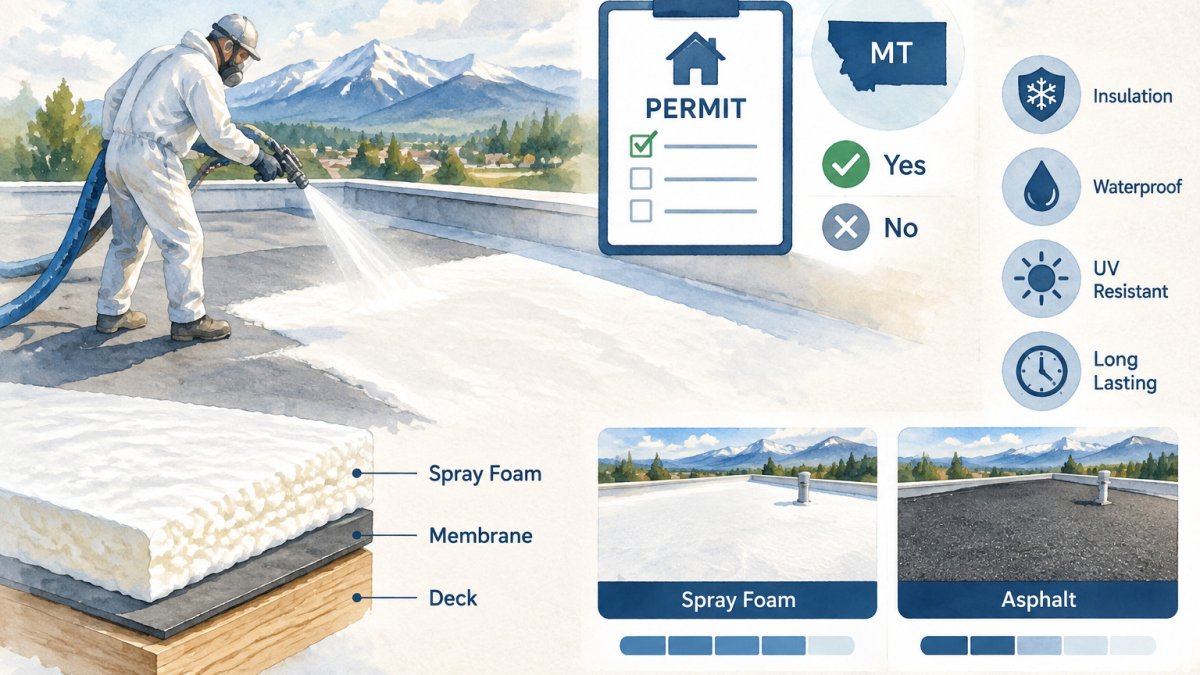
- Full spray polyurethane foam installation: A complete new roof system is the most likely to need a permit and inspection.
- Repair: Small repairs are often exempt, but some offices want notice for larger repairs.
Project scope matters too. A small patch on a few square feet is not the same as work across most of the roof area. Structural changes, such as opening a roof assembly or altering load paths, also raise the chance that a permit is required.
Step-by-Step: Verifying Permit Requirements With Your Building Department
Most permit disputes start with a vague phone call. The goal of this process is to leave with a defensible answer tied to a specific code edition, a named reviewer, and a written record.
-
Identify the authority having jurisdiction (AHJ). The AHJ is the office legally responsible for enforcing the building code at your address, and it is not always the city. If the building sits outside city limits, the county or a state-level office may be the AHJ. If it sits inside a city but the county issues the permit, confirm which office actually reviews roof assemblies. Ask the front desk which office issues the permit for a roof replacement at this address and which code edition they are currently enforcing.
-
Confirm the adopted code edition and any local amendments. Many jurisdictions adopt a model code and then amend it locally. The edition year matters because definitions of "repair" and "alteration" change between cycles. Ask for the edition year and whether the jurisdiction has published local amendments that touch roofing or spray foam.
-
Describe the project by scope rather than by product name. Saying "spray foam roofing" can get you a blank stare. Instead describe the work: tear-off or re-cover, square footage affected, whether the roof deck or structural members will be exposed, whether insulation thickness changes, and whether the roof assembly's fire or thermal classification changes. The permit clerk maps your description onto the code's definitions, so give them the inputs they need.
-
Ask the classification question directly. Ask: "Under your code, is this work a repair, an alteration, or a new roof?" That single answer usually determines whether a permit is required, because most codes exempt ordinary repairs but require permits for alterations and new construction. Get the classification in writing if you can.
-
Ask about separate trade permits. A spray foam roof project can touch more than one permit category. Ask whether the jurisdiction requires a separate permit for the foam application, for any electrical work tied to roof-mounted equipment, or for structural work if the deck is being reinforced. Some offices bundle these; others do not.
-
Request the submittal checklist. Rather than guessing what to bring, ask the office to email or hand you the submittal checklist for a roofing permit. That checklist is the authoritative list of drawings, product data, contractor registrations, and fees for that jurisdiction.
-
Document the answer. Record the date, the staff member's name and title, the code section or ordinance cited, and the classification you were given. If the answer was verbal, send a short follow-up email summarizing it and ask them to confirm. A written record protects you if a later inspector or a buyer's agent questions the work.
-
Have the contractor confirm in writing. Before work starts, get the roofing contractor's written confirmation that they will pull any required permit, that the permit will be posted on site, and that they will schedule inspections. A contractor who resists putting that in writing is a warning sign.
Watch out: A verbal "probably fine" from someone who does not review roof assemblies is not a determination.
Before any roof work starts, work through these steps with your building department to get a clear, documented answer.
| Step | What to do | Time or frequency |
|---|---|---|
| 1. Identify the AHJ | Confirm which office issues permits at your address | Before any work |
| 2. Confirm code edition | Ask for the adopted edition and local amendments | Before any work |
| 3. Describe the scope | Explain tear-off or re-cover, square footage, deck exposure | Before applying |
| 4. Ask classification | Ask if the work is a repair, alteration, or new roof | Get it in writing |
| 5. Ask about trade permits | Check for separate foam, electrical, or structural permits | Before applying |
| 6. Request checklist | Get the submittal checklist for roofing permits | Before applying |
| 7. Document the answer | Record date, staff name, and code section cited | At each contact |
| 8. Contractor confirmation | Get written confirmation the contractor pulls permits | Before work starts |
Preparing a Spray Foam Roofing Permit Application and What Inspectors Check
A permit application is a scope document, and the inspection is a check against that document plus the adopted code. Understanding both sides helps you avoid the most common delays.
What the application usually needs. Requirements vary by jurisdiction, but a roofing permit submittal commonly includes:
- Property address, parcel number, and owner information
- A written scope describing tear-off or re-cover, square footage, and roof assembly layers
- Product data sheets and installation instructions for the spray polyurethane foam system and the protective coating
- Evidence of code compliance for fire and thermal performance, such as an evaluation report or listing for the foam and coating system
- Contractor license or registration number, where the jurisdiction requires one
- Site plan or roof plan for larger or commercial projects
- Structural information if the deck, framing, or load path changes
What inspectors actually verify. Inspectors generally check three things: that the work matches the approved scope, that it complies with the adopted code, and that required inspections were called at the right stages. For spray foam roofing, common inspection points include:
- Deck preparation: surface condition, attachment, and cleanliness before foam is applied
- Foam application: thickness, adhesion, and coverage relative to the approved specification
- Coating and protection: coating thickness and coverage, and any required thermal barrier or fire-rated assembly
- Flashing and drainage: details at penetrations, edges, and drains that affect water shedding
- Final closeout: confirmation that corrections were made and that the permit can be closed
Permit approval is not the same as code compliance. This is the distinction most homeowners miss.
Records to keep after closeout. Retain the approved permit, the inspection record, the final signed-off inspection card, product data sheets, and the contractor's warranty. To see what an installer's warranty typically covers and excludes, read Spray Foam Roof Warranty Details: Coverage & Exclusions.
Watch out: Do not treat a passed rough inspection as final approval. Confirm the permit is formally closed out and that you have the signed inspection record in hand before the contractor's final payment.
Roofing Permit Inspection Process and Common Reasons for Failed Inspections
Most permitted roofing jobs involve at least one inspection. Common inspection points include the prepared roof deck, the foam application, and the final coating. Some jurisdictions also check drainage, flashing, and fire protection requirements.
Failed inspections often happen for avoidable reasons:
- Work started before the permit was issued
- Inaccurate roof area or material information on the application
- Missing product data or installer documentation
- Poor surface preparation before foam application
- Flashing or drainage details that do not match the approved plan
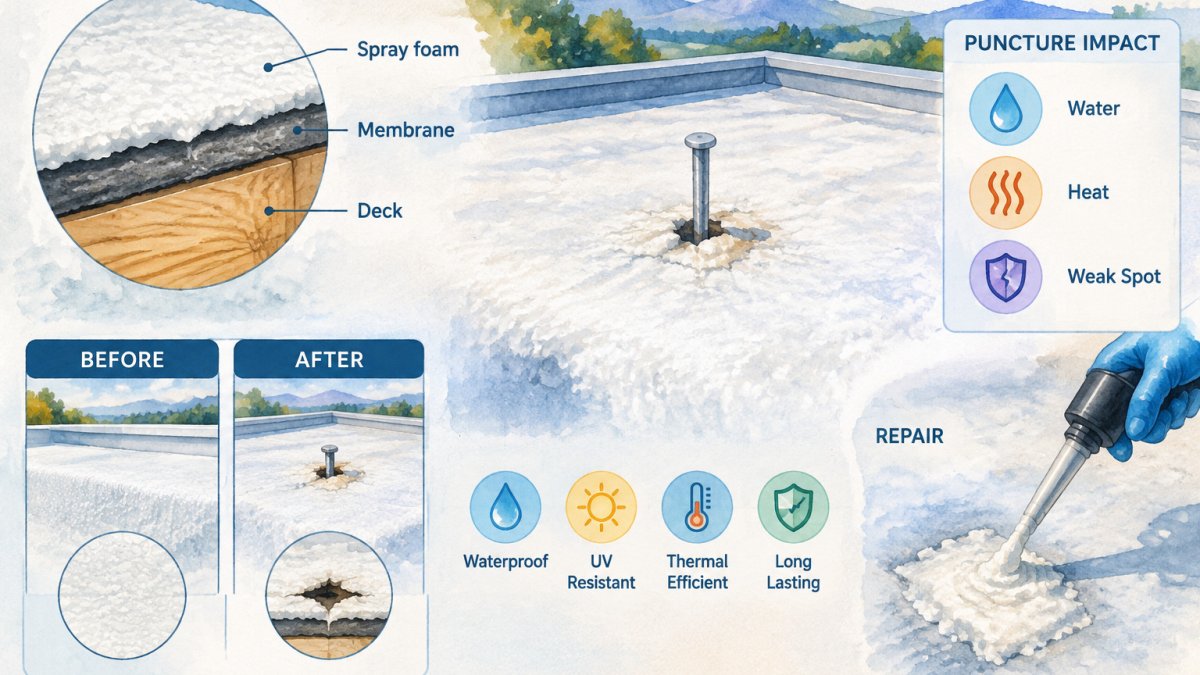
If a punctured or damaged area is found during inspection, it generally must be repaired and rechecked before the project can close out. For details on how punctures are handled, see What Happens If a Spray Foam Roof Gets Punctured.
What Roofing Permit Costs Typically Involve and What Unpermitted Work Can Cost You
Permit fees vary widely by jurisdiction and project size, so check your local fee schedule rather than relying on a general number.
Unpermitted work can cost far more than the permit itself. Possible consequences include stop-work orders, fines, required removal or correction of work, and problems when you sell the property or file an insurance claim.
Watch out: Skipping the permit to save time or fees can turn a manageable project into a costly correction.
Scheduling Your Spray Foam Roof Project With Sun Flex Home Improvement
Planning ahead makes permit approval and inspections easier. To plan around the work itself, learn how long spray foam roof installation takes. Sun Flex Home Improvement can help you sort out the work scope and gather product information. We specialize in spray foam roofing restoration for Montana and Northern Wyoming, and we are a BBB Accredited Business with over 25 years of industry experience.
Ready to find out whether your roof project needs a permit? Request a Free Estimate from Sun Flex Home Improvement.
Frequently Asked Questions
Do you need a permit to spray foam a roof?
Often, yes. Whether a permit is required depends on your local building department, the scope of the project, and whether the work changes the roof assembly or structure. A full spray polyurethane foam roof installation is more likely to require a permit than a light maintenance coat. Because rules vary by city and county across Montana and Wyoming, call your local building department before starting, describe the planned work, and ask them to confirm in writing whether a permit or inspection applies.
Does applying spray foam roof coating require a building permit?
It depends on the jurisdiction and the extent of the work. Many building departments treat a surface coating over an existing sound roof as routine maintenance that does not need a permit, while re-covering or structural alteration usually does. Confirm this with your local building department. Ask specifically whether the coating counts as repair, replacement, or a new roof assembly under local code, since that classification usually decides the permit question.
What can happen if spray foam roofing is installed without a required permit?
Unpermitted roofing work can lead to stop-work orders, fines, and requirements to open the roof for inspection. It can also complicate insurance claims and home sales, because buyers and insurers may ask whether the work was approved. In some cases the owner must remove or correct the work to meet code. Obtaining the permit after the fact is often possible but may cost more and take longer than permitting the job from the start.