 how-to
How to Stop Metal Roof Popping Noises in Winter
Last Updated: November 5, 2026
Quick Summary
Metal roof noise in winter happens because panels expand in the sun and shrink in the cold, and that constant movement against fasteners and framing creates popping, clicking, and cracking sounds. The noise itself rarely means your roof is failing; it usually means the panels are doing exactly what metal does when temperatures swing. Cold nights tighten the panels, morning sun heats them fast, and they shift.
- Loose fasteners cause more metal roof noise than any other single problem.
- Over-tightening screws crushes the panel and strips the hole, making the problem worse.
- Standing seam roofs use hidden clips designed to let panels slide as they expand and contract.
- Popping within an hour of sunrise or sunset points to thermal movement.
- Do not climb onto a snow-covered or icy metal roof to chase a noise.
Table of Contents
- Why Your Metal Roof Pops More in Winter
- How Metal Roof Thermal Expansion Noise Actually Works
- Metal Roof Loose Fasteners: The Most Common Fixable Cause
- Standing Seam Metal Roof Noise: Why Clips and Seams Matter
- How to Stop Metal Roof Noise: A Winter Diagnostic Checklist
- When a Noisy Metal Roof Needs a Professional Inspection
- Frequently Asked Questions
Why Your Metal Roof Pops More in Winter
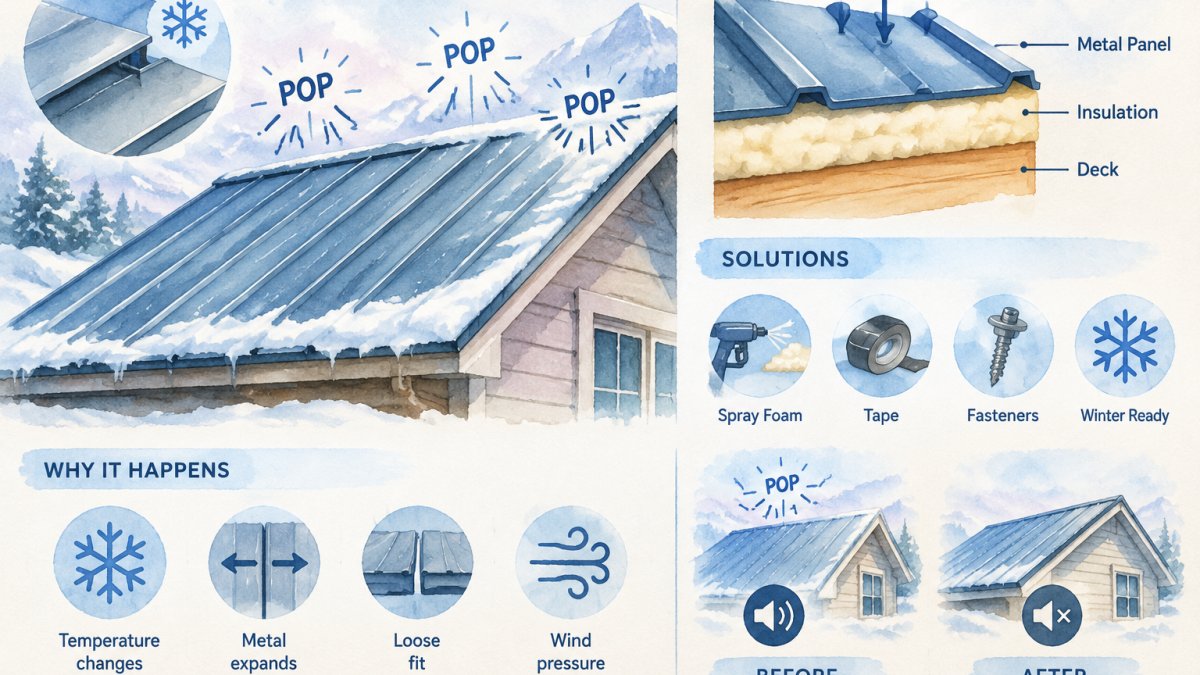
If your metal roof noise gets worse every winter, you are not imagining it. Metal panels expand in the sun and shrink in the cold, and that constant movement against fasteners and framing creates the popping, clicking, and cracking sounds you hear. This guide explains what is normal, what is not, and how to quiet a noisy roof.
Here is the part most guides get wrong: the noise itself rarely means your roof is failing. It usually means the panels are doing exactly what metal does when temperatures swing. Cold nights tighten the panels. Morning sun heats them fast, and they shift. That shift is the pop.
Days can warm quickly after a hard freeze, and that daily cycle can work the panels harder than the steadier temperatures of summer.
Below, we break down the causes, the fixes, and when to call a pro.
Normal Popping vs. a Noise That Signals Trouble
Normal popping is short, sharp, and tied to temperature changes. You hear it in the morning as the sun hits the roof, or in the evening as it cools. It repeats in a pattern. It does not come with leaks, loose panels, or visible damage.
Concerning noise looks different. Watch for these warning signs:
- A loud bang or boom that shakes the ceiling
- Popping that gets louder or more frequent over weeks
- Sounds paired with water stains, drips, or daylight in the attic
- A panel that looks lifted, dented, or wavy from the ground
- Noise centered on one spot rather than spread across the roof
If you see any of these, get the roof checked. A popping sound on its own is usually harmless. Popping plus a leak is a different story.
How Metal Roof Thermal Expansion Noise Actually Works
Metal roof thermal expansion noise is the sound of steel or aluminum panels changing size as temperatures move. Metal absorbs heat from sunlight and releases it fast when the sun drops.
The math is simple. A long panel moves more than a short one. Dark panels get hotter than light ones. A roof in full sun all day swings more than one shaded by trees.
This is why winter is loud. Cold nights shrink the panels. Morning sun heats them in minutes.
Snow adds another layer. Snow load presses down on the roof. When it melts and slides, the load lifts. Panels flex under that push and pull, and the framing below can shift too.
For a closer look at how metal roofs handle snow and cold, see our guide on metal roof snow shedding.
Metal Roof Loose Fasteners: The Most Common Fixable Cause
Loose fasteners cause more metal roof noise than any other single problem. Fasteners hold panels to the deck. Over years of freeze-thaw cycles, they can back out a fraction of an inch.
A common mistake is cranking down on every screw you can reach. Over-tightening crushes the panel and strips the hole, which makes the problem worse. Fasteners need the right tension and the right placement.
What most guides miss is the pattern. Loose fasteners usually show up in clusters, not at random. Check the edges, the ridge, and the areas that get the most sun and wind. Those spots take the hardest beating.
Fastener quality matters too. The wrong screw for a high-wind area will work loose again within a season. Our breakdown of metal roof fasteners for high wind areas covers which types hold up through wind and freeze-thaw cycles.
Standing Seam Metal Roof Noise: Why Clips and Seams Matter
Standing seam metal roof noise is governed almost entirely by how the panels are allowed to move.
Here is the mechanism most guides skip. A metal panel expands and contracts along its length far more than across its width.
Seams add a second variable. A standing seam is a folded joint, and the fold needs room to flex.
Panel length, color, and orientation all change the math. A dark panel in full sun reaches a higher surface temperature than a light panel, so it moves more.
Installation details decide which roof you get. Clip spacing, screw torque, panel length, seam type, and the expansion allowance at eaves and ridges all affect how much the roof moves.
If your roof is noisy and you are about to hire someone to look at it, read our guide on how to hire a metal roofing contractor before you make any calls.
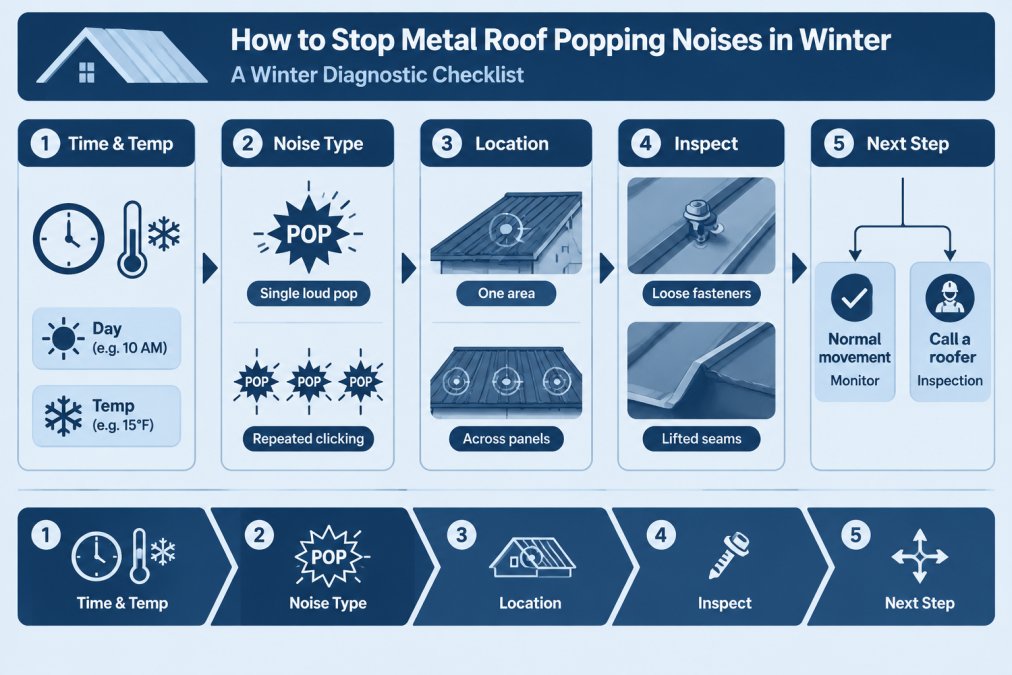
How to Stop Metal Roof Noise: A Winter Diagnostic Checklist
You can trace most metal roof noise to its source without ever getting on the roof. The trick is to separate the four things that actually move, panels, fasteners, roof decking, and framing, using clues you can observe from the ground and the attic. Work through this sequence over two or three days so you catch both the cold-morning and warm-afternoon behavior.
- Log the time and outdoor temperature. Write down each event with the thermometer reading. Popping that starts within an hour of sunrise, or within an hour of sunset, points hard at thermal movement. Noise that happens at random times, or in the middle of the night when temperatures are flat, points elsewhere.
- Classify the sound. A single sharp pop is usually a panel releasing stored tension. Rapid clicking or ticking is often a fastener or clip slipping. A long creak or groan suggests decking or framing movement. A deep boom that shakes the ceiling is a different category and deserves a prompt inspection.
- Map the location. Stand in different rooms and listen. Noise concentrated over one wall or one valley suggests a localized fastener or clip problem. Noise that travels across the whole ceiling is more consistent with broad panel movement.
- Inspect from the ground with binoculars. Look for backed-out screws, lifted seams, wavy or oil-canned panels, dents, and rust trails at fasteners. Do not use a ladder on snow or ice.
- Check the attic in daylight. Look for pinholes of daylight, water stains, crushed or sagging decking, and gaps at framing connections. Note whether the noise seems to come from directly above a specific framing member.
- Compare across seasons. If the noise disappears in mild spring and fall weather and returns with hard freezes, thermal movement is the leading cause. If it persists in stable temperatures, look harder at fasteners and decking.
Watch out: Do not climb onto a snow-covered or icy metal roof to chase a noise. Metal panels shed snow and ice unpredictably and become slick fast; a fall is far more dangerous than the pop you are trying to find. Keep your inspection to the ground and the attic, and use a phone camera on a pole if you need a closer look at the eaves.
What to Document Before You Call Anyone
A roofer can find the cause faster when you hand over a record instead of a description. Before you call, gather:
- Dates, times, and outdoor temperatures for each noise event
- A phone video that captures both the sound and the room where you hear it
- Photos of any lifted seams, backed-out screws, dents, or stains
- The roof's install date, material, and the name of the installer if you have it
- Any recent storms, hail, ice dams, or heavy snow loads
- Whether the noise is new or has been building over several winters
That record also shows whether the problem is stable or getting worse, which is the single most useful thing a professional can know before arriving.
Work through these steps over two or three days to catch both cold-morning and warm-afternoon behavior.
| Step | What to do | What it tells you |
|---|---|---|
| 1 | Log the time and outdoor temperature | Popping within an hour of sunrise or sunset points to thermal movement |
| 2 | Classify the sound | Sharp pop means panel tension; clicking means fastener or clip; boom needs inspection |
| 3 | Map the location | Noise over one wall or valley suggests localized fastener or clip problem |
| 4 | Inspect from the ground with binoculars | Look for backed-out screws, lifted seams, wavy panels, dents, rust trails |
| 5 | Check the attic in daylight | Look for daylight pinholes, water stains, crushed decking, framing gaps |
| 6 | Compare across seasons | Noise gone in mild weather and back with hard freezes means thermal movement |
When a Noisy Metal Roof Needs a Professional Inspection
Some noise is worth a professional look. Call a roofer if the popping comes with leaks, visible damage, or a sound that keeps getting worse.
A pro can check fastener torque, clip spacing, and seam condition. They can also tell whether the noise is normal movement or a sign of a real problem.
If you are already seeing leaks or water stains, do not wait. Our 7-step roof leak repair guide walks through how to spot and stop leaks before damage spreads.
Winter roofing problems often trace back to how the roof was built for cold. Our guide on the best roofing for Montana winters explains what to look for in a roof that has to handle hard freezes and fast warm-ups.
A noisy metal roof in winter is usually a roof doing its job, not a roof that is failing.
Frequently Asked Questions
Is it normal for a metal roof to pop in cold weather?
Yes, in most cases. Metal panels expand in sunlight and contract as temperatures drop, and that movement against fasteners and framing produces popping and clicking sounds. Winter makes it more noticeable because cold nights and sunny days create a wide daily temperature swing. A roof that pops mainly in the morning as it warms, or in the evening as it cools, is usually behaving normally. Noise that is sudden, localized to one spot, or paired with a leak points to a different problem.
Can metal roof loose fasteners cause popping or cracking sounds?
They can. When a screw backs out or a fastener is over-driven, the panel no longer sits tight against the deck, so it lifts and snaps back as it moves. That reads as a sharp crack or pop rather than a soft creak. If the noise comes from one area, inspect that section for backed-out screws, elongated holes, or lifted panel edges. Replacing and correctly placed fasteners often quiets the roof, but the fix should account for thermal movement so the screws do not work loose again.
Do standing seam metal roofs make popping noises?
Standing seam roofs use concealed clips rather than exposed screws, which removes one common noise source. They still expand and contract, so some popping or ticking is possible, especially on long panel runs and in wide temperature swings. Noise on a standing seam roof usually traces to clip placement, panels that are fastened too tightly, or framing movement underneath. If the sound started suddenly or is getting louder, have the clips and seams checked before assuming it is normal.
When should I have a noisy metal roof inspected?
Call for an inspection if the noise is new, getting louder, or concentrated in one spot; if you see backed-out fasteners, lifted seams, or dents; or if you find water staining, ceiling spots, or ice damming. Also call if the sound continues on days with little temperature change. A roofer can check fastener torque, panel movement, and deck condition. Document the dates, times, and weather when you hear the noise, since that record shortens the diagnostic work.