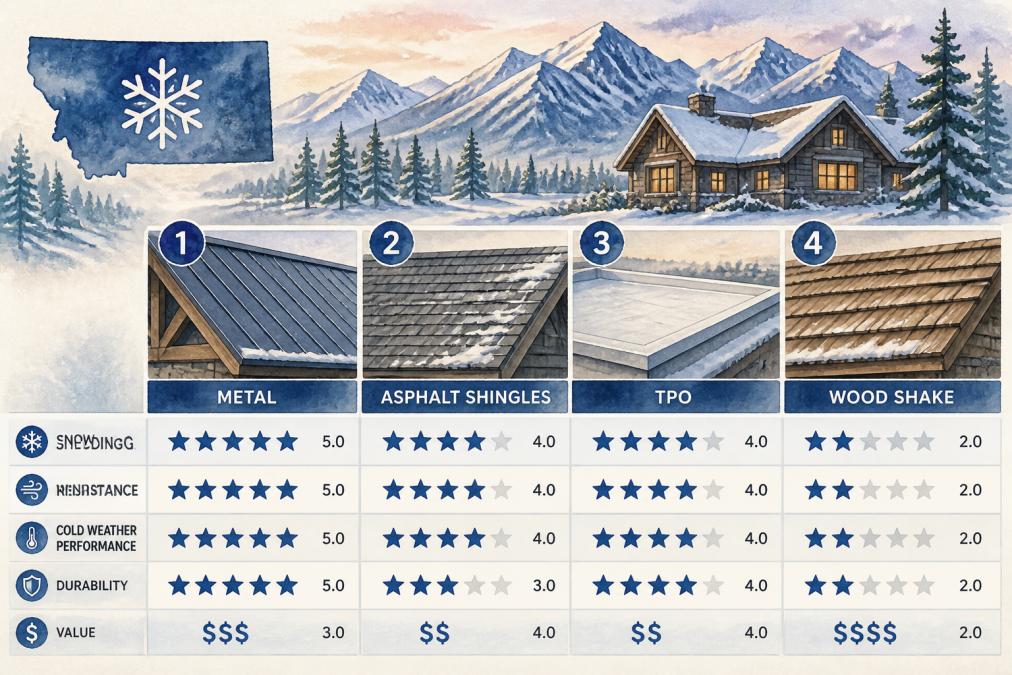
 blog
blog
Best Roofing for Montana Winters: 2026 Guide
Table of Contents
- How Montana Winters Stress Every Roof
- Metal Roofing: The Benefits of Metal Roof Snow Shedding
- Metal Roofing vs Asphalt Shingles Cost Over 30 Years
- Preventing Ice Dams on Residential Roofs: What Actually Works
- Spray Foam Restoration: A Cost-Effective Alternative to Replacement
- Building Codes, Roof Pitch, and Energy Efficiency in Winter
- Frequently Asked Questions
Last Updated: September 17, 2026
How Montana Winters Stress Every Roof
Montana winters are a structural test, not a seasonal inconvenience. The best roofing for Montana winters must survive three forces at once: snow that never fully melts between storms, water that refreezes inside every seam, and wind that finds the weakest fastener on the deck. At Sun Flex Home Improvement, we've spent 25 years watching roofs fail in this climate.
Snow Load, Ice Dams, and Freeze-Thaw Cycles
Snow load capacity is the total weight per square foot a roof can carry before it deflects or collapses, and in cold-climate construction that number drives everything else. A roof that sheds snow quickly never tests its limit; one that holds snow compacts it into ice, and that's where trouble starts.
Why Roof Pitch and Ventilation Decide Performance
Roof pitch determines whether snow slides or sits, and ventilation determines whether the deck stays cold enough to prevent meltwater. Get both right and most winter problems never start.
Metal Roofing: The Benefits of Metal Roof Snow Shedding
The benefits of metal roof snow shedding come down to surface friction. Metal panels are smooth, so snow releases in controlled slides rather than sitting and compacting, reducing snow load, limiting ice dam formation, and cutting how often a roof must be cleared.
Standing Seam, Stone-Coated Steel, and Snow Guards
Standing seam metal uses raised interlocking seams with concealed fasteners, removing the most common leak path on metal roofs. The trade-off is speed: it sheds snow fast enough to slide in one sheet, dangerous over doorways and walkways.
- Standing seam: fastest shedding, best for steep pitches, needs snow guards above walkways
- Stone-coated steel: moderate shedding, Class 4 impact rating, traditional appearance
- Snow guards: essential on any metal roof over an entry, driveway, or equipment
Metal Roofing vs Asphalt Shingles Cost Over 30 Years
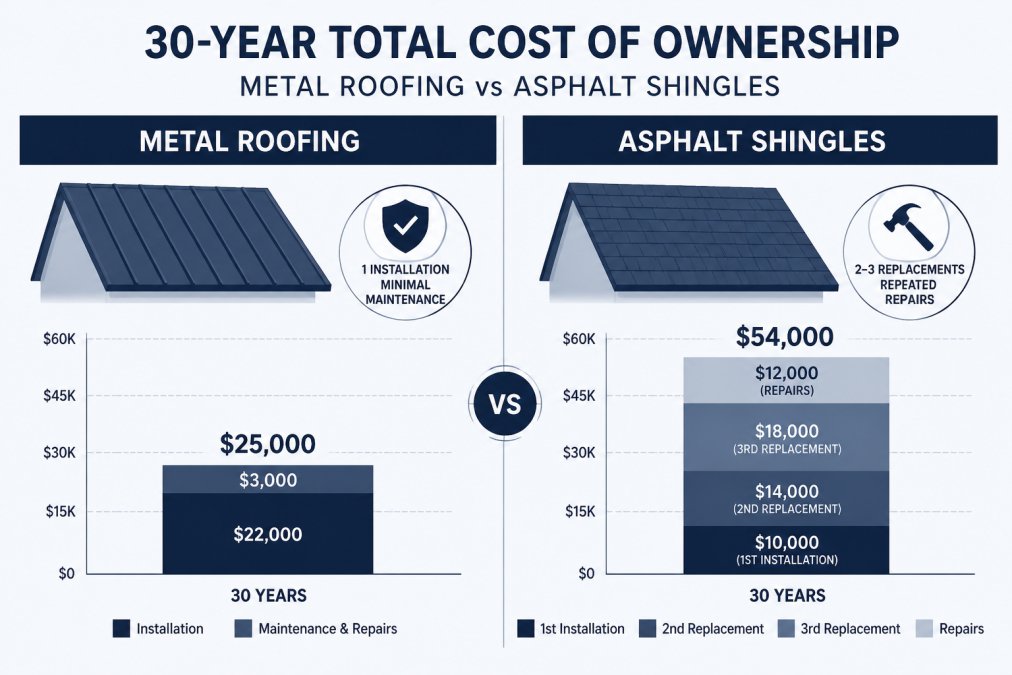
The metal roofing vs asphalt shingles cost comparison changes completely over 30 years. Asphalt is cheaper on day one and more expensive across the life of the building, because it must be replaced multiple times while metal does not. Four cost lines drive the gap.
The Four Cost Lines That Decide the 30-Year Number
1. Installation cycles. A typical architectural asphalt shingle carries a 25-to-30-year warranty, but with repeated freeze-thaw cycling and heavy snow load, effective service life runs shorter. A 30-year window usually contains at least one full tear-off and re-roof. Metal roofing is commonly installed once across the same window.
Why the Upfront Premium Is Smaller Than It Looks
Property owners tend to compare the metal quote against the asphalt quote as if both were one-time purchases. The honest comparison is the metal quote against the sum of every asphalt installation, tear-off, repair, and claim deductible across the same period. Framed that way, the upfront premium narrows considerably, and for owners holding the property past the first asphalt replacement, it usually disappears.
Class 4 Impact Resistance and Hail in Northern Wyoming
Class 4 impact resistance is the highest rating under the standard hail-impact test, meaning the material survives impact without cracking. Northern Wyoming hail seasons are severe enough that this rating isn't optional for owners who want to avoid repeat insurance claims.
What to Ask a Contractor Before You Compare Quotes
- The expected service life of the specific product in this climate, not the warranty length
- Whether the quote includes tear-off and disposal, or assumes a re-cover
- The assembled-system impact rating and the underlayment specified
- The fastening pattern and whether it meets the local wind uplift requirement
- A 30-year cost estimate that includes at least one replacement cycle for asphalt
A quote that answers all five is comparable. A quote that answers only the first is a materials price, not a roof price.
Preventing Ice Dams on Residential Roofs: What Actually Works
Preventing ice dams on residential roofs works in one direction: keep the roof deck cold. If warm air reaches the underside of the deck, ice dams form no matter what you install on top.
Heat Cables, Snow Guards, and Attic Insulation
Heat cables run along the eaves and through gutters to channel meltwater. They work, but they cost money all winter and treat the symptom, not the cause. Attic insulation and air sealing stop warm air from reaching the deck in the first place.
The order of operations matters:
- Air-seal penetrations between the living space and attic
- Bring attic insulation up to current recommended levels for the climate zone
- Verify intake and exhaust ventilation are balanced
- Add heat cables only for problem areas that remain after the first three steps
Spray Foam Restoration: A Cost-Effective Alternative to Replacement
Spray foam restoration applies a seamless, self-adhering foam layer over an existing roof system to seal leaks, add insulation, and extend service life without a full tear-off. Sun Flex Home Improvement specializes in this approach because it addresses the two things that actually fail in this climate: water intrusion and heat loss.
How Spray Foam Seals Leaks and Adds Insulation
Spray foam expands into cracks, seams, and fastener penetrations that patch materials can't reach, curing into a continuous membrane with no seams to fail, which is why it holds up through freeze-thaw cycling better than layered systems. The same layer adds insulation value, lowering heating demand in winter and cooling demand in summer.
- Seamless, self-adhering membrane with no fasteners to back out
- Seals existing leak points rather than covering them
- Adds insulation and improves energy efficiency in winter
- Extends the life of the existing roof structure
Building Codes, Roof Pitch, and Energy Efficiency in Winter
Local building codes set the floor for snow load capacity, roof pitch minimums, and ventilation requirements, and they vary by jurisdiction. A roof that meets code in one county may be undersized a ridge over. Before any roof decision, confirm the snow load requirement for the specific address, that number determines what materials and framing are viable.
Snow Load Requirements: The Number That Drives Everything
Snow load is expressed in pounds per square foot (psf) of ground snow load, converted to a roof snow load based on exposure, thermal condition, and slope. In mountainous and high-elevation parts of the region, ground snow load values commonly run well above the national baseline, and design loads in the most exposed areas can be several times higher than a mild-climate default roof would carry.
Roof Pitch and Snow Load Capacity: The Relationship Nobody Explains
Roof pitch does two things at once: it changes how much snow the roof sheds on its own, and how much of the ground snow load the structure actually carries.
- Steep pitches (commonly 6:12 and above) shed snow under its own weight before it can compact. The steeper the slope, the less snow stays on the roof, and the lower the effective load on the framing.
- Low pitches (below roughly 4:12) hold snow. It compacts, densifies, and the load approaches the full ground snow load rather than a reduced roof value.
- Very low pitches (below 3:12) generally require a membrane system rather than shingles, because shingles rely on slope to shed water and cannot be trusted to keep a near-flat deck dry through a freeze-thaw cycle.
Energy Efficiency in Winter: Where the Heat Actually Goes
Energy efficiency in winter depends on the same variables as ice dam prevention: insulation, air sealing, and ventilation. The roof surface itself contributes far less than most owners assume.
- Attic insulation and air sealing do the heavy lifting. Warm air leaking from the living space into the attic melts snow on the upper roof and starts the ice dam cycle. Sealing penetrations and bringing insulation up to the recommended level for the climate zone addresses the cause.
- Ventilation keeps the underside of the deck near outdoor temperature, stopping the melt-freeze cycle at the source. Balanced intake and exhaust matter more than total vent area.
- Roof surface reflectance helps in summer and does very little in a deep winter, when solar gain is low and the priority is keeping heat inside. Do not choose a roof for summer performance and expect winter savings.
- Roof-level insulation value, the R-value of the roof assembly itself, matters most on cathedral ceilings and low-slope roofs with no separate attic. Spray foam restoration adds insulation value directly at the roof, improving winter performance on buildings with no attic cavity.
Matching Material to Pitch, Load, and Winter Performance
| Roof Option | Snow Shedding | Hail Resistance | 30-Year Cost Profile | Best For |
|---|---|---|---|---|
| Standing seam metal | Fastest | High | Highest upfront, lowest lifetime | Steep pitches, new construction |
| Stone-coated steel | Moderate | Class 4 | High upfront, low lifetime | Hail-prone areas, traditional look |
| Asphalt shingles | Slow | Varies | Lowest upfront, highest lifetime | Budget-limited, short hold periods |
| Spray foam restoration | Depends on substrate | High | Lowest total for existing roofs | Leaking roofs facing replacement |
The right column is the one to read first. Material choice follows pitch and snow load, not the other way around. Confirm the snow load for the address, confirm the minimum pitch the material requires, then pick the material that fits both, and verify the attic is doing its job before spending a dollar on the surface.
Frequently Asked Questions
What type of roof is best for snowy climates?
Metal roofing performs best in snowy climates because its smooth surface sheds snow before it can pile up. Standing seam metal and stone-coated steel are top choices, with snow guards added above entryways. Class 4 impact-resistant asphalt shingles are a budget option but hold more snow. Spray foam restoration extends the life of an existing roof and adds insulation. The right pick depends on your roof pitch, snow load, and budget, so get a local assessment.
How does metal roofing improve snow shedding?
Metal roofing sheds snow faster than asphalt because the surface is smooth and slick. Snow slides off at lower pitches, reducing the weight sitting on your structure. This lowers snow load stress and cuts the risk of ice dams forming at the eaves. Adding snow guards keeps the shedding controlled so it does not dump on walkways or doors. The benefits of metal roof snow shedding are strongest on roofs with a pitch of 3:12 or steeper.
How do ice dams form and how can the right roof prevent them?
Ice dams form when warm attic air melts snow on the upper roof, and the water refreezes at the cold eaves. The ice blocks drainage, and meltwater backs up under shingles. Preventing ice dams on residential roofs starts with sealing air leaks and adding attic insulation so the roof deck stays cold. Roof ventilation, a moisture barrier under the shingles, and heat cables in problem spots also help. Metal roofing with proper underlayment reduces the risk further.
What is the minimum roof pitch required for heavy snow areas?
A minimum pitch of 4:12 is common for heavy snow areas, though 6:12 or steeper sheds snow better. Low-slope roofs under 3:12 need a membrane or spray foam system, not standard shingles. Local building codes set the actual minimum based on ground snow load for your area. Check with your contractor before choosing a material, because pitch affects both snow shedding and which roofing products qualify for your structure.