 blog
blog
Spray Foam Roof for Warehouses: Cost, Benefits & Performance
Table of Contents
- How Spray Polyurethane Foam Roofing Works
- Spray Foam Roofing Pros and Cons for Warehouse Buildings
- Thermal Insulation, Energy Efficiency, and Operating Cost Reduction
- Spray Foam Roof Cost: What to Expect
- Spray Foam Roofing Over Metal Roofs: Performance and Suitability
- Spray Foam Roof Maintenance and Durability
- Spray Foam Roof Systems vs. Traditional Warehouse Roofing Alternatives
- Frequently Asked Questions
Last Updated: October 6, 2026
How Spray Polyurethane Foam Roofing Works
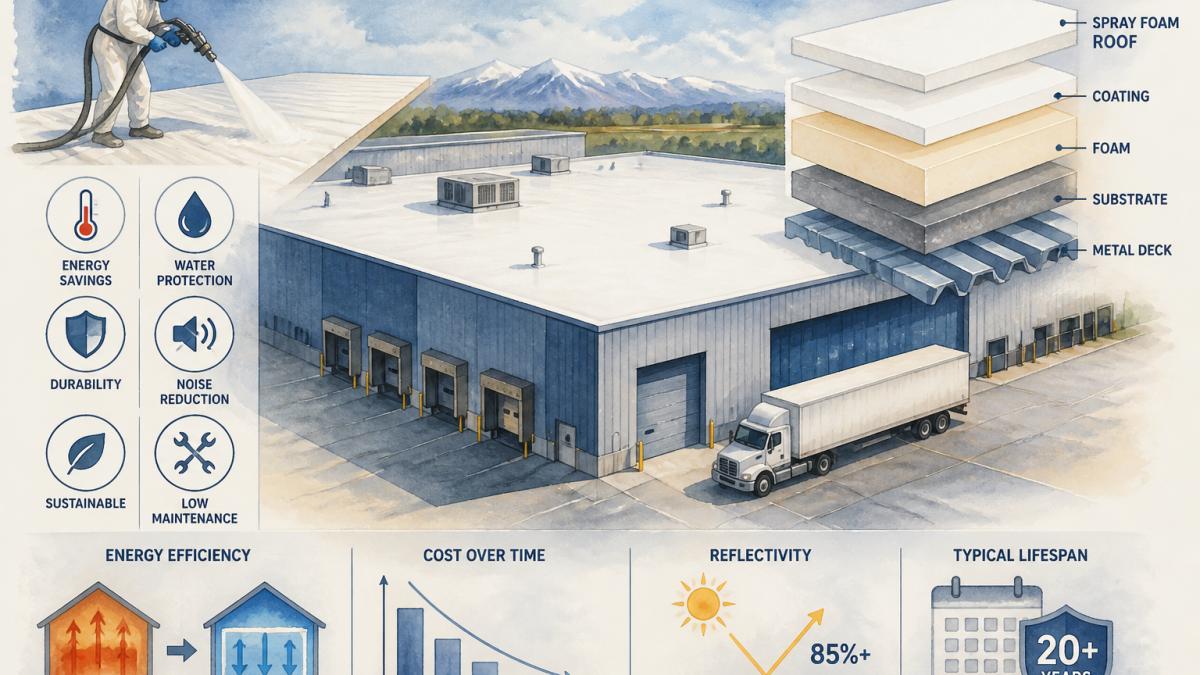
A spray foam roof for warehouses is a liquid polyurethane coating applied directly to your existing roof deck, where it expands and hardens into a seamless, insulated barrier.
The process sprays two chemical components that react and expand on contact, filling gaps, sealing penetrations, and conforming to irregular surfaces. Within seconds, the foam hardens into a rigid, closed-cell structure that provides insulation and waterproofing in one step.
Closed-Cell Foam and Roof Deck Reinforcement
Closed-cell spray foam contains millions of sealed cells that trap air for superior insulation. This dense structure also adds rigidity to your roof deck, valuable for older warehouses where framing has weakened over decades.
On metal roofs or deteriorating decks, closed-cell foam reinforces the substrate, bonding securely to rust, old coatings, and weathered surfaces without full removal. This extends the service life of marginal decks that might otherwise need replacement.
Seamless Waterproofing and Leak Prevention
Spray foam's continuous, monolithic nature eliminates seams, the primary failure point in traditional roofing. With no joints, fasteners, or overlaps for water to infiltrate, the foam expands into every crack, crevice, and penetration, creating a complete vapor barrier.
Warehouse roofs with chronic leaks often benefit immediately. The seamless barrier stops water intrusion at the source, permanently sealing previous leak paths around HVAC units, roof penetrations, and flashing.
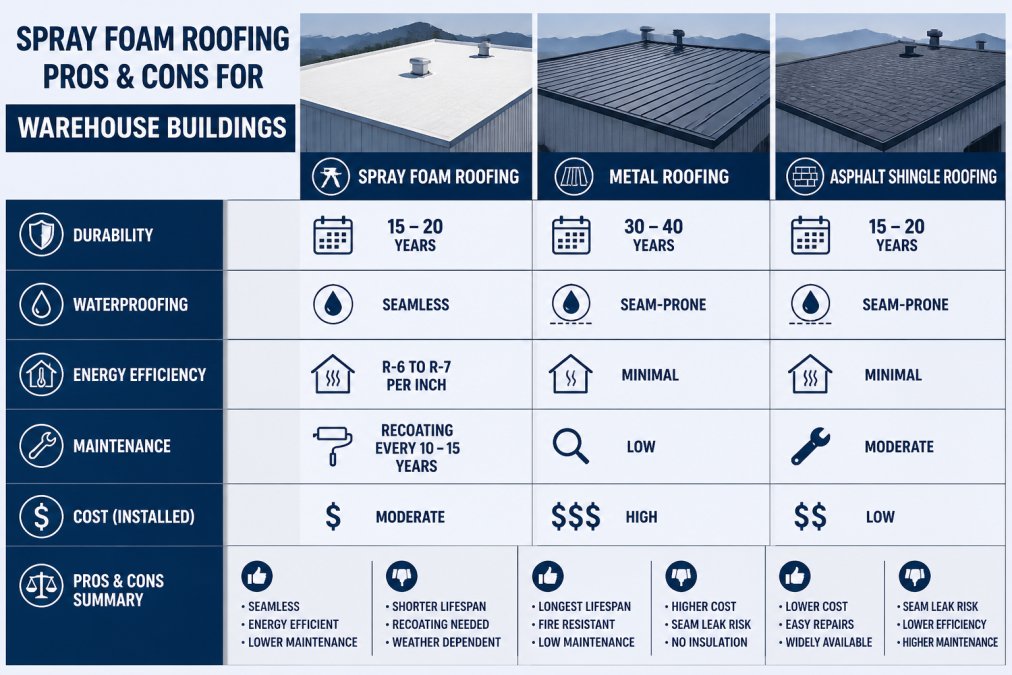
Spray Foam Roofing Pros and Cons for Warehouse Buildings
Spray foam roofing offers distinct advantages for warehouses, but it has trade-offs. Understanding both sides helps you decide whether this system suits your property.
Advantages:
- Seamless waterproofing eliminates seam-related leaks
- Thermal insulation reduces HVAC load and energy costs
- Lightweight system requires no structural reinforcement
- Adheres to almost any substrate, metal, concrete, asphalt
- Extends the life of existing roof structures, avoiding full replacement
- Flexible coating accommodates building movement and settling
- Single application covers irregular surfaces and penetrations
Disadvantages:
- Requires protective topcoat to resist UV degradation
- Topcoat reapplication needed every 10-15 years
- Moisture sensitivity during application, weather delays are common
- Repair patches may show color variation
- Requires skilled applicators for proper installation
- Upfront material and labor costs are significant
- Not ideal for roofs with standing water or poor drainage
Thermal Insulation, Energy Efficiency, and Operating Cost Reduction
Spray foam delivers R-value between 6 and 7 per inch, making it one of the most efficient roofing insulation systems available.
For warehouses, this insulation directly reduces HVAC demand: heating and cooling systems work less, translating to lower energy bills.
Savings depend on climate, current roof condition, and HVAC efficiency. Colder regions see the most dramatic benefits since warehouses maintain heated interiors year-round.
Spray Foam Roof Cost: What to Expect
Cost is the question warehouse owners ask first. Spray foam roofing is priced per square (100 square feet) and quoted as a bundled system: surface preparation, foam thickness, and protective topcoat. Because those variables move independently, two identical warehouses can land thousands of dollars apart.
Typical Cost Ranges
Industry cost guides and contractor bid ranges generally place spray foam roof installation in the following bands, installed:
- Light restoration over a sound metal deck: roughly $2.50 to $4.50 per square foot
- Full system over a prepared deck with a quality topcoat: roughly $4.50 to $8.00 per square foot
- Complex roofs with heavy penetration density, poor drainage, or extensive prep: $8.00 per square foot and up
For a 50,000-square-foot warehouse, that's roughly $125,000 to $400,000 depending on scope. A 100,000-square-foot building scales proportionally, though per-square-foot cost usually drops as mobilization and equipment costs spread across more area.
The Cost Drivers That Actually Move the Number
- Foam thickness (R-value target). Foam is sold by the board foot (12" x 12" x 1"). A 2-inch average over 50,000 square feet is roughly 100,000 board feet of material. Going to 3 inches for a colder climate adds roughly 50% more foam material and labor time.
- Average vs. minimum thickness. Roofs need a minimum thickness for code and a higher average to create positive drainage slope. The gap between the two is where budgets blow up.
- Surface preparation. Power washing, degreasing, rust treatment, and removal of failed flashing or wet insulation all add labor. A roof with ponding water or saturated substrate may need partial tear-off first.
- Topcoat system. A basic acrylic coating is the least expensive; silicone and polyurethane coatings cost more but last longer between recoat cycles. Coating choice affects both upfront cost and the 10-15 year recoat budget.
- Penetration density. Every HVAC curb, vent, skylight, and pipe boot is hand-work. A roof with 40 penetrations takes far longer than one with 10.
- Access and staging. Limited truck access, no on-site power, or a need to work around dock schedules adds labor hours.
- Regional labor rates. Applicator labor varies widely by market and by whether the contractor is union or open shop.
Lifecycle Cost: The Number That Matters
The upfront number is only half the story. Spray foam's economics come from avoiding full replacement and from energy savings.
A common pattern: a warehouse facing a tear-off can restore with spray foam for less, keep the existing deck, and add insulation in the same pass.
Energy savings vary by climate, existing insulation, and HVAC equipment. Cold climates with heated interiors and hot-humid climates with heavy cooling loads see the largest reductions.
How to Compare Bids
Ask every contractor for the same line items so bids are comparable:
- Average and minimum foam thickness (in inches)
- Foam density and manufacturer
- Topcoat type, thickness, and warranty term
- Surface preparation scope
- Penetration and flashing detail
- Recoat schedule and estimated future cost
- Warranty: material only, or labor and material
A low bid that skips prep or uses a thin topcoat will cost more over the roof's life than a higher bid that does the job correctly the first time.
Spray polyurethane foam roofing guidance and technical bulletins
Spray Foam Roofing Over Metal Roofs: Performance and Suitability
Metal warehouse roofs are excellent candidates for spray foam restoration. Metal's smooth, nonporous surface provides ideal adhesion, and unlike asphalt or deteriorated concrete, it needs no prep beyond cleaning and degreasing.
The thermal benefits are significant too. Metal conducts heat rapidly, making metal-roof buildings expensive to heat and cool; spray foam on top dramatically improves thermal performance and reduces energy costs.
One consideration: metal expands and contracts with temperature more than other substrates.
Spray Foam Roof Maintenance and Durability
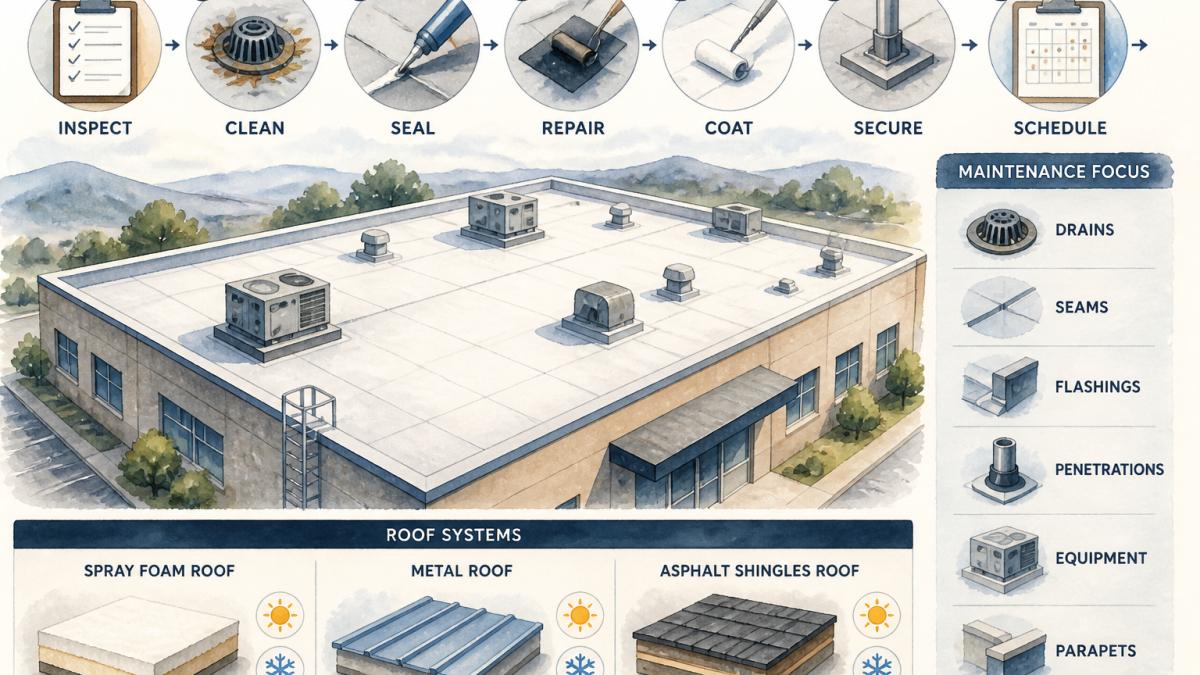
A properly installed and maintained spray foam roof for warehouses typically lasts 15-20 years before significant restoration. The key to longevity is the protective topcoat and routine maintenance.
Weather Resistance and Storm Protection
Spray foam with a quality elastomeric or polyurethane topcoat resists UV, rain, hail, and temperature extremes. The topcoat protects the foam from degradation while the foam provides structural integrity and insulation.
In high-wind environments, spray foam's monolithic nature prevents the membrane separation common in traditional systems, no loose seams or fasteners to lift. Hail may cause minor surface damage, but the continuous foam maintains its waterproofing and insulation.
Fire Safety and Building Code Compliance
Spray polyurethane foam is classified as combustible, so it requires a protective topcoat to meet building code fire safety requirements. Most jurisdictions require a thermal barrier or approved topcoat achieving specific fire ratings.
Elastomeric and polyurethane topcoats used on warehouse roofs meet fire codes in most areas. Before installation, verify your local building department approves the specific foam and topcoat combination.
Spray Foam Roof Systems vs. Traditional Warehouse Roofing Alternatives
Warehouse roof selection comes down to five systems: spray polyurethane foam, single-ply membrane (TPO, EPDM, PVC), metal standing seam, built-up roofing (BUR) with gravel or cap sheet, and rigid-board insulation with a membrane. Each is evaluated on the same criteria: installed cost, service life, insulation value, maintenance burden, and suitability for a warehouse's clear-span, high-ceiling, continuous-operation environment.
Side-by-Side Comparison
| Criterion | Spray Foam | Single-Ply (TPO/EPDM/PVC) | Metal Standing Seam | Built-Up (BUR) | Rigid Board + Membrane |
|---|---|---|---|---|---|
| Typical installed cost | $2.50-$8.00/sq ft | $4.00-$9.00/sq ft | $8.00-$16.00/sq ft | $4.00-$8.00/sq ft | $5.00-$10.00/sq ft |
| Service life | 15-20 yrs, extendable by recoating | 15-25 yrs | 30-40 yrs | 15-25 yrs | 15-25 yrs |
| Insulation | R-6 to R-7 per inch, integral | None (requires separate insulation) | None (requires separate insulation) | Minimal | R-value from board only |
| Seams | None (monolithic) | Heat-welded or adhered seams | Mechanical seams and fasteners | Multiple plies, many seams | Membrane seams |
| Maintenance | Recoat every 10-15 yrs | Seam repair, patching | Fastener and panel checks | Frequent patching, gravel replenishment | Seam repair |
| Best fit | Restoration over marginal decks; adding insulation | New construction with sound deck | Long-horizon new construction | Legacy systems | New construction with separate insulation spec |
Where Each System Wins
Built-up roofing is the legacy system on many older warehouses. It's cheap to repair in small sections but accumulates layers, adds dead load, and offers minimal insulation.
Rigid board with membrane is common in new construction where insulation is specified independently of waterproofing.
Spray foam wins on restoration economics: it bonds to the existing substrate, adds insulation and waterproofing in one pass, and eliminates seams.
Warehouse-Specific Selection Factors
A warehouse isn't a typical commercial building. Clear-span interiors, high ceilings, and continuous dock operations change the calculus:
- HVAC load. High-ceiling warehouses lose heat at the roof plane; spray foam's integral R-value reduces that loss without a separate insulation trade.
- Business continuity. Tear-off systems expose the interior to weather during installation. Spray foam goes over the existing roof, so the building stays dry and operations continue.
- Inventory sensitivity. Leaks damage stored goods. A seamless foam membrane removes the seam failure mode that plagues membrane and BUR systems.
- Structural load. Spray foam is lightweight and adds minimal dead load, important on older decks with limited capacity.
- Drainage. Foam can be tapered for positive drainage, but chronic ponding needs drainage correction first, no roofing system fixes a flat, ponding deck on its own.
Commercial roof system selection guidance
Frequently Asked Questions
How long does a spray foam roof last on a warehouse?
A properly maintained spray foam roof system typically lasts 20-30 years or longer. The closed-cell foam core provides structural durability, while protective elastomeric coatings shield against UV exposure and weather damage. Recoating every 10-15 years extends service life significantly. Actual lifespan depends on climate exposure, maintenance frequency, and the quality of installation.
What are the downsides of spray foam roofing for warehouses?
Common drawbacks include higher upfront installation costs compared to patching, moisture sensitivity during application, and the need for periodic recoating to maintain UV protection. Spray foam also requires professional installation, improper application can lead to adhesion issues or incomplete coverage. In very wet climates, moisture can accumulate beneath the foam if the vapor barrier is compromised, potentially causing condensation problems.
Can spray foam roofing be applied over an existing warehouse roof?
Yes, spray foam roofing can be applied directly over existing metal, asphalt, or concrete roof decks without full removal. This approach saves labor and disposal costs. However, the existing roof must be structurally sound, dry, and properly cleaned. Surface preparation is critical, dirt, algae, and loose debris prevent adhesion. If the existing roof has significant ponding or active leaks, those issues should be addressed first.
How much does spray foam roofing cost compared to roof replacement?
Spray foam restoration can be a cost-effective alternative to complete roof replacement, depending on warehouse size, roof condition, and local labor rates. A restoration adds a waterproof, insulated layer over the existing structure, while replacement removes and rebuilds the entire system. Pricing depends on square footage, surface preparation needs, and coating specifications. Contact Sun Flex Home Improvement for a free estimate tailored to your warehouse's specific requirements.