 ultimate-guide
Spray Foam Roof Energy Savings: What Homeowners Should Know
Table of Contents
- How Spray Foam Roofing Works and Why It Saves Energy
- Understanding Spray Foam Roofing R-Value and Thermal Performance
- Real Energy Savings: What to Expect on Your Utility Bills
- Closed-Cell vs. Open-Cell Foam: Which Delivers Better Energy Efficiency
- Roofing Tax Credits for Energy Efficiency: Federal Incentives You Can Claim
- How to Clean Spray Foam Roof Coating and Maintain Peak Performance
- Spray Foam Roofing ROI: Cost vs. Long-Term Savings
- Conclusion
- Frequently Asked Questions
Last Updated: September 30, 2026
How Spray Foam Roofing Works and Why It Saves Energy
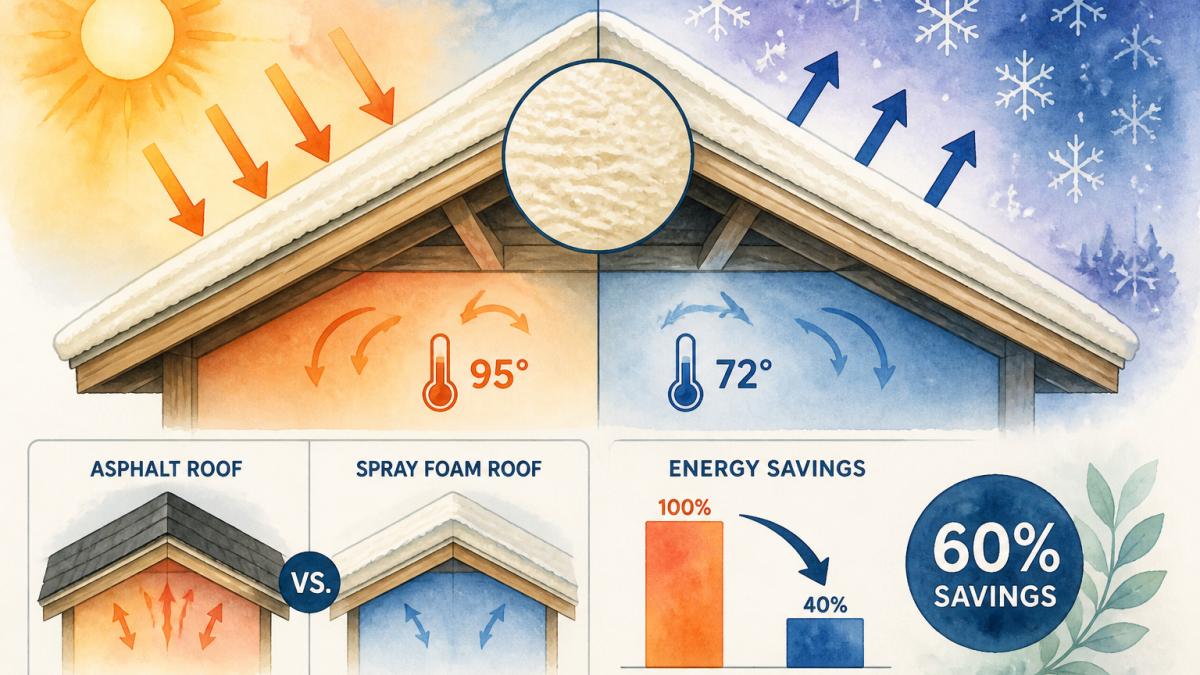
Spray foam roof energy savings come from a simple principle: continuous insulation with no thermal bridges. When spray polyurethane foam (SPF) is applied directly to your roof substrate, it creates an unbroken thermal barrier that traditional materials cannot match. Unlike asphalt shingles or fiberglass batts, which have gaps and seams where heat escapes, spray foam adheres completely to the roof surface and expands to fill every cavity and irregularity.
A trained technician sprays liquid foam onto your existing roof, where it expands and hardens into a seamless insulation system that also serves as a moisture barrier and weather-resistant coating, a dual function that separates spray foam from conventional roofing.
Energy savings occur because your HVAC system works less when your building envelope has fewer thermal bridges and air infiltration points. In cold climates, this means less fuel consumption during winter; in summer, lower cooling loads and reduced electricity demand.
Understanding Spray Foam Roofing R-Value and Thermal Performance
The R-value measures thermal resistance, how well a material prevents heat transfer. Closed-cell spray foam typically delivers 6.0 to 7.0 R-value per inch, while open-cell foam provides 3.5 to 4.0 per inch. For comparison, traditional asphalt shingles offer only 0.5 to 0.7 per inch, and fiberglass batts deliver about 3.2 to 3.8 per inch.
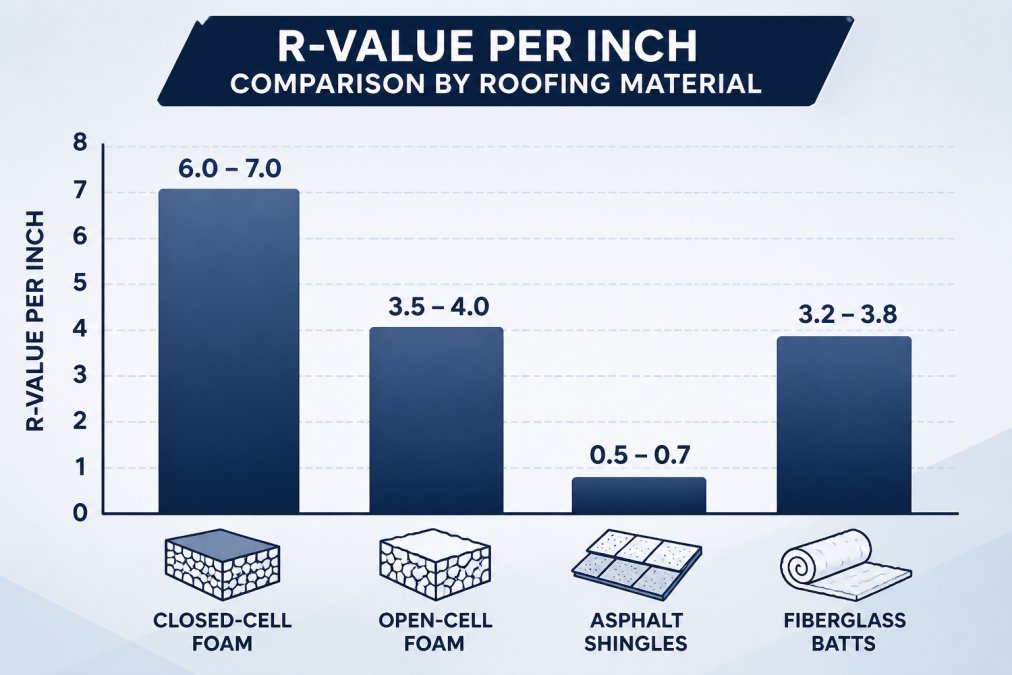
A 2-inch layer of closed-cell foam delivers roughly 12-14 R-value total. However, thermal bridging through roof trusses and fasteners can reduce effective performance by 15-25% in traditional systems. Spray foam eliminates this by wrapping around structural members completely.
Most installations use 2 to 4 inches of closed-cell foam, targeting total R-values between 12 and 28. A professional assessment will determine optimal thickness based on climate zone, existing roof condition, and energy efficiency goals.
Spray foam addresses both insulation and air sealing simultaneously, which is why spray foam roof energy savings often exceed predictions based on R-value alone.
Real Energy Savings: What to Expect on Your Utility Bills
Energy savings vary based on climate, building size, existing insulation, and HVAC efficiency. Calculate your specific payback period using actual utility costs and roof area rather than generic percentage claims.
Estimating Your Payback Period
Start with your current annual heating and cooling costs from utility bills. For typical residential properties, space conditioning represents 40-50% of annual energy costs in cold climates and 25-35% in moderate climates.
Properties with uninsulated roofs in cold climates typically see 20-35% heating cost reductions. Hot climates with existing attic insulation see 15-25% cooling reductions. Mixed climates average 15-20% total HVAC savings.
Multiply your annual space conditioning cost by your expected percentage reduction. For example:
- Annual heating/cooling cost: $2,400
- Expected reduction: 25%
- Annual savings: $600
Divide the installed cost of spray foam roofing by your annual savings to find payback period. If your spray foam installation costs $8,000, payback is approximately 13 years ($8,000 ÷ $600). After that point, all energy savings are additional benefit.
Climate-Zone Performance Differences
Cold climates (heating degree days above 7,000 annually) see the largest percentage savings because heating dominates the energy load, with 25-35% heating cost reductions realistic for uninsulated roofs.
Moderate climates (heating degree days 4,000-7,000) experience balanced heating and cooling loads, delivering 15-25% total HVAC savings split between seasons.
Hot climates (heating degree days below 4,000) benefit primarily from reduced cooling costs, with 10-20% savings possible. Absolute dollar savings remain substantial in regions with high electricity rates, $1,500-2,500 annually in Arizona or Texas despite lower percentage reductions.
Commercial buildings achieve faster payback due to larger roof area and longer HVAC operating hours. A 15,000-square-foot commercial roof in a cold climate might reduce annual heating costs by $3,000-5,000, resulting in 5-8 year payback on a $25,000-40,000 installation.
Factors That Affect Your Actual Savings
Temperature extremes, thermostat settings, HVAC system age, and occupancy patterns all affect savings. Older HVAC systems may not respond as efficiently to improved insulation, while variable-capacity systems adjust quickly and deliver proportional savings.
Many property owners report noticeable utility bill reductions within the first heating or cooling season. Track utility bills for at least one full year post-installation to establish actual baseline improvement.
Closed-Cell vs. Open-Cell Foam: Which Delivers Better Energy Efficiency
Closed-cell spray foam delivers higher R-value per inch (6.0-7.0), superior moisture resistance, and acts as an effective vapor retarder, critical in cold climates where moisture can condense inside the building envelope.
Open-cell foam offers lower R-value per inch (3.5-4.0), costs less, and provides acoustic absorption, but requires an additional vapor barrier for roof applications in cold climates.
For spray foam roof energy savings in Montana and Northern Wyoming, closed-cell foam is superior: higher R-value requires less thickness, vapor barrier properties prevent moisture problems, and rigidity adds structural support to aging roof decks.
Roofing Tax Credits for Energy Efficiency: Federal Incentives You Can Claim
Residential property owners who install qualifying energy-efficient roofing may claim a federal tax credit for materials and labor meeting Department of Energy efficiency standards.
According to IRS guidance on energy-efficient home improvements, qualifying roofing products must have a solar reflectance of at least 0.65 and thermal emittance of at least 0.75, or meet equivalent energy performance standards. Spray foam roofing with reflective coating can meet these requirements, though you'll need documentation from your installer confirming the product specifications.
Contact a tax professional to verify your eligibility and the specific credit amount available in your tax year. Requirements and credit amounts change periodically, so current guidance from Energy.gov's home energy tax credits should be consulted before installation to confirm your property qualifies.
Check with your local utility provider for state and local rebates for energy efficiency upgrades including roofing improvements.
How to Clean Spray Foam Roof Coating and Maintain Peak Performance
Spray foam roofing requires periodic maintenance to preserve its protective coating. Unlike traditional roofing repairs, spray foam repairs involve patching and recoating, creating both advantages and trade-offs.
Routine Cleaning and Inspection
Annual inspection is the foundation of spray foam roof maintenance. Check for cracks, bare foam areas, debris accumulation, or standing water. Remove debris promptly, as it traps moisture and accelerates coating degradation. Semi-annual cleaning may be necessary in regions with heavy pollen or algae growth.
Use low-pressure water (under 1,500 PSI) and mild detergent rather than high-pressure washing. For stubborn stains, use a soft-bristled brush. Test cleaning approaches on small areas first and avoid harsh chemicals or solvents.
Repair vs. Replacement: How Spray Foam Differs from Traditional Roofing
Spray foam repair differs from traditional roofing: instead of replacing individual shingles, you patch the damaged area and recoat it, requiring more skill and creating a visible seam.
Small cracks or punctures (under 6 inches) can be patched with spray foam sealant or polyurethane caulk, then recoated, typically costing $200-500.
Larger damage (6-24 inches) requires cutting out the damaged section, spraying new foam, and recoating, costing $500-1,500 depending on size and complexity.
Extensive damage may warrant recoating the entire roof section or surface, costing $1,500-5,000+, still significantly less than full roof replacement.
The Recoating Advantage
After 15-20 years, the topcoat may degrade from UV exposure, but the foam insulation remains intact. A professional recoating costs $0.75-1.50 per square foot ($3,000-6,000 for typical residential roofs) and extends life another 15-20 years, a fraction of full replacement cost ($8,000-15,000+).
This recoating capability is one of spray foam's strongest long-term financial advantages, though your roof will need professional attention every 15-20 years.
Professional Maintenance Schedule
Professional maintenance every 3-5 years is recommended for commercial properties and larger residential roofs, costing $500-1,500 per visit and preventing expensive repairs.
For residential properties in moderate climates, annual DIY inspection plus professional service every 5-7 years is often sufficient. Harsh climates benefit from more frequent professional inspection.
Factors Affecting Maintenance Costs
Steep roofs or complex geometry increase inspection and repair costs by 25-50%.
Spray Foam Roof Lifespan with Proper Maintenance
Spray Foam Roofing ROI: Cost vs. Long-Term Savings
Return on investment depends on installation cost, energy savings, and ownership duration.
Conclusion
Spray foam roof energy savings are real, measurable, and deliver long-term financial benefit through reduced utility bills, extended roof life, and avoided replacement costs. The combination of superior R-value, complete air sealing, and integrated waterproofing makes spray foam roofing the most effective restoration approach for properties across Montana and Northern Wyoming facing aging roofs and rising energy costs.
Frequently Asked Questions
How much can spray foam roof energy savings actually reduce my monthly utility bills?
Energy savings depend on your current roof's condition, local climate, and HVAC efficiency. Homeowners commonly report 10-30% reductions in heating and cooling costs after spray foam installation, though results vary. A professional energy audit can estimate your specific savings based on your building's thermal performance and current energy consumption patterns.
What is the R-value of spray foam roofing compared to traditional materials?
Closed-cell spray foam achieves 6.0-7.0 R-value per inch, while open-cell foam provides 3.5-4.0 per inch. Traditional asphalt shingles offer only 0.5-0.7 R-value. This superior thermal resistance means spray foam creates a much stronger barrier against heat transfer, reducing your HVAC workload and energy demand throughout the year.
Are there tax credits available for spray foam roofing installations?
Yes. Federal tax credits may be available for energy-efficient home improvements, including qualifying roofing systems that improve your building envelope's thermal performance. Consult a tax professional to confirm your qualification and the specific credit amounts available.
Will spray foam roofing actually hold up in harsh climates like Montana and Northern Wyoming winters?
Spray polyurethane foam (SPF) is designed to handle extreme temperature swings, freeze-thaw cycles, and heavy snow loads. The closed-cell variety resists moisture infiltration and maintains its thermal properties in cold climates. However, UV exposure requires a protective coating. Regular maintenance and professional installation are essential for long-term durability in severe weather regions.