 ultimate-guide
Hail Resistant Roofing for Warehouses: 2026 Guide
Table of Contents
- Why Hail Resistant Roofing for Warehouses Is a Financial Decision
- Understanding Impact Resistance Ratings and FM Global Standards
- Class 4 Impact Resistant Roofing: What the Rating Actually Means
- Commercial Roofing Systems Built for Hail Zones
- Warehouse Structural Load and Solar Array Considerations
- Insurance Premium Credits and Cost-Benefit Analysis
- Commercial Roofing Maintenance Checklist for Hail-Prone Regions
- Commercial Roof Hail Damage Repair: What to Do After a Storm
- Frequently Asked Questions
Last Updated: September 21, 2026
Why Hail Resistant Roofing for Warehouses Is a Financial Decision
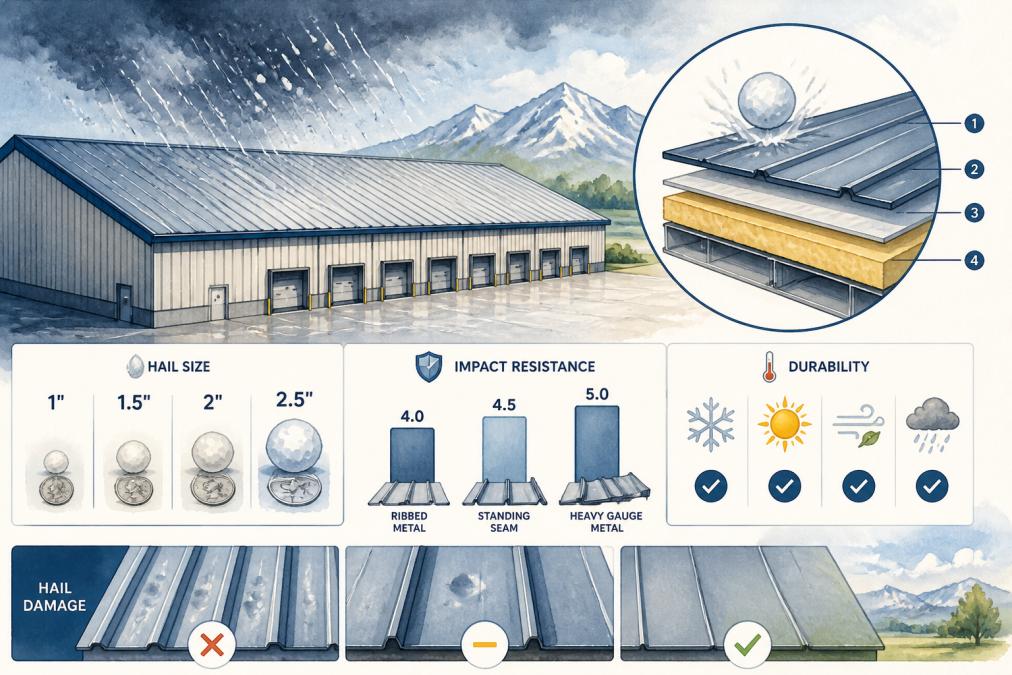
Hail resistant roofing for warehouses is a roof assembly engineered, tested, and rated to withstand hailstones without cracking, puncturing, or losing its watertight seal. For a warehouse, the roof is the lid on your inventory, racking, and revenue.
Understanding Impact Resistance Ratings and FM Global Standards
Impact resistance measures how much kinetic energy a roofing material absorbs before it cracks, punctures, or fails. In commercial roofing, that is formalized through ASTM testing standards and approvals issued by FM Global, an insurance-backed research and certification body.
Two rating frameworks matter for a warehouse:
- UL 2218, the impact test that produces the familiar Class 1 through Class 4 ratings for roofing materials (UL Solutions, IBHS Drive Trust in Residential Roofing Shingles).
- FM Global 4470, the approval standard that evaluates the entire roof assembly, not just the top surface.
Class 4 Impact Resistant Roofing: What the Rating Actually Means
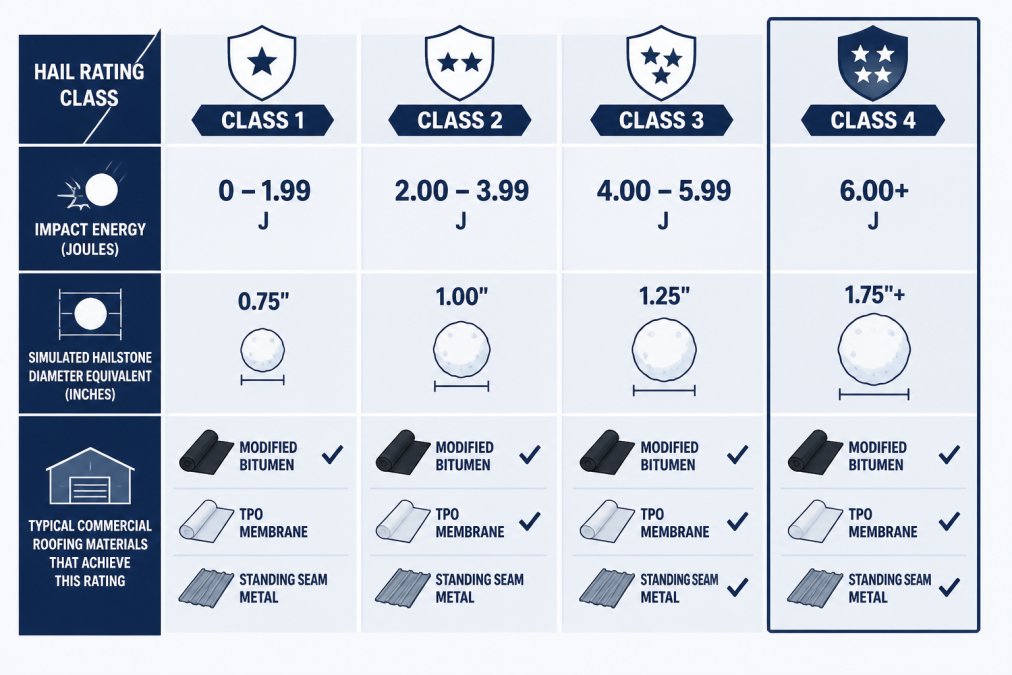
Class 4 impact resistant roofing is the highest rating under UL 2218, meaning the material survived the test's largest steel-ball impact without cracking. These products are most likely to shrug off the hailstone sizes that cause real damage in hail-prone regions.
Class 4 vs. Class 3: The Testing Difference
Class 3 and Class 4 materials both survive meaningful impacts, but Class 4 absorbs a substantially larger impact before failure, which matters where hailstone diameter regularly exceeds the sizes Class 3 is tested against.
Very Severe Hail (VSH) and FM Global Approvals
Very Severe Hail (VSH) is an FM Global designation for regions and roof assemblies facing the most extreme hail exposure. FM Global 4470 testing evaluates the full assembly under repeated, high-energy strikes that simulate real storm conditions.
Commercial Roofing Systems Built for Hail Zones
No single material wins everywhere. The right system depends on roof slope, structural capacity, budget, and actual hail exposure.
| System | Hail Performance | Best For | Key Trade-Off |
|---|---|---|---|
| TPO membrane | Good with proper assembly | Large flat warehouse roofs | Seam quality drives performance |
| Standing seam metal | Excellent | Low-slope and steep-slope | Higher upfront cost |
| Stone-coated metal | Excellent | Visible, architectural roofs | Heavier than single-ply |
| Spray foam with coating | Strong when maintained | Restoration over existing roofs | Requires recoating cycle |
| Synthetic shingles | Good | Smaller commercial buildings | Less common at warehouse scale |
TPO Membrane and Single-Ply Systems
TPO membrane is a single-ply thermoplastic widely used on large, flat warehouse roofs. Its hail performance depends on the assembly beneath it: a thick cover board and quality underlayment dramatically improve puncture resistance and impact absorption.
Standing Seam Metal and Stone-Coated Metal
Standing seam metal roofing uses concealed fasteners and raised seams for a durable, weathertight surface with excellent impact resistance. Stone-coated metal adds a granular surface over steel, improving aesthetics and impact absorption.
Spray Foam and Synthetic Options
Spray foam roofing is applied as a liquid, expands into a seamless membrane, and cures into a monolithic surface with no seams to fail, a real advantage in hail zones, where damage often starts at seams and fasteners.
Warehouse Structural Load and Solar Array Considerations
Most hail-resistance guides are written for houses, but a warehouse is a different engineering problem. A residential roof carries a few hundred square feet of dead load; a warehouse roof can span hundreds of thousands, and every pound per square foot multiplies across that area.
Dead Load, Live Load, and the Structural Math
Before specifying any hail-rated system, a licensed structural engineer should confirm the roof's remaining load capacity. The relevant figures are:
- Dead load, the permanent weight of the roof assembly itself (deck, insulation, cover board, membrane or metal, ballast).
- Live load, temporary loads including snow, maintenance crews, and rooftop equipment.
- Collateral load, permanently mounted equipment such as HVAC units, solar arrays, and conduit.
Attachment, Uplift, and Hail Performance Interact
Hail performance is about how the assembly is attached, not just the surface material. On low-slope membrane roofs, fastener pull-through and seam integrity under wind uplift affect how the roof behaves when hail strikes a stressed membrane. On standing seam metal, clip spacing and thermal movement determine whether an impact dents a panel or dislodges a seam.
Solar Array Integration: Sequence Matters
Warehouses increasingly carry rooftop solar, and hail-resistant roofing and solar mounting must be engineered together. Key considerations:
- Penetration strategy. Ballasted solar avoids roof penetrations but adds significant dead load and can interfere with membrane hail performance at ballast points. Penetrated mounts require flashing details that preserve the roof's impact and watertight integrity.
- Standoff height. Mounting rails create a gap between the panel and the roof surface. That gap can concentrate hail impact on panel edges or allow hailstones to ricochet into the roof, so standoff design matters.
- Panel hail ratings. Solar panels themselves carry impact ratings, and a hail event can damage panels and roof simultaneously. Coordinating the roof warranty and the solar warranty before installation prevents finger-pointing after a storm.
- Removal and reinstallation cost. If the roof must be replaced or restored, the solar array has to be de-mounted and re-mounted. That cost should be modeled into the roof's life-cycle budget from day one.
When to Bring in a Structural Engineer
Bring in a licensed structural engineer when:
- The building is a PEMB and you are adding more than a minimal dead load.
- You are adding ballasted solar or a ballasted roof system.
- The existing roof has ponding, deflection, or prior structural repairs.
- The roof will carry new rooftop equipment in addition to the hail-rated assembly.
The review is a small line item compared to a structural failure or a denied insurance claim after a storm.
Insurance Premium Credits and Cost-Benefit Analysis
For a warehouse, the insurance conversation is where a hail-resistant roof pays for itself or does not. The math differs from residential: larger numbers, more complex policies, and underwriting to FM Global standards rather than a consumer rating scale.
How Commercial Insurers Actually Price Hail Risk
Commercial property insurers evaluate hail risk through catastrophe modeling, historical loss data, and, critically, the roof's FM Global approval status. FM Global publishes Property Loss Prevention Data Sheets that insurers and risk engineers reference. An assembly carrying the relevant FM Approval (including Very Severe Hail approval where applicable) gives the underwriter a documented basis for a lower expected loss.
- The insurer's own hail risk appetite and reinsurance terms.
- The building's construction class, occupancy, and protection features.
- The deductible structure and any coinsurance clause in the policy.
- Whether the roof documentation is submitted before renewal, not after a loss.
The Three Cost Inputs, With Industrial Specifics
1. Upfront cost. Hail-rated assemblies carry a premium over standard replacements, varying widely by system. A single-ply membrane upgrade with a thicker cover board is a modest incremental cost. Standing seam or stone-coated metal is a larger capital commitment. Spray foam with a high-build coating sits between the two and can restore a sound existing roof, avoiding tear-off cost and landfill fees.
- Roof repair or replacement cost.
- Interior water damage to inventory, racking, and finished goods.
- Business interruption while crews work above active operations.
- Contingent costs if the warehouse is a distribution node in a larger network.
Modeling Total Cost of Ownership
The right comparison is not "hail-rated roof vs. standard roof" but "hail-rated roof over its service life vs. standard roof plus expected hail losses over the same period." A simple framework:
| Line Item | Standard Roof | Hail-Rated Assembly |
|---|---|---|
| Initial installation | Lower | Higher |
| Expected hail repairs over service life | Multiple events | Minimal |
| Interior damage and business interruption | Possible | Largely avoided |
| Insurance deductible exposure | Higher (percentage-based) | Potentially restructured |
| Premium credits | None | Possible, documentation-dependent |
| End-of-life replacement timing | Earlier | Later |
Documentation That Unlocks the Credit
Insurers do not apply credits on trust. The package typically includes:
- The manufacturer's FM Approval listing for the specific assembly.
- The contractor's specification showing the full assembly, not just the membrane.
- Installation records and, where applicable, third-party inspection reports.
- The roof's maintenance log showing proactive inspection.
The Solar and PPA Wrinkle
If the warehouse hosts a solar array under a power purchase agreement (PPA) or lease, the roof decision affects the solar owner too. A hail-damaged roof can force de-mounting and re-mounting, and the PPA or lease may allocate that cost surprisingly. Review the solar agreement's roof-replacement and damage provisions before finalizing the roof specification; coordinating the roof warranty, solar warranty, and PPA terms up front prevents a three-way dispute after a storm.
Commercial Roofing Maintenance Checklist for Hail-Prone Regions
A commercial roofing maintenance checklist is the difference between a roof that survives hail season and one that fails at the first storm. Inspections catch the small failures, loose fasteners, cracked sealant, and ponding water, that turn a survivable impact into a leak.
Run this checklist before and after every hail season:
- Inspect all seams and membrane edges for separation or lifting
- Check fasteners and ballast for pull-through or displacement
- Clear drains, scuppers, and gutters of debris
- Look for ponding water that stresses the assembly
- Examine penetrations, vents, and HVAC curbs for cracked sealant
- Document roof condition with dated photos after each inspection
- Schedule recoating on spray foam systems per the manufacturer's interval
- Verify warranty terms are not voided by unauthorized repairs
Commercial Roof Hail Damage Repair: What to Do After a Storm
Commercial roof hail damage repair should begin with documentation, not a phone call to a contractor. Your insurer will want evidence of the storm's impact and the roof's condition before repairs start.
The sequence that protects your claim:
- Photograph and date everything. Capture hailstone size references, dented metal, cracked membrane, and any interior water staining.
- Do not authorize permanent repairs before the adjuster inspects. Emergency tarping to stop active leaks is fine; permanent work can complicate the claim.
- Get a written scope from a qualified commercial roofer. The scope should identify whether the damage is repairable or whether the assembly has failed.
- Review repair versus restoration. On some roofs, restoring the existing assembly is more cost-effective than a full tear-off, particularly where the structural deck is sound.
- Confirm warranty implications. Repairs done wrong can void a manufacturer's warranty, so use approved materials and methods.
Frequently Asked Questions
What type of roof is most resistant to hail damage?
Class 4 impact resistant roofing offers the highest protection under ASTM testing standards. For warehouses, standing seam metal, stone-coated metal, and some TPO membrane systems with enhanced puncture resistance meet Class 4 criteria. FM Global Very Severe Hail (VSH) approval goes further, testing assemblies against larger simulated hailstones. The right choice depends on your roof slope, structural capacity, and insurance requirements. A roofing professional can assess which system fits your building.
What is a Class 4 hail resistant roof?
A Class 4 rating means the roofing material survived impact testing with two-inch steel balls dropped from a specified height without cracking or puncturing, per ASTM standards. This is the highest impact resistance classification. Many insurers offer premium credits for Class 4 systems on commercial buildings. For warehouses, combining Class 4 cover material with a reinforced underlayment and proper fastening creates a roof assembly that handles hailstone kinetic energy far better than standard systems.
How do I know if my warehouse roof is hail resistant?
Check your roof's documentation for a Class 4 rating or FM Global approval. If you lack paperwork, a roofing inspector can identify the membrane type, assess its condition, and look for impact damage patterns. Signs of trouble include dented metal panels, cracked membrane, granule loss on shingles, and exposed fastener heads. Even a rated roof loses effectiveness as it ages, so annual inspections are critical in hail-prone regions.
What is the 25% rule for roofing?
The 25% rule is an insurance guideline: if storm damage affects more than 25% of a roof's surface, many carriers require full replacement rather than partial repair. For warehouse owners, this means a single severe hail event can trigger a complete roof replacement claim. Installing hail resistant roofing reduces the likelihood of reaching that threshold and may lower your premium. Check your policy language, because thresholds vary by carrier and state regulations.