 ultimate-guide
Spray Foam Insulation for Roofs: 2026 Homeowner's Guide
Table of Contents
- What Spray Foam Insulation for Roofs Actually Does
- Closed-Cell vs. Open-Cell: Which Foam Belongs on Your Roof
- Spray Foam Roofing Pros and Cons for Home and Commercial Buildings
- How to Clean Spray Foam Roof Coating Without Damaging the Membrane
- Spray Foam Roof Maintenance Schedule: What to Check Each Season
- Installation, Code Compliance, and When to Call a Professional
- Cost, Long-Term ROI, and Environmental Impact
- Frequently Asked Questions
Last Updated: September 16, 2026
What Spray Foam Insulation for Roofs Actually Does
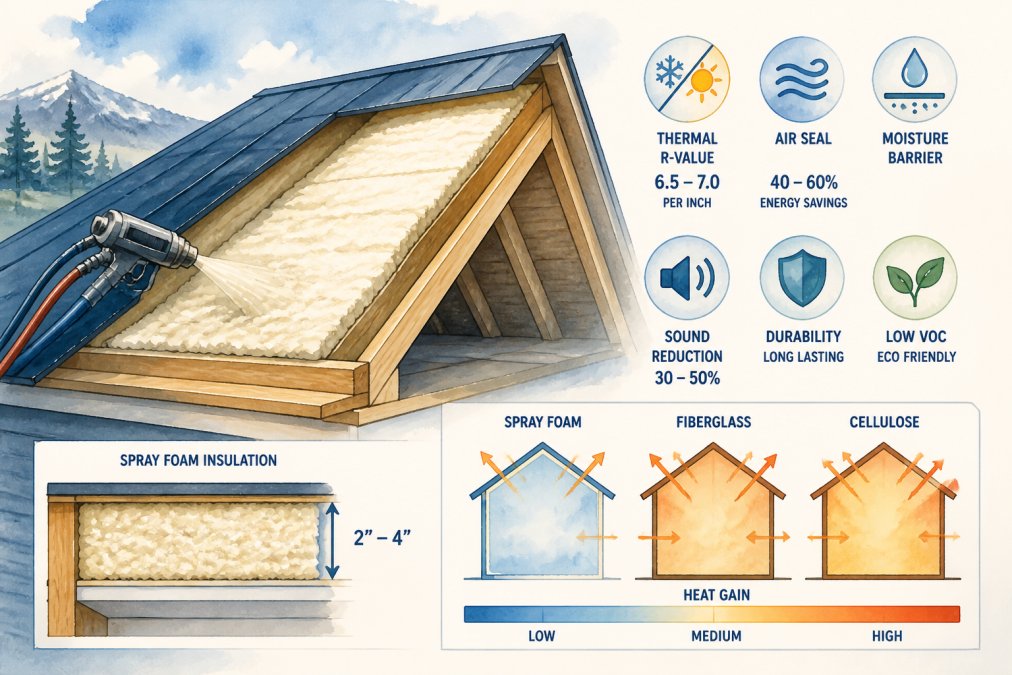
Spray foam insulation for roofs is a seamless, spray-applied system that bonds directly to the roof deck, expanding to fill gaps, cracks, and seams other materials leave exposed. Unlike rolled or sheet membranes that rely on fasteners and overlapping layers, it cures into one continuous surface with no joints for water to exploit.
Closed-Cell vs. Open-Cell: Which Foam Belongs on Your Roof
Closed-cell foam is the correct choice for roofing in nearly every case: its denser structure resists moisture absorption, delivers higher compressive strength, and provides a built-in vapor barrier. Open-cell foam is softer, lighter, and cheaper, but absorbs water and offers roughly half the R-value per inch.
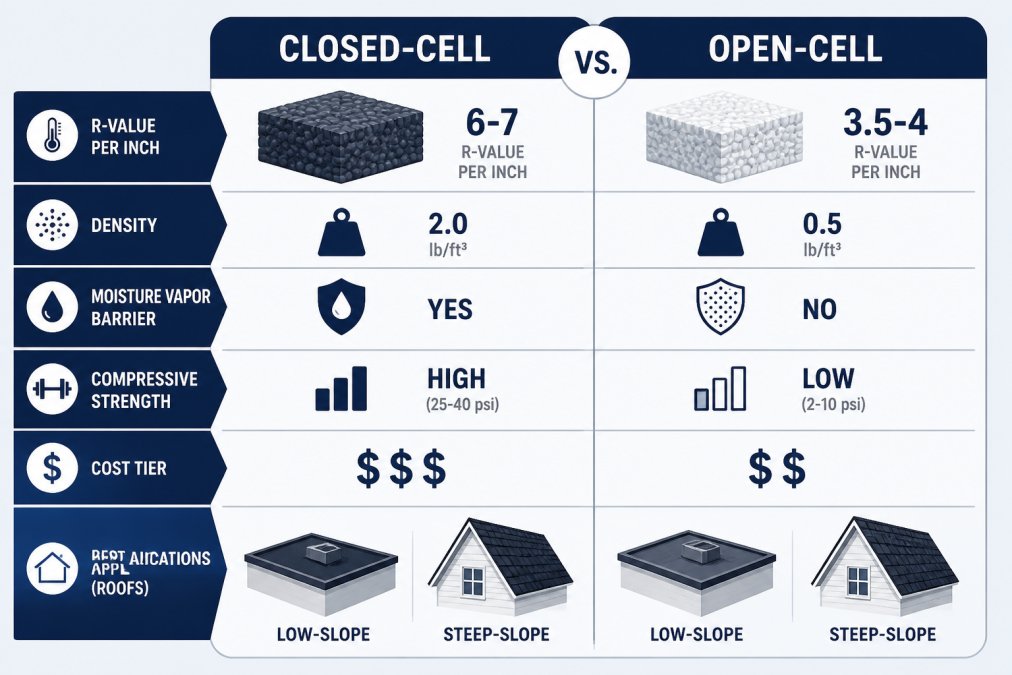
Here's how the two compare in practice:
| Property | Closed-Cell | Open-Cell |
|---|---|---|
| R-value per inch | Roughly 6-7 | Roughly 3.5-4 |
| Moisture behavior | Resists absorption | Can absorb and hold water |
| Compressive strength | High, walkable surface | Low, not traffic-rated |
| Vapor barrier | Yes, integral | No |
| Best roof use | Low-slope, flat, commercial | Interior walls, attics |
Spray Foam Roofing Pros and Cons for Home and Commercial Buildings
Pros:
- Seamless membrane eliminates leak points at fasteners and seams
- High R-value reduces heat transfer and heating costs
- Bonds to most substrates, including existing roof decks
- Adds structural rigidity without significant weight
- Restorable rather than replaceable in many cases
Cons:
- Requires a protective coating to resist UV degradation
- Application demands trained crews and correct substrate prep
- Not a DIY material; improper mixing or moisture during application causes failures
- Walking surface requires a granule or coating top layer for traffic
For commercial buildings, the calculus tilts further toward foam: the seamless membrane protects large decks where seams are the primary failure mode.
How to Clean Spray Foam Roof Coating Without Damaging the Membrane
A safe routine:
- Remove loose debris with a soft-bristle broom or leaf blower
- Rinse with low-pressure water (garden hose, not a pressure washer)
- Use a mild detergent solution for stubborn dirt or biological growth
- Scrub gently with a soft brush only where needed
- Rinse thoroughly and let the surface dry before inspection
Cleaning frequency depends on tree cover, dust, and biological growth. In our service area, roofs under cottonwoods need attention more often than open-exposure roofs.
Spray Foam Roof Maintenance Schedule: What to Check Each Season
A spray foam roof maintenance schedule is simple because there's so little to inspect. No fasteners to tighten, no seams to reseal, no shingles to replace. What remains is coating condition and drainage.
| Season | What to Check | Why It Matters |
|---|---|---|
| Spring | Post-winter coating wear, ponding water | Freeze-thaw is hardest on coatings |
| Summer | UV coating thickness, surface chalking | UV exposure degrades unprotected foam |
| Fall | Debris removal, drain clearance | Leaves block drainage before snow |
| Winter | Ice dams, snow load, visible damage | Weight and ice stress the membrane |
guidance on cool roofing and reflective surfaces
Installation, Code Compliance, and When to Call a Professional
This section determines whether your roof passes inspection. Fire ratings and code compliance aren't paperwork, they're the difference between a legal assembly and one that has to be torn out.
The installation sequence, step by step
A professional spray foam roof install follows a fixed order; skipping any step causes failures months later:
- Inspection and moisture survey. The deck is checked for wet insulation, ponding, and structural movement. Any saturated material is removed before anything else happens.
- Surface preparation. The deck is cleaned, loose material is removed, and a primer is applied where the substrate requires it. Adhesion is entirely dependent on this step.
- Detail work. Penetrations, drains, parapets, and edges are foamed first, by hand, so the field coat can tie into them seamlessly.
- Field application. Heated proportioning equipment mixes the two components at a precise ratio and sprays them in passes to build the specified thickness. Ambient and substrate temperature, humidity, and dew point all have to be within the manufacturer's window.
- Curing and inspection. The foam cures within minutes to hours depending on thickness and conditions, then is inspected for thickness, density, and off-ratio areas.
- Coating. A base coat and UV-stable topcoat are applied. Granules may be broadcast for traffic or slip resistance.
Fire ratings and code compliance
The code framework governing foam plastic insulation, including spray polyurethane foam, is set by NFPA 285 and the model codes that reference it. Key concepts:
- Class A fire rating. Roof coverings are classified by their resistance to external fire exposure. A properly installed spray foam roof with an approved coating can achieve a Class A rating, which is the highest classification and the one most commercial and many residential codes require.
- Thermal barrier. Foam plastic insulation installed on the interior side of a roof assembly generally must be separated from the interior of the building by an approved thermal barrier, commonly a minimum thickness of gypsum board, unless the assembly passes a specific fire test. This is the requirement most often missed by homeowners reading product literature.
- Exterior roof assemblies. Foam installed on the exterior of a roof deck is evaluated as a roof covering assembly, and the coating system is part of what earns the rating. The coating isn't just UV protection; it's a fire-performance component.
- Local authority having jurisdiction (AHJ). The AHJ, your city or county building department, makes the final call on what's approved in your jurisdiction. National standards set the floor; local amendments can raise it.
building code and fire safety standards for foam plastics
DIY vs. professional: where the line actually is
Spray foam kits sold at home centers are real products with legitimate uses, sealing rim joists, filling small gaps, insulating a crawl space. They are not a substitute for a roof system, for three reasons:
- Equipment. Roof-scale application requires heated proportioning equipment that maintains precise ratio and temperature. A disposable kit can't hold those tolerances across a full roof.
- Conditions. Roof application is weather-sensitive. Kits give you no way to monitor substrate temperature, humidity, or dew point, which are the variables that cause adhesion failure.
- Code. A DIY foam roof won't come with the code compliance documentation your AHJ requires, and it won't carry the manufacturer's warranty.
Cost, Long-Term ROI, and Environmental Impact
Most guides dodge this section because the honest answer is "it depends." Here's the framework professionals use to price a spray foam roof and decide whether it beats a tear-off over 10 to 20 years.
What drives the price
Four variables move the number more than anything else:
- Roof area and geometry. Square footage sets the baseline. Penetrations, parapet walls, drains, and HVAC curbs add labor because each one has to be detailed by hand before the field coat goes down.
- Substrate condition. A dry, sound deck needs cleaning and priming. A deck with ponding, blisters, or saturated insulation needs repair or partial removal first, and that work is billed separately from the foam.
- Foam thickness. Closed-cell foam is priced by the board-foot (one square foot at one inch thick). Specifying 1.5 inches versus 3 inches roughly doubles the material cost, so the R-value target drives the bid.
- Coating system. A base coat plus a UV-stable topcoat is standard. Adding granules for traffic or a reflective topcoat for cool-roof compliance adds cost but also adds service life.
Because of those variables, a legitimate contractor won't quote a number over the phone; anyone who does is guessing or padding.
The ROI math, in plain terms
The case for restoration over replacement rests on three savings streams:
- Avoided tear-off and disposal. Removing and landfilling an existing roof is a real line item, labor, dumpster fees, and landfill tipping charges. Foam applied over a prepared existing deck skips most of that.
- Reduced heating and cooling load. Adding continuous insulation on top of the roof deck raises the assembly's R-value, which cuts the energy the building loses through the roof. The savings show up every month, not just once.
- Extended service life through recoating. The foam itself is the waterproof layer; the coating is the wear layer. Recoating every several years is far cheaper than re-roofing, and each recoat resets the clock on UV protection.
Environmental impact: the part most guides skip
The sustainability story has two halves, and only one is flattering.
The upside:
- Restoration keeps existing roofing material out of landfills. Roofing is one of the largest single contributors to construction and demolition debris, and the EPA documents how much of that waste stream ends up buried.
- Continuous roof insulation lowers the energy a building consumes, which reduces the emissions tied to heating and cooling over the roof's life.
- A reflective topcoat can qualify the assembly as a cool roof, which lowers surface temperature and reduces the urban heat island effect.
The trade-off:
- Spray polyurethane foam is petroleum-based, and its blowing agents can have high global warming potential. Some formulations use hydrofluoroolefin (HFO) blowing agents with dramatically lower GWP than older hydrofluorocarbon (HFC) chemistry, but not every contractor stocks them.
- Freshly applied foam off-gasses, mostly during and immediately after application, which is why occupants are typically kept out during cure and the space is ventilated afterward.
- If you want the lowest-impact option, ask your contractor which blowing agent is in the drum before you sign. That single question separates a genuinely greener install from a greenwashed one.
EPA information on construction and demolition materials
Frequently Asked Questions
Is spray foaming your roof a good idea?
For low-slope and flat roofs, spray polyurethane foam is often a strong choice. It forms a seamless membrane that seals seams, flashing, and penetrations where leaks typically start, and it adds continuous insulation that reduces thermal bridging. It also adheres directly to most substrates, so it can restore an aging roof instead of tearing it off. The catch is that SPF needs a UV-protective coating and periodic recoating to last, and it should be installed by a trained applicator because mixing ratios and substrate prep determine how well it performs.
What are the disadvantages of a spray foam roof?
The main drawbacks are cost of the protective coating, sensitivity to UV exposure if the topcoat wears thin, and the need for skilled installation. Foam applied over a wet roof deck can trap moisture, so any active leaks or saturated insulation must be fixed first. Some foams also expand significantly during curing, which can be an issue around tight details. Finally, hail and foot traffic can dent the surface on softer foam densities, which is why a durable acrylic, silicone, or polyurea coating matters in storm-prone areas.
What is the recommended thickness of spray foam for a roof?
Most low-slope roof restorations use about 1 to 1.5 inches of closed-cell foam, which delivers roughly R-6 to R-7 per inch. Thicker applications are used when the goal is primarily insulation rather than waterproofing. Your contractor should calculate thickness based on your climate zone, existing insulation, and the R-value you want to hit. In cold regions, going thicker reduces heat loss and condensation risk on the underside of the deck. Always confirm the specified thickness in writing before work begins.
How long does a spray foam roof last?
A properly installed spray foam roof can last 20 to 30 years or more, but that lifespan depends heavily on the protective coating. The foam itself is the waterproof layer; the acrylic, silicone, or polyurea topcoat shields it from UV rays and weather. When the coating wears thin, it can be reapplied to extend the roof's life without removing the foam. Skipping recoating lets UV degrade the surface, causing chalking and eventual failure. A maintenance schedule with annual inspections keeps the system on track.
Does spray foam insulation cause roof rot?
Spray foam itself does not cause rot. Rot happens when moisture gets trapped against wood. Closed-cell foam acts as a moisture vapor barrier and, when applied to a dry, sound deck, keeps water out. Problems arise when foam is sprayed over a wet substrate or an active leak, sealing moisture inside. That is why proper prep, moisture testing, and repairing existing damage before application are essential. On the interior side, foam can also change how a roof deck dries, so ventilation and vapor management should be planned by a qualified contractor.
Can spray foam roofing handle hail and heavy snow?
Yes, with the right density and coating. Closed-cell SPF is dense and resilient, and it absorbs impact better than brittle materials because it flexes rather than cracks. Hail can still bruise the surface in severe storms, but damage tends to be cosmetic rather than a breach. Heavy snow loads are generally fine because foam adds little weight and conforms to the deck. After any major hail event, have the roof inspected and touch up the coating where needed to maintain UV and water protection.
How do I clean a spray foam roof coating?
Use a soft-bristle brush or a low-pressure washer with mild detergent and water. Avoid harsh solvents, aggressive scrubbing, or high-pressure spray, which can abrade the coating. Rinse thoroughly and let the surface dry. Remove debris, leaves, and dirt from drains and low spots so water does not pond. For stubborn stains like algae or tree sap, use a manufacturer-approved cleaner. Clean once or twice a year, and after any storm that leaves grit or debris behind, to protect the coating and extend its service life.