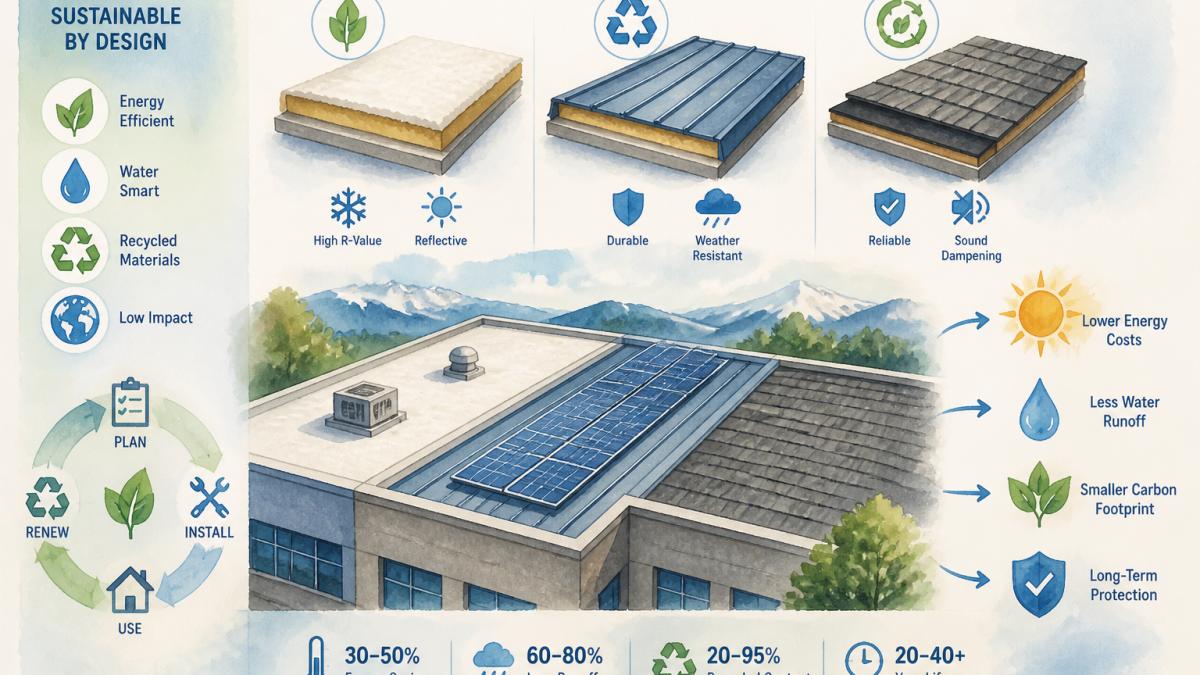
 ultimate-guide
Sustainable Roofing Solutions for Business: A 2026 Guide
Table of Contents
- Why Sustainable Roofing Solutions Matter for Business
- Sustainable Roofing Material Comparison
- Benefits of Cool Roofing for Businesses
- Commercial Roof Tax Credits and Incentives
- Energy Efficiency and Thermal Performance
- Retrofitting vs. New Construction: Which Approach Saves Money
- Lifecycle Cost Analysis and Long-Term ROI
- Durability and Weather Resistance for Regional Climates
- Frequently Asked Questions
Last Updated: October 4, 2026
Why Sustainable Roofing Solutions Matter for Business
Sustainable roofing solutions for business are now essential, not optional. The choice between replacement and restoration affects long-term asset protection, operational efficiency, and available tax incentives.
Over 25 years, Sun Flex Home Improvement has helped commercial and agricultural property owners adopt sustainable roofing solutions that extend roof lifespan and reduce energy consumption. Buildings with aging roofs waste energy continuously, paying twice, once in wasted utilities and again at replacement.
Full replacement guarantees a fresh start but requires massive upfront capital. Strategic restoration through sustainable materials preserves existing investment while delivering energy and durability gains. Matching the right approach to your building type and climate is critical.
Sustainable Roofing Material Comparison
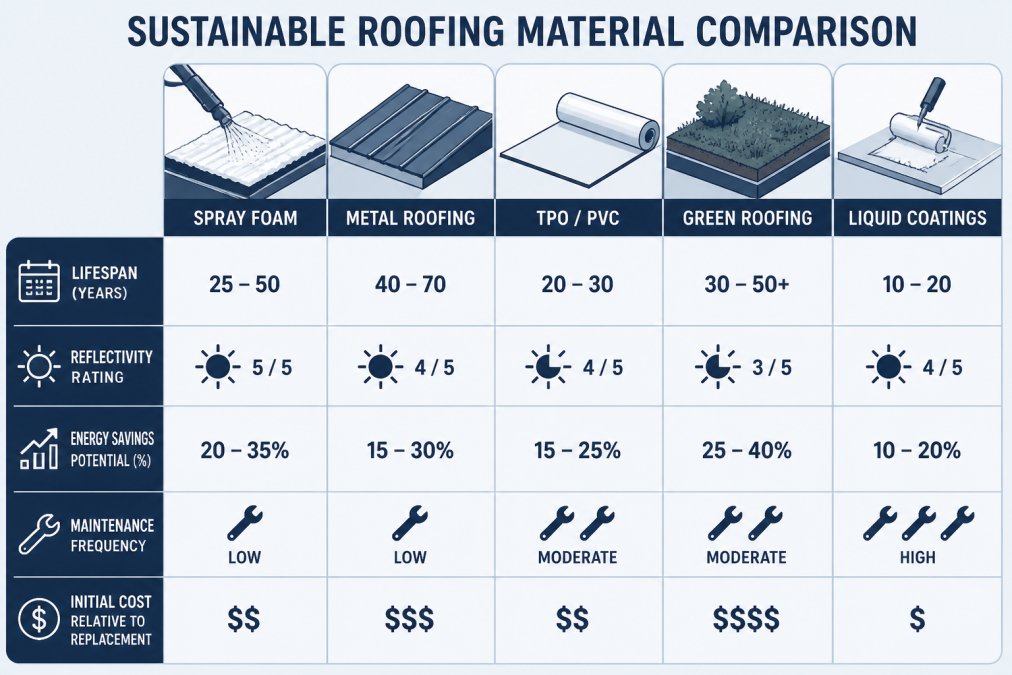
Each sustainable roofing solution offers different performance profiles, costs, and best uses. Comparison requires examining thermal performance, lifespan, maintenance demands, and regional weather suitability.
Spray Foam Roofing: Energy Efficiency and Durability
Spray foam roofing creates a monolithic, seamless membrane that bonds directly to existing roof structure, eliminating seams where leaks typically develop. The material expands during application to conform to irregularities and penetrations, forming a watertight barrier with integrated insulation, a unified system rather than stacked components.
Spray foam excels in buildings with complex profiles, multiple HVAC units, or frequent penetrations, particularly agricultural structures and older commercial buildings with uneven surfaces.
Pros:
- Monolithic design eliminates seams, the primary leak failure point
- Integrated insulation reduces energy consumption across heating and cooling seasons
- Conforms to irregular surfaces without requiring substrate modification
- Can extend existing roof life when properly applied and maintained
- Minimal structural load increase compared to other restoration methods
Cons:
- Requires specialized application equipment and trained technicians
- Performance depends heavily on installer expertise and surface preparation quality
- Periodic maintenance (typically every 5-10 years) involves recoating to maintain UV protection
- Not suitable for roofs with active ponding or standing water issues without proper drainage modification
Metal Roofing: Longevity and Recyclability
Metal roofing delivers 40-50+ year lifespan with minimal maintenance and full recyclability at end of life. Reflective coatings reduce summer heat absorption and cooling costs. Higher upfront material cost is offset by extended lifespan and reduced maintenance, narrowing cost-per-year significantly. Ideal for industrial buildings, warehouses, and agricultural structures.
Pros:
- Lifespan of 40-50 years with minimal maintenance
- Fully recyclable, reducing environmental impact at end of life
- Superior weather resistance, including high wind and hail performance
- Reflective coatings reduce cooling energy consumption
- Fire-resistant and resistant to pests and rot
Cons:
- Higher upfront material cost relative to asphalt-based systems
- Installation requires specialized metal roofing contractors
- Expansion and contraction in temperature extremes requires proper fastening and spacing
- Noise from rain and hail impact without acoustic underlayment
TPO and PVC Membranes: Cool Roof Technology
TPO and PVC membranes are engineered single-ply roofing with high solar reflectance for flat and low-slope commercial roofs. TPO uses heat-welded seams and is lightweight; PVC offers superior chemical resistance. Both excel in retail centers, office buildings, and industrial facilities where energy efficiency and cost control matter equally.
Pros:
- High solar reflectance reduces cooling energy consumption
- Heat-welded seams provide reliable water protection
- Lightweight installation reduces structural load
- Long lifespan (25-30 years) with proper maintenance
- Available in various colors and finishes
Cons:
- Can be susceptible to punctures from heavy foot traffic or sharp objects
- Installation requires specialized heat-welding equipment
- Performance depends on proper seam execution during installation
- Some formulations may degrade under extreme UV exposure without protective coatings
Green Roofing Systems: Biodiversity and Stormwater Management
Green roofing systems install vegetation over a waterproofing membrane to manage stormwater, improve air quality, and provide thermal insulation. The vegetation absorbs rainfall, reducing runoff, particularly valuable in urban settings. Green roofs support LEED certification and biodiversity while offering aesthetic and property value benefits.
Pros:
- Reduces stormwater runoff, supporting environmental compliance goals
- Provides thermal insulation and temperature moderation
- Supports LEED certification and sustainability credentials
- Extends waterproofing membrane lifespan by protecting it from UV exposure
- Improves air quality and urban biodiversity
Cons:
- Requires structural assessment to verify load-bearing capacity
- Higher upfront cost relative to conventional roofing
- Ongoing maintenance includes irrigation, weeding, and plant health monitoring
- Not suitable for buildings with limited structural capacity or weight restrictions
Liquid-Applied Coatings: Cost-Effective Restoration
Liquid-applied coatings restore aging roofs without tear-off, creating seamless waterproofing over existing materials. Reflective formulations reduce solar heat gain and support cool roof standards. This approach preserves substrate, avoids landfill waste, and reduces timeline, ideal for agricultural buildings, older structures, and budget-constrained projects.
Pros:
- Significantly lower cost than membrane replacement or new installation
- Seamless application eliminates traditional seam failure points
- Reduces waste by avoiding substrate tear-off
- Faster installation timeline compared to replacement approaches
- Reflective formulations support energy efficiency goals
Cons:
- Performance depends heavily on existing substrate condition
- Coating adhesion requires thorough surface preparation
- Lifespan typically 10-15 years, shorter than replacement systems
- Not suitable for roofs with significant structural damage or active leaks requiring substrate repair
Benefits of Cool Roofing for Businesses
Cool roofing materials with high solar reflectance reduce building energy consumption by absorbing less solar heat (the EPA). A 10,000-square-foot roof upgraded to cool roof technology delivers meaningful savings, especially in warm climates or high-cooling-demand buildings. Cool roofing also extends waterproofing membrane life by reducing thermal cycling stress and mitigates urban heat island effects.
Commercial Roof Tax Credits and Incentives
Property owners implementing sustainable roofing solutions may qualify for federal tax credits and state-level rebates that reduce net project cost. Eligibility depends on material selection, performance metrics, and program compliance. Cool roof systems, green roofing, and photovoltaic-ready systems frequently qualify. Consult a tax professional and review current guidelines before project planning to ensure material selection aligns with requirements and capture all available benefits.
Energy Efficiency and Thermal Performance
Thermal performance measures a roofing system's ability to resist heat transfer, quantified as R-value or U-factor. Higher R-values indicate better insulation; lower U-factors indicate less heat transfer.
Spray foam roofing delivers R-values ranging from 6 to 7 per inch of thickness, providing integrated insulation without separate layers. Metal roofing, when installed with insulation, achieves comparable performance.
Thermal performance improvements reduce heating costs during winter months and cooling costs during summer. A building losing conditioned air through an aging roof wastes energy continuously.
The payback period for energy efficiency improvements varies by climate, building usage patterns, and utility rates.
Retrofitting vs. New Construction: Which Approach Saves Money
The decision between restoration and replacement hinges on substrate condition, remaining structural capacity, and capital availability. A roof with sound structural integrity but deteriorated waterproofing is a candidate for restoration.
Restoration can be a significant advantage for budget-constrained projects. The work completes faster, reducing operational disruption.
Replacement guarantees a fresh start with modern materials and full structural warranty. New construction projects have the advantage of designing roofing systems to match building requirements precisely.
The financial comparison extends beyond material and labor costs. Restoration preserves existing assets, avoiding landfill waste and associated environmental impact.
For most commercial property owners, restoration through sustainable materials represents the optimal balance between cost control and performance improvement. The approach extends roof life meaningfully while freeing capital for other business priorities.
Lifecycle Cost Analysis and Long-Term ROI
Lifecycle cost analysis (LCCA) compares total ownership cost across a system's expected life, including materials, installation, maintenance, energy consumption, and eventual replacement or disposal.
A spray foam restoration with maintenance and a functional life produces a different total cost picture than a replacement system with a longer lifespan and minimal maintenance.
Energy savings compound over time. A cool roof reducing annual cooling costs by a measurable amount generates cumulative savings across 15-20 years.
LCCA frameworks account for the time value of money, adjusting future costs and savings to present-day equivalents.
For most commercial applications, sustainable roofing solutions deliver favorable LCCA results compared to conventional systems.
Durability and Weather Resistance for Regional Climates
Metal roofing excels in harsh climates, resisting wind uplift, shedding heavy snow loads, and surviving hail impact without permanent damage.
Green roofing systems require climate-specific plant selection and drainage design to function in cold regions.
TPO and PVC membranes perform adequately in regional climates when installed with proper insulation and drainage.
Durability claims should be verified against regional weather data and installation requirements specific to your location.
Sustainable roofing solutions for business protect your property investment while reducing operational costs and environmental impact.
We at Sun Flex Home Improvement have guided property owners through this decision across Montana and Northern Wyoming.
Contact us for a free estimate.
Frequently Asked Questions
What are the most sustainable roofing materials for commercial buildings?
Metal roofing with recycled content, TPO and PVC membranes with high solar reflectance, spray foam systems that extend existing roof life, and green roofing systems all qualify as sustainable options. Metal roofing lasts 40-50 years and is fully recyclable. TPO and PVC membranes reduce cooling energy consumption through reflective coatings. Spray foam restoration avoids landfill waste by preserving existing structures. Green roofing systems provide insulation, stormwater management, and biodiversity benefits. Choose based on your building's structure, climate, and sustainability priorities.
How does sustainable roofing improve energy efficiency for businesses?
Sustainable roofing solutions reduce energy consumption through thermal insulation and reflective coatings. Cool roof technology using TPO, PVC, or reflective coatings reflects solar radiation, lowering cooling loads in warm months. Spray foam creates a seamless thermal barrier that minimizes heat transfer. Green roofing systems provide natural insulation and reduce the urban heat island effect around your building. Metal roofing with cool coatings reflects heat effectively. These improvements directly lower utility bills, businesses typically see measurable reductions in HVAC operating costs, particularly in commercial buildings with large roof areas.
Are there tax incentives for installing green roofs or sustainable roofing on commercial properties?
Yes. Some states and local jurisdictions offer rebates for energy-efficient roofing, cool roofs, or green infrastructure. LEED-certified projects may qualify for property tax abatements or expedited permitting. Spray foam restoration and reflective coatings may qualify for energy efficiency tax deductions. Consult a tax professional and check with your state energy office for current incentives, eligibility depends on your specific roofing solution, location, and building classification.
What is the lifespan of eco-friendly commercial roofing systems?
Lifespan varies by material. Metal roofing lasts 40-50 years with minimal maintenance. TPO and PVC membranes typically last 20-30 years. Spray foam restoration can extend an existing roof's life by 10-20 years, deferring replacement costs significantly. Green roofing systems last 40+ years with proper drainage and maintenance. Durability depends on climate exposure, maintenance frequency, and installation quality. In harsh regional weather with hail and temperature extremes, professional installation and regular inspections are critical to achieving the full expected lifespan.
How do spray foam and metal roofing contribute to building sustainability?
Spray foam restoration eliminates landfill waste by preserving existing roof structures instead of tearing them off, reducing the environmental impact of replacement. It creates a seamless waterproofing membrane and thermal insulation, improving energy efficiency and extending roof life by 10-20 years. Metal roofing is fully recyclable at end-of-life and contains high recycled steel content. Both materials reduce carbon footprint by lowering energy consumption and minimizing construction waste. Metal roofing's 40-50 year lifespan means fewer replacements over time, further reducing environmental impact compared to shorter-lived alternatives.
What makes spray foam roofing a reliable alternative to full roof replacement?
Spray foam creates a seamless, monolithic waterproofing barrier that eliminates leak-prone seams and adapts to roof irregularities. It bonds directly to existing materials, asphalt, metal, concrete, forming a durable thermal and moisture barrier. The restoration approach preserves the existing roof structure, avoiding the cost and waste of tear-off replacement. Spray foam can save property owners up to half the cost of new roof installation while extending roof life. Professional application with proper surface preparation and drainage ensures long-term performance. Sun Flex Home Improvement's 25+ years of spray foam expertise means reliable installation and durability even in harsh regional weather.
Will sustainable roofing solutions hold up to hail storms and extreme weather?
Yes, when properly installed. Metal roofing is specifically engineered for hail and wind resistance, with impact ratings tested for severe weather. Spray foam systems, when applied to adequate thickness with proper substrate preparation, resist impact and weather exposure. TPO and PVC membranes are UV-resistant and designed for wind uplift and extreme temperature swings. Green roofing systems include root barriers and drainage layers for weather protection. In regions with brutal hail and temperature extremes, professional installation by experienced contractors ensures materials are applied correctly and anchored securely. Sun Flex Home Improvement's regional expertise in Montana and Northern Wyoming weather conditions ensures your system is built to withstand local climate challenges.