 ultimate-guide
Cost of Spray Foam Roofing: What Drives Your 2026 Price
Table of Contents
- How to Estimate Your Spray Foam Roofing Cost
- Price Factors That Move Your Spray Foam Roofing Cost the Most
- Spray Foam Roofing vs Metal Roofing: Cost and Performance
- Spray Foam Roofing Lifespan and What Recoating Adds
- How to Clean Spray Foam Roof Coating Without Damaging It
- Permitting, Inspection Fees, and Hidden Line Items
- Conclusion
- Frequently Asked Questions
Last Updated: October 2, 2026
How to Estimate Your Spray Foam Roofing Cost
The cost of spray foam roofing depends on four variables: roof size, foam thickness, substrate condition, and local permitting. Because those inputs shift so widely, no two quotes land in the same place. Spray foam roofing is a restoration system, so pricing tracks the work underneath the foam as much as the foam itself.
At Sun Flex Home Improvement, we've quoted and installed these systems across Montana and Northern Wyoming for over 25 years. Owners who understand the cost formula before calling a contractor get sharper numbers and fewer surprises. This guide covers what drives your price, how spray foam compares to metal, and where hidden line items hide.
The Cost Formula Contractors Actually Use
Most roofing contractors price spray foam roofing with a straightforward formula:
Total cost = (roof square footage × foam thickness × cost per board foot) + labor + substrate preparation + permits and fees + equipment mobilization
The board foot is the industry's unit of measure: one square foot of foam at one inch thick. A roof needing three inches of closed-cell foam to hit the target R-value costs roughly three times the material of a one-inch application. A common mistake is comparing quotes on square footage alone, a low bid often assumes minimal substrate preparation, where the real money sits.
Why Two Quotes for the Same Roof Can Differ by Thousands
Quotes diverge because contractors make different assumptions about what they'll find once they strip the surface. Roof deck condition, existing moisture, and roof slope all change the scope.
- One contractor budgets for full substrate preparation; another assumes a light cleaning
- Foam thickness varies with the target insulation density and climate zone
- Some quotes bundle flashing and sealing; others list them separately
- Equipment mobilization costs more for remote or agricultural properties
The biggest swing comes from moisture: trapped water means deck repair before any foam goes down. Ask every contractor to state in writing what they assume about deck condition, that question separates accurate quotes from optimistic ones.
Price Factors That Move Your Spray Foam Roofing Cost the Most
Five factors drive the bulk of your total. Material and foam thickness set the baseline, but labor, substrate work, permits, and mobilization routinely cost more than owners expect.
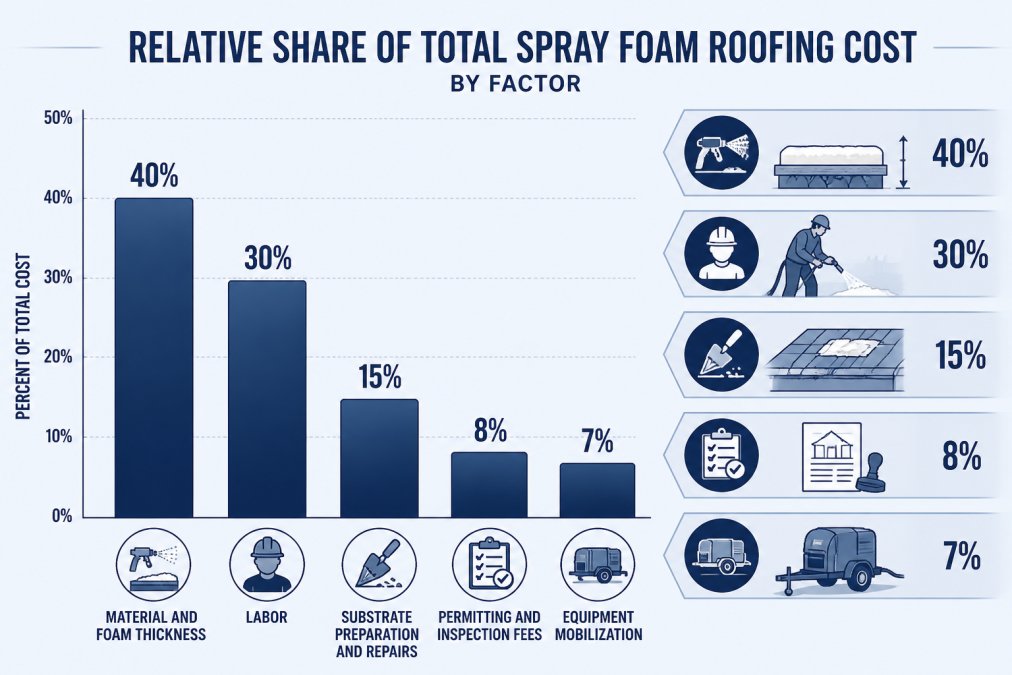
| Cost factor | What drives it | How it behaves |
|---|---|---|
| Material and foam thickness | Board feet (1 sq ft at 1 inch thick) | Scales linearly with thickness; closed-cell runs higher than open-cell |
| Labor | Roof complexity, penetrations, access, crew size | Higher per square foot on steep, cut-up residential roofs |
| Substrate preparation and repairs | Deck condition, moisture, existing membrane | The single most variable line item; can exceed material on a wet roof |
| Permitting and inspection fees | Jurisdiction, scope, whether it's a reroof or repair | Fixed per project, not per square foot |
| Equipment mobilization | Distance, site access, power availability | Flat fee; disproportionately large on small or remote jobs |
The Board-Foot Math Behind Your Quote
A 10,000-square-foot roof at 2 inches of closed-cell foam requires roughly 20,000 board feet of material; at 3 inches, 30,000. That linear relationship is why thickness, not square footage, separates a low bid from a high one. Two contractors can quote the same roof thousands apart because one budgets 2 inches and the other 3, or one assumes a dry deck while the other prices saturated sheathing replacement.
Commercial vs. Residential Cost Nuances
Commercial and residential projects price differently even at matching square footage.
Commercial flat roofs. Large, low-slope, and relatively free of penetrations, they speed application and lower labor per square foot. They also commonly qualify for thicker insulation packages, 2 to 3 inches or more, that improve HVAC efficiency across a large conditioned space. The energy math favors spray foam more strongly here than on a house, because you condition far more volume per roof dollar; on a warehouse roof, payback from reduced cooling load can arrive in a handful of years.
Residential roofs. Steeper roof slopes, dormers, vents, chimneys, and valleys slow the crew and increase installation complexity.
Agricultural and outbuildings. Large and simple like commercial roofs, but frequently remote, which raises equipment mobilization.
Before comparing two quotes, confirm they price the same building type, thickness, and deck assumptions. A residential and a commercial quote for the same square footage are not comparable numbers.
Where the Money Actually Hides
Material is the most visible line and rarely the most expensive surprise. Budget-blowing swings live in three places:
- Substrate preparation. If the existing roof has trapped moisture, the deck needs repair before any foam goes down. This is the line that turns a $2-per-square-foot job into a much larger one.
- Flashing and penetration sealing. Some quotes bundle it; others list it as an add-on. On a roof with many vents and curbs, this is real money.
- Coating. Every SPF system needs a protective elastomeric coating. A quote that prices the foam but not the coating is incomplete.
Ask every contractor to state, in writing, what they assume about deck condition, thickness, and coating. That single question separates accurate quotes from optimistic ones.
Spray Foam Roofing vs Metal Roofing: Cost and Performance
Spray foam and metal solve different problems. Metal is a full roof replacement; spray foam is typically a restoration over a sound existing roof. That distinction drives price and timeline, and makes a straight per-square-foot comparison misleading.
| Factor | Spray Foam Roofing | Metal Roofing |
|---|---|---|
| Typical approach | Restoration over existing roof | Full tear-off and replacement |
| Insulation | Foam provides R-value directly | Requires separate insulation |
| Seam profile | Seamless, monolithic surface | Many fasteners and seams |
| Hail resistance | Absorbs impact, self-sealing | Dents under heavy impact |
| Thermal bridging | Minimal | Present at fasteners |
| Maintenance model | Periodic recoating | Repainting, fastener and sealant upkeep |
| Best for | Restoring a sound roof | Roofs at end of life |
The Cost Comparison Nobody Shows You
A metal roof is priced as a replacement: tear-off, disposal, new decking where needed, underlayment, panels, trim, and fasteners. Spray foam is priced as a restoration: cleaning, deck repair, foam, and coating.
That advantage disappears the moment the deck is failing, then you're paying for a new roof either way, and metal becomes a legitimate option. Spray foam wins on cost when the existing roof is sound enough to restore; metal wins at end of life when you want a single tear-off-and-replace event.
ROI and Payback: Where Spray Foam Pulls Ahead
Most guides stop at upfront cost. What matters over a 5- to 10-year horizon is total cost of ownership, where spray foam's insulation value does its work.
Because the foam provides R-value directly, it reduces the cooling load from day one, and on a commercial building with a large conditioned volume that reduction compounds every summer.
Metal roofing is a durable weather barrier but not an insulation upgrade on its own.
Longevity and the Recoat Cycle
A metal roof lasts decades with minimal intervention, though fasteners, sealants, and paint finish need upkeep. A spray foam system also lasts decades, but its lifespan is governed by the protective coating rather than the foam. Recoating on schedule refreshes the UV protection and moisture barrier without touching the foam underneath, at a fraction of replacement cost.
The trade-off is maintenance discipline: metal tolerates neglect longer, while spray foam rewards owners who keep up with recoating.
The Hail Question
In hail country, metal's weakness is the fastener and seam line, not the panel, dents are cosmetic, but compromised fasteners and sealant are where leaks begin.
Neither system is universally better. If your deck is sound and you want to avoid a tear-off while adding insulation, foam wins. If the structure is failing, metal or a full replacement is the honest call.
Spray Foam Roofing Lifespan and What Recoating Adds
A spray foam roofing system can last decades, but the foam isn't the part that ages first, the protective coating is. Spray foam roofing lifespan depends almost entirely on keeping that top layer intact and renewed on schedule.
Once cured, the foam resists moisture and impact well; sun exposure is what degrades it. That's why the industry treats recoating as routine maintenance rather than a repair, refreshing the UV protection and moisture barrier without touching the foam underneath.
Three things determine how long your system lasts:
- Coating quality and thickness at installation
- Recoating interval, which varies with sun exposure and climate
- Prompt repair of any punctures, blisters, or ponding areas
For commercial owners, this is where the ROI and payback period gets interesting: a recoating costs a fraction of a replacement and resets the clock on the protective layer.
How to Clean Spray Foam Roof Coating Without Damaging It
Cleaning a spray foam roof is gentler work than most owners expect. The coating is durable, but abrasive tools and harsh chemicals can strip the layer that protects the foam. The goal is removing dirt and debris without scuffing the surface.
Here's how to clean spray foam roof coating safely:
- Remove leaves, branches, and debris by hand or with a soft-bristle broom
- Rinse with a garden hose and mild detergent, never a pressure washer on high
- Avoid wire brushes, abrasive pads, and solvent-based cleaners
- Clear drains and scuppers so water doesn't pond on the surface
- Inspect for blisters, punctures, or worn spots while you're up there
- Schedule professional recoating when the coating looks chalky or thin
The single biggest mistake is pressure washing. High pressure can lift the coating at seams and edges. A soft wash and a visual inspection twice a year will do more for longevity than any aggressive cleaning.
Permitting, Inspection Fees, and Hidden Line Items
Permits and inspections are the line items owners forget to budget for, and they vary widely by jurisdiction. A reroof or restoration typically requires a building permit, and some jurisdictions add separate inspection fees tied to the work scope.
Because requirements differ by county and city, we won't quote a figure here. Ask your contractor which permits apply to your address and whether the fee is included in the bid or billed separately, that question alone prevents most end-of-project surprises.
Other hidden items to watch for:
- Flashing and penetration sealing quoted as an add-on
- Deck repair discovered after the surface is opened
- Disposal fees if any material is removed
- Coating upgrades or a second coat not in the original scope
Conclusion
The real challenge with spray foam roofing cost isn't finding a number, it's finding a number you can trust.
Sun Flex Home Improvement has spent over 25 years restoring roofs across Montana and Northern Wyoming, building every estimate around the factors that actually move your price: deck condition, foam thickness, and the details most contractors leave out.
Get started with Sun Flex Home Improvement and request your free estimate today.
Frequently Asked Questions
What factors influence the total cost of a spray foam roof installation?
The biggest drivers are roof square footage, foam thickness measured in board feet, and how much substrate preparation the roof deck needs before spraying. Labor rates, roof slope and access, flashing and sealing details, and local permitting and inspection fees also move the number. Because every roof has a different mix of these factors, a contractor has to assess the deck and existing membrane before quoting. Sun Flex Home Improvement provides a free estimate that accounts for your specific site conditions.
Does spray foam roofing provide long-term energy savings?
Yes, when the foam is installed at the right thickness for your climate. Closed-cell polyurethane foam delivers a high R-value per inch and, once covered with an elastomeric coating, acts as both a moisture barrier and a thermal barrier that reduces thermal bridging. That helps lower heating and cooling loads, and can ease strain on HVAC equipment. Actual savings vary by building, insulation thickness, and utility rates, so ask your contractor to model your roof rather than promise a fixed percentage.
How often does a spray foam roof require maintenance or recoating?
A spray foam roof typically needs a recoating every 10 to 15 years, depending on UV exposure and foot traffic. The foam itself can last decades if the protective coating is kept intact. Maintenance is usually a visual inspection plus cleaning and spot repairs, which costs far less than a full roof replacement. In hail-prone areas, schedule an inspection after major storms so small punctures get sealed before they turn into leaks.
Is spray foam roofing expensive compared to metal roofing?
Spray foam roofing often costs less than a full metal roof replacement, especially when the existing deck is sound and can be restored instead of torn off. Metal roofing has a long lifespan and strong hail resistance, but material and installation costs run higher, and it offers less insulation value on its own. The right choice depends on your roof slope, budget, and whether you want insulation and waterproofing in one system. A free estimate from Sun Flex Home Improvement can compare both options for your property.