 ultimate-guide
Spray Foam Roofing for Flat Roofs: Complete 2026 Guide
Table of Contents
- What Is Spray Polyurethane Foam Roofing?
- Why Spray Foam Works for Flat Roofs
- Cost of Spray Foam Roofing Per Square Foot
- The Spray Foam Roof Installation Process
- How to Clean Spray Foam Roof Coating
- Spray Foam Roof Repair Process and Long-Term Maintenance
- Spray Foam Roofing vs. Traditional Flat Roof Materials
- Performance in Cold and Hail-Prone Climates
- Frequently Asked Questions
Last Updated: September 27, 2026
What Is Spray Polyurethane Foam Roofing?
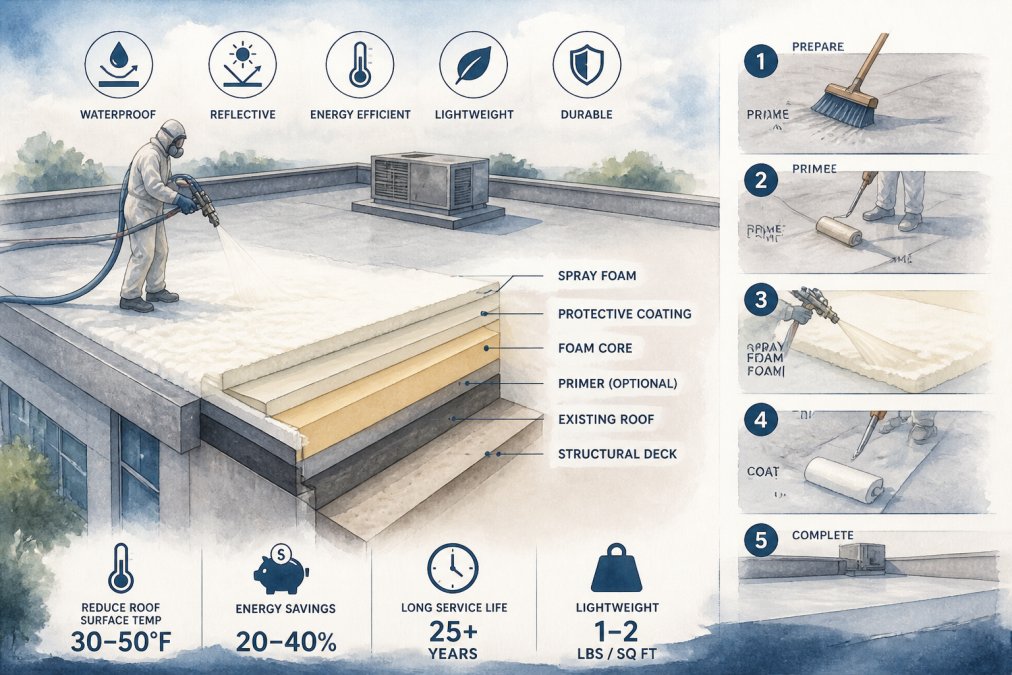
Spray polyurethane foam roofing is a seamless, monolithic insulation system applied directly to flat roof substrates, creating a continuous protective barrier that bonds with the existing roof structure. When cured, the closed-cell foam hardens into a durable, lightweight layer that provides both insulation and waterproofing in a single application.
Sun Flex Home Improvement has helped hundreds of property owners across Montana and Northern Wyoming understand that spray foam roofing for flat roofs differs fundamentally from traditional patching or partial repairs. Unlike built-up roofing or TPO membranes that sit atop the substrate, spray polyurethane foam integrates with your existing roof, eliminating seams and the leak points they create. The foam expands during application to fill cracks, gaps, and low spots, then hardens to form a seamless shell.
The system consists of two primary components: a polyol resin and an isocyanate that react chemically when sprayed. This reaction generates the foam, which expands to roughly 30 times its liquid volume. Once cured, the foam typically achieves an R-value between 6 and 7 per inch, substantially higher than most traditional roofing materials (Spray Polyurethane Foam Product Types | Safer Choice). A protective silicone or urethane coating is then applied over the foam to provide UV protection and enhance durability against weather exposure.
Why Spray Foam Works for Flat Roofs
Flat roofs present unique challenges that spray foam addresses directly. Standing water, poor drainage, and repeated freeze-thaw cycles damage traditional materials quickly. Spray foam's seamless application eliminates the vulnerable joints where most leaks originate.
The monolithic insulation layer creates a thermal envelope that reduces heating and cooling costs significantly. Because the foam adheres directly to the substrate, whether concrete, metal, or existing asphalt, it prevents air gaps that undermine energy efficiency. Property managers and homeowners often report improved comfort and lower utility bills within the first heating season after installation.
Spray foam's compressive strength allows it to handle foot traffic and equipment loads without degrading. This matters for commercial buildings with rooftop HVAC units, solar installations, or maintenance access. The material doesn't crack or split under weight the way rigid insulation boards do, and it won't compress permanently when equipment is moved or repositioned.
The restoration advantage matters most to property owners facing expensive replacement. Rather than tearing off the old roof and installing new materials, a process that takes weeks and disrupts operations, spray foam can be applied over existing surfaces. This extends the roof life cycle by 10-15 years in many cases, deferring the cost of full replacement while maintaining structural integrity.
Cost of Spray Foam Roofing Per Square Foot
Pricing for spray foam roofing depends on multiple factors: foam thickness (typically 4-8 inches), substrate condition, roof accessibility, regional labor costs, and whether the project involves new construction or restoration of an existing roof.
Most property owners find that spray foam restoration costs substantially less than full roof replacement. The exact cost per square foot varies based on your specific situation, substrate preparation needs, the condition of flashing and penetrations, and local contractor availability all affect the final price. Sun Flex Home Improvement recommends requesting a detailed estimate that breaks down material costs, application labor, and the protective coating separately.
The long-term value proposition shifts the comparison significantly. Because spray foam extends roof life and improves energy efficiency, the cost-per-year of protection is lower than many alternatives. A roof that lasts 15 additional years after spray foam application costs less annually than replacing the entire system every 20-25 years.
Financing options are often available through roofing contractors or commercial lenders for larger projects. Some property owners bundle spray foam restoration with other energy efficiency improvements to access federal tax credits or utility rebates. Request information about available incentives when obtaining your estimate.
The Spray Foam Roof Installation Process
Installation begins with thorough substrate preparation. The existing roof surface must be clean, dry, and structurally sound. Any debris, loose material, or standing water must be removed. Cracks and gaps larger than a quarter-inch should be sealed to prevent foam from flowing underneath the substrate.
Flashing around roof penetrations, vents, pipes, HVAC units, and edges, must be inspected and repaired.
How to Clean Spray Foam Roof Coating
Regular maintenance keeps spray foam roofing for flat roofs performing optimally. Debris accumulation, leaves, branches, dirt, traps moisture and accelerates coating degradation. Twice yearly cleaning, in spring and fall, prevents buildup.
Spray Foam Roof Repair Process and Long-Term Maintenance
Minor damage, small punctures, cracks, or coating wear, can be repaired without replacing large sections. A roofing contractor can apply patch kits designed for spray foam, using compatible polyurethane or silicone materials. Small repairs typically cost a fraction of recoating the entire roof.
Spray Foam Roofing vs. Traditional Flat Roof Materials
Spray polyurethane foam offers distinct advantages over conventional roofing systems, though each material has appropriate applications.
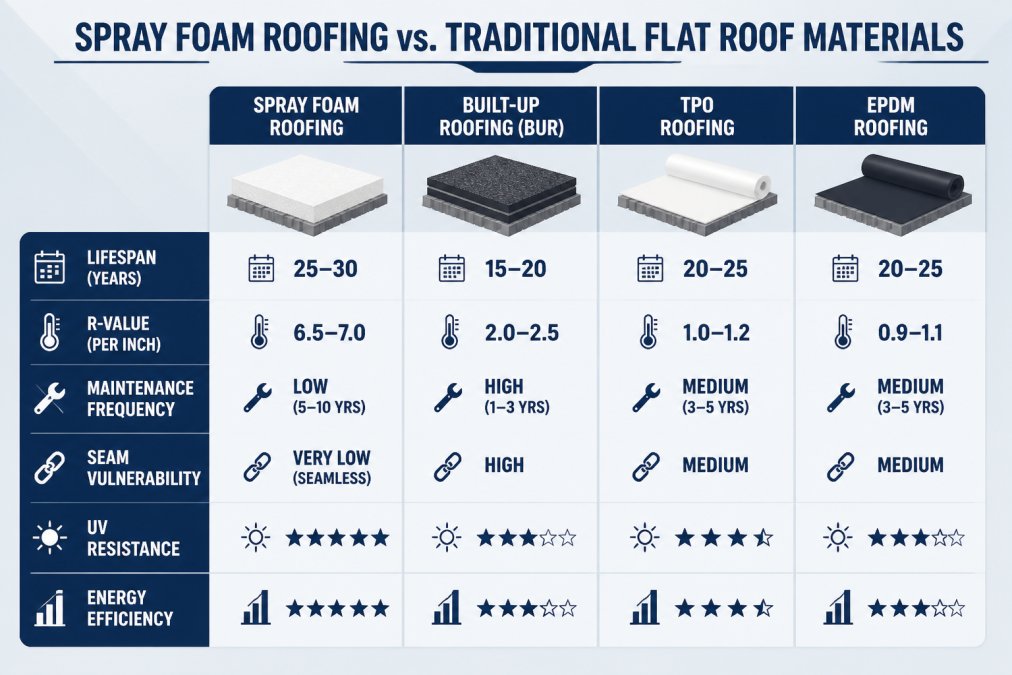
| Roofing Material | Lifespan | R-Value per Inch | Maintenance Frequency | Seam Vulnerability | Energy Efficiency |
|---|---|---|---|---|---|
| Spray Foam | 20-30 years | 6-7 | Annual inspection | None (seamless) | Excellent |
| Built-Up | 15-20 years | 0-1 | Frequent | High (multiple seams) | Poor |
| TPO | 15-20 years | 0-1 | Regular | High (single seam) | Good |
| EPDM | 20-25 years | 0-1 | Regular | High (single seam) | Good |
| Metal | 30-40 years | 0 | Minimal | Moderate (fasteners) | Good |
Performance in Cold and Hail-Prone Climates
Montana and Northern Wyoming winters present extreme conditions: temperature swings of 40+ degrees in a single day, heavy snow loads, and freeze-thaw cycles that crack and degrade roofing materials. Spray foam roofing for flat roofs performs well in these environments because the material doesn't become brittle in cold, doesn't crack under thermal stress, and expands and contracts minimally compared to single-ply membranes.
Frequently Asked Questions
How long does spray foam roofing actually last on a flat roof?
Spray polyurethane foam roofing typically lasts 20 to 30 years when properly maintained and recoated every 10 to 15 years with a protective elastomeric or silicone coating. The lifespan depends on climate exposure, UV protection maintenance, and the quality of installation. Regular inspections and timely repairs extend the roof life cycle significantly compared to traditional materials that may need replacement in 10 to 15 years.
What is the cost of spray foam roofing per square foot compared to roof replacement?
Spray foam roof restoration typically costs 40 to 50 percent less than complete roof replacement. Since pricing depends on roof size, substrate condition, local labor rates, and coating specifications, contact Sun Flex Home Improvement for a free estimate tailored to your property. The savings increase substantially when your existing roof structure is sound and only needs restoration rather than complete tearoff and rebuild.
Can spray foam roofing handle hail and severe weather in cold climates?
Spray polyurethane foam with a protective silicone or urethane coating resists impact damage better than single-ply membranes, though extreme hail can still cause punctures. The closed-cell foam's compressive strength and monolithic design create a seamless barrier that recovers from minor impacts. In harsh climates like Northern Wyoming and Montana, proper substrate preparation, adequate coating thickness, and regular maintenance are critical to performance during freeze-thaw cycles and hail storms.
How do I know if spray foam roof repair will actually fix my leak problem?
Spray foam creates a monolithic, seamless roofing system with no seams or flashing gaps where leaks typically start. The spray foam roof repair process involves cleaning the damaged area, applying fresh foam to fill voids, and recoating the section. If your existing roof structure is sound and leaks are caused by deteriorated seams or small punctures, spray foam restoration stops the problem at its source. A professional inspection before installation confirms whether your roof is a candidate for restoration or requires replacement.
What maintenance does a spray foam roof require after installation?
Annual inspections, debris removal, and recoating every 10 to 15 years keep spray foam roofing performing optimally. How to clean spray foam roof coating involves gentle pressure washing to remove dirt and algae without damaging the elastomeric coating. Avoid walking on the roof unnecessarily, seal any small punctures immediately, and trim nearby trees to prevent leaf accumulation. These simple steps preserve the weatherproofing and UV protection that extend your roof's life cycle.
Will spray foam roofing actually reduce my heating and cooling costs?
Yes. Spray polyurethane foam offers an R-value of 6 to 7 per inch, creating a continuous thermal barrier with no thermal bridging. This monolithic insulation layer reduces heat loss in winter and heat gain in summer, lowering HVAC demand significantly. Commercial and residential properties typically see noticeable reductions in energy costs, though exact savings depend on your existing roof's insulation value, climate zone, and building usage patterns.
What is the difference between DIY roof repair and professional spray foam installation?
Professional installation ensures proper substrate preparation, correct foam density and thickness, seamless application, and protective coating application. DIY attempts risk improper mixing, inadequate coverage, substrate contamination, and coating failure. Spray polyurethane foam requires specialized equipment, safety protocols, and expertise to create a weatherproof system. Professional contractors like Sun Flex Home Improvement provide warranties and guarantees that protect your investment, while DIY work voids manufacturer coverage and leaves you liable for failure costs.