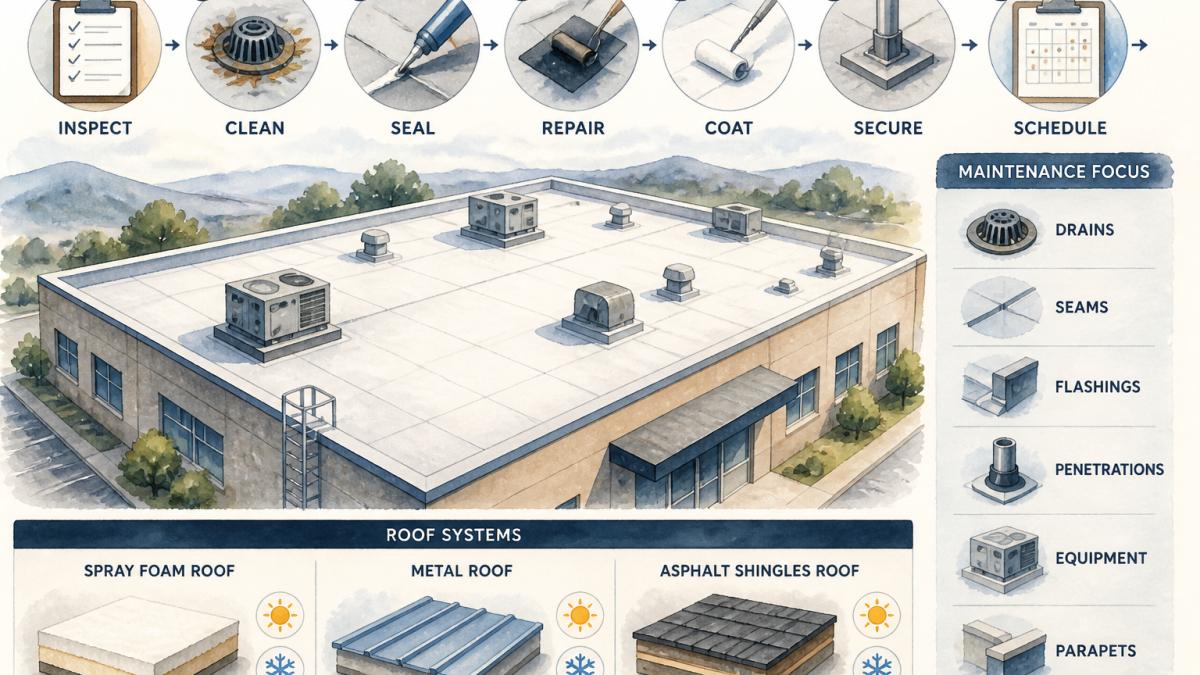
 how-to
How to Maintain Commercial Roofs: A Step-by-Step Guide
Table of Contents
- Why Routine Commercial Roof Maintenance Matters
- Develop a Commercial Roof Inspection Schedule
- Create Your Commercial Roof Maintenance Checklist
- Execute Preventive Maintenance Tasks
- Understand Your Commercial Roof Lifespan
- Maintain Safety and Documentation
- Budget for Roof Maintenance and Repairs
- Frequently Asked Questions
Last Updated: October 5, 2026
Why Routine Commercial Roof Maintenance Matters
To maintain commercial roofs properly protects your building, extends its lifespan, and saves money.
Think of roof maintenance like servicing a vehicle: skip the oil changes and the engine eventually fails.
The cost difference is dramatic.
Maintaining your commercial roof also protects your warranty. Most roofing manufacturers require documented maintenance to honor coverage.
Develop a Commercial Roof Inspection Schedule
Your first step is a consistent inspection schedule. Most commercial properties benefit from inspections at least twice per year, ideally in spring and fall, when damage from winter weather and summer storms is visible.
Beyond seasonal checks, inspect your roof immediately after severe weather. High winds, hail, and heavy snow can cause hidden damage that worsens quickly.
Spring and Fall Inspections
Schedule your spring inspection in April or May, after winter weather passes, looking for damage from freeze-thaw cycles, ice dams, and snow accumulation. Fall inspections should happen in September or October, before winter arrives.
Document everything with photos and notes to create a maintenance record that proves you're caring for your roof properly.
Post-Storm Assessments
Don't wait for your scheduled inspection if severe weather hits, inspect within 24-48 hours of storms. High winds lift membrane edges and dislodge fasteners, hail creates punctures and cracks, and heavy snow adds weight stress. Document storm damage with photos and timestamps to support insurance claims.
Create Your Commercial Roof Maintenance Checklist
A solid maintenance checklist ensures you don't miss critical items, but a list alone isn't enough, you need to know how serious each finding is and how fast to act.
Your checklist should cover these core areas:
- Seams and membrane condition
- Flashing around penetrations
- Drainage systems and gutters
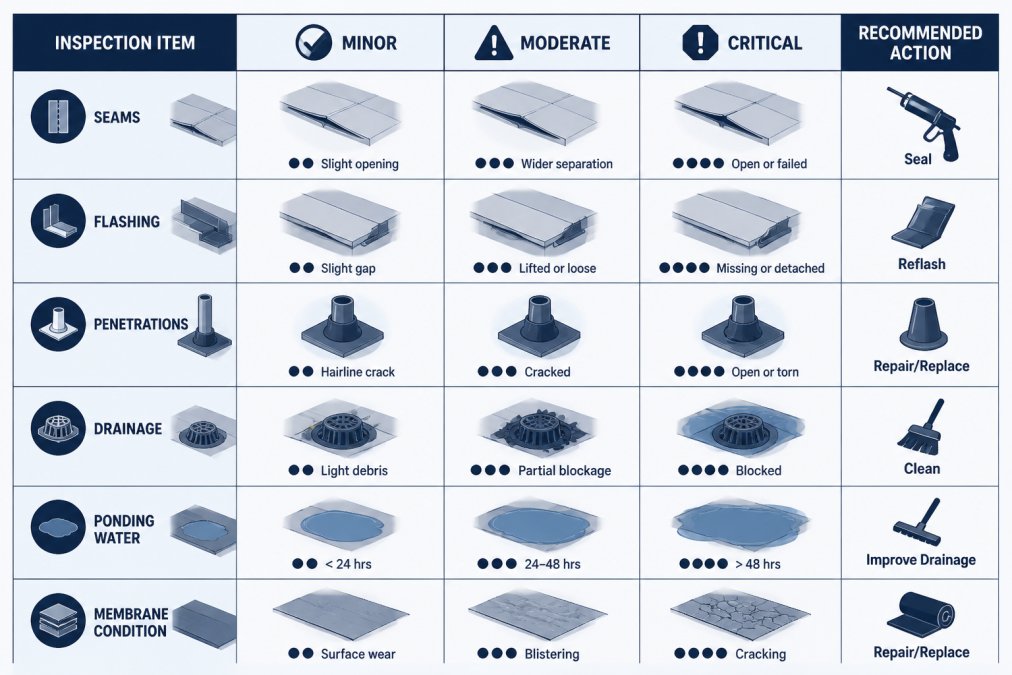
Rate Every Finding by Severity
A checklist without severity levels produces notes nobody can act on. For each item, record a condition rating and target response time using a simple three-tier system:
- Minor (monitor, address at next scheduled service): Small blisters under 2 inches, light surface debris, minor sealant shrinkage at a penetration, hairline cracks in coating. Document with a photo and a location note. Recheck at the next inspection.
- Urgent (repair within 30 days): Open seams longer than a few inches, flashing pulling away from a curb, ponding water that persists past 48 hours, clogged drains, cracked sealant around HVAC curbs, punctures under 1 inch. These won't fail tomorrow, but they will fail this season.
- Emergency (repair immediately, same day if possible): Active leaks into the building, displaced or missing flashing, membrane peeled back at an edge, standing water over a known defect, exposed insulation, or any condition that lets water enter the assembly right now.
If you find an emergency condition, do not wait for a scheduled contractor visit. Tarp or temporarily seal the area if it can be done safely, and call a roofing professional the same day. Water that enters the roof assembly can travel laterally and show up as a ceiling stain far from the actual breach.
Adjust Priorities by Roof Type
Generic checklists treat every roof the same, but failure modes, and inspection priorities, differ by system:
- Single-ply membranes (TPO, EPDM, PVC): Focus on seam integrity first. Heat-welded TPO seams and adhesive-bonded EPDM seams are the most common failure point. Check for seam separation, fishmouths (lifted seam edges), and punctures from foot traffic or dropped tools. Look at the membrane surface for chalking, crazing, or shrinkage at terminations.
- Built-up roofing (BUR) and modified bitumen: Focus on surface condition and flashing. Look for alligatoring (cracked, dried-out surfacing), blisters, and slippage at the ply sheets. Check gravel surfacing for bare spots where the asphalt has worn through. Pay close attention to base flashing and counterflashing, which fail before the field membrane does.
- Metal roofs: Focus on fasteners and sealants. Back out or loose fasteners, elongated screw holes, and deteriorated sealant washers are the leading causes of leaks. Check for rust at cut edges, panel lap corrosion, and movement at expansion joints. On standing-seam metal, inspect the seam clips and any exposed fasteners at the eave and ridge.
Document Each Finding the Same Way
For every item, record four things: location (a grid reference or photo with a landmark), condition rating, a dated photo, and the recommended action with a target date. This turns a checklist into a work order and a maintenance history at once.
Number your roof into zones (for example, Zone A through Zone D) and label them on a simple roof plan. When you write "seam separation, Zone C, near HVAC-2," anyone, you, a contractor, or an insurance adjuster, can find it without a site visit.
Inspect Seams, Flashing, and Penetrations
Seams join two roof sections, and flashing seals where pipes, vents, and equipment penetrate the roof, your most common leak sources. Look for separation, cracks, or deterioration in seams, and check that flashing sits flush and isn't pulling away.
Penetrations include HVAC units, skylights, exhaust pipes, and satellite dishes, where water pools. Make sure sealant hasn't cracked or shrunk.
Check for Ponding Water and Drainage Issues
Ponding water, standing water that sits on your roof more than 48 hours after rain, adds weight, stresses the structure, seeps through tiny cracks, and accelerates membrane deterioration (Glossary). If you see it, your drainage system needs attention. Check roof drains and gutters and remove debris blocking water flow.
Execute Preventive Maintenance Tasks
Once you've inspected your roof, act on what you found, executing the maintenance tasks needed to maintain commercial roofs. Preventive maintenance stops problems from worsening.
Clean Roof Surfaces and Remove Debris
Debris accumulation is a silent killer: leaves, dirt, and branches trap moisture against the membrane. Clean your roof at least twice yearly with a soft brush or low-pressure wash, never high-pressure equipment, which can damage the membrane and dislodge fasteners. Pay special attention to corners, edges, and low spots where debris collects and ponding water forms.
Clear Drains, Gutters, and Drainage Systems
Clogged drains cause ponding water, and clogged gutters overflow and spill water down building walls. Clean gutters and downspouts quarterly, more often near trees, removing leaves, dirt, and debris by hand. Clear buildup around roof drain openings and test drainage by running water to confirm it flows freely.
Repair Leaks and Damage Promptly
Small leaks become big problems fast, spreading water damage through insulation, framing, and interior spaces. Address them immediately: seal tiny cracks, patch small holes, re-seal deteriorated seams. Don't delay repairs hoping they'll improve, damage only worsens with weather exposure.
Understand Your Commercial Roof Lifespan
Different roofing materials last different lengths of time. Knowing your roof's expected lifespan helps you plan for replacement.
Material-Specific Maintenance Requirements
Built-up roofs typically last 15-20 years and need regular maintenance to prevent membrane breakdown. Metal roofs last 40-60 years with proper care but need fastener checks and sealant maintenance. Spray foam roofs can extend existing roof life by 15-20 years when properly maintained, with annual coating inspections and recoating every 5-10 years depending on climate and foot traffic.
Climate and Building-Use Considerations
Climate dramatically affects roof lifespan: harsh winters, intense sun, and frequent storms accelerate deterioration. Heavy rooftop traffic, HVAC units, maintenance access, foot traffic, wears roofs faster, and commercial kitchens and laundries add heat and moisture wear, requiring more frequent inspections. Adjust your maintenance plan to your specific conditions.
Maintain Safety and Documentation
Roof work involves hazards, so safety must come first. Documentation protects you legally and helps with insurance claims.
Worker Safety During Inspections
Falls are the leading cause of construction fatalities, and roofing is one of the highest-risk trades. Even a "quick look" on a low-slope roof carries real risk. Follow these practices on every inspection:
- Never inspect a roof alone. Always have a second person present who knows you're up there and can call for help.
- Use fall protection. On any roof with an unprotected edge 6 feet or more above a lower level, OSHA requires fall protection. Wear a full-body harness and connect to a fixed anchor point rated for the load. A personal fall arrest system, guardrail, or safety net all qualify, a body belt does not.
- Wear slip-resistant shoes. Roofs are slippery, especially when wet, dusty, or coated with algae. Smooth-soled work boots are a hazard.
If your roof is steep, has complex geometry, or lacks safe access, hire a professional inspector. It's safer and more thorough than a DIY inspection, and most roofing contractors include a basic inspection in a service call.
Keep Detailed Maintenance Records
Document every inspection and repair, dates, findings, photos, and actions taken. A useful roof asset record has five components:
- A roof plan with zones. Sketch the roof and label zones (A, B, C, D). Every finding gets a zone reference so it can be located later without a site visit.
- Dated photos. Photograph each finding with a date stamp and a landmark in the frame (an HVAC unit, a drain, a roof hatch). Before-and-after photos of repairs are especially valuable.
- Inspection reports. One report per inspection, using the same checklist and severity ratings each time. This makes trends visible, for example, a seam that was "minor" last fall and is "urgent" this spring.
- Repair history. Log every repair with the date, the contractor, the materials used, and the warranty on the work. This matters when a repair fails and you need to call the contractor back.
- Warranty documents. Keep the manufacturer's warranty, the installer's workmanship warranty, and any maintenance requirements in the same file. Most manufacturers require documented maintenance to honor coverage, and a claim without records is often denied.
Keep records at least 10 years, longer if your warranty runs longer. They prove you maintained your roof properly, support warranty claims, and show due diligence in a dispute.
Store records digitally in a dedicated folder with subfolders for inspections, repairs, warranties, and photos. Back up the folder to cloud storage. When you sell the building, a clean roof asset record is a selling point, buyers and their inspectors treat it as evidence the roof has been managed, not neglected.
Turn Records into a Maintenance Calendar
A record file is only useful if it drives action. After each inspection, transfer every "urgent" and "monitor" finding into a dated task list: schedule urgent repairs within 30 days and set a reminder to recheck monitor items at the next seasonal inspection. This closes the loop between inspection and repair, the step most property owners skip.
Budget for Roof Maintenance and Repairs
Set aside money annually for roof maintenance, it's far cheaper than emergency repairs or premature replacement.
A professional roof assessment can estimate remaining lifespan and recommend a maintenance budget.
Maintaining your commercial roof doesn't have to be complicated. Regular inspections, prompt repairs, and consistent documentation keep it in good shape for years.
Frequently Asked Questions
How often should a commercial roof be inspected?
Commercial roofs should be inspected at minimum twice per year: once in spring and once in fall. Many property managers also schedule post-storm inspections after severe weather. The frequency may increase for older roofs, roofs in harsh climates, or buildings in high-wind zones. Regular inspections catch small issues before they become costly repairs and help extend your roof's service life significantly.
What should be included in a commercial roof maintenance checklist?
A comprehensive commercial roof maintenance checklist includes: inspecting seams and flashing for separation or deterioration, checking for ponding water in drainage areas, examining the membrane for cracks or blistering, clearing debris from roof surfaces and gutters, verifying that roof drains are functioning, and looking for signs of water intrusion or leaks inside the building. Document all findings with photos and notes to track your roof's condition over time.
What is the typical lifespan of a commercial roof?
Commercial roof lifespan varies by material and maintenance. Asphalt-based systems typically last 15-20 years, while metal roofs can exceed 40-50 years with proper care. Spray foam roofing systems can extend an existing roof's life by 15-20 years when applied to a sound substrate. Regular preventive maintenance, prompt repairs, and protection from harsh weather all significantly impact how long your roof system performs. Climate conditions in colder regions may require more frequent inspections.
How can you tell if a commercial roof needs repair or replacement?
Signs your roof needs repair include isolated leaks, small membrane tears, failed flashing, or localized ponding water. If damage covers more than 25% of the roof surface, the membrane is severely deteriorated, or repairs are needed every season, replacement may be more cost-effective. A qualified roofing contractor can assess whether targeted repairs or a full restoration will best protect your investment and extend your roof's service life.