 listicle
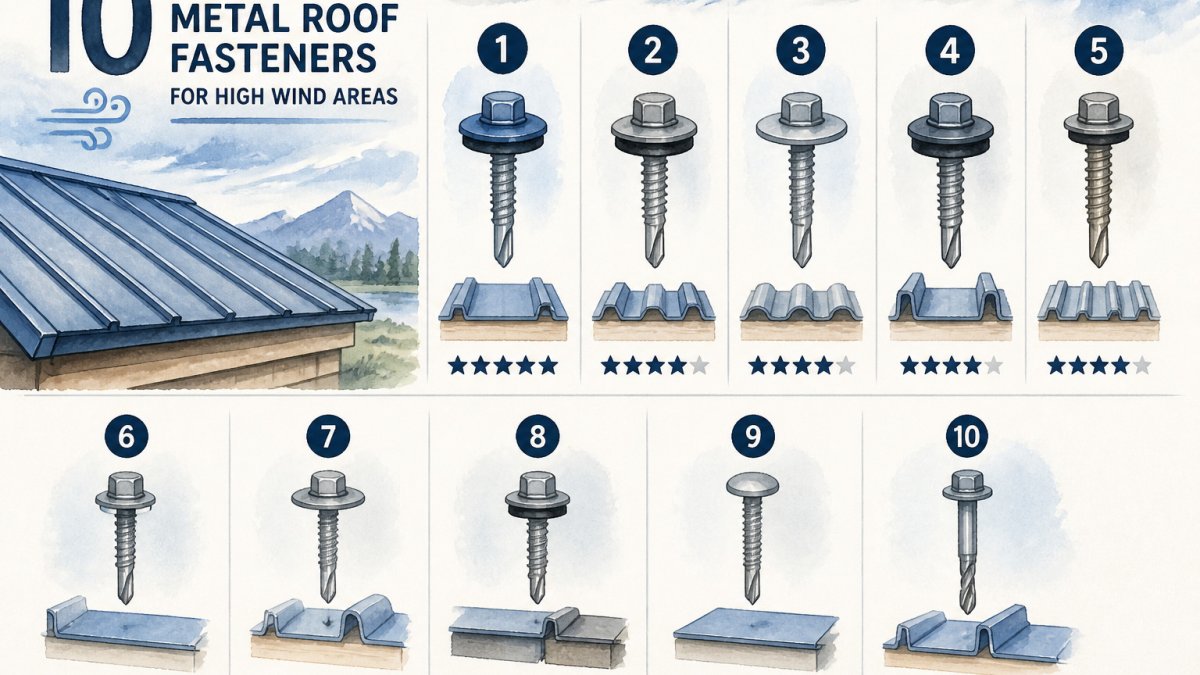
10 Best Metal Roof Fasteners for High Wind Areas
Quick Summary
The best metal roof fasteners for high wind are chosen by the tested assembly they belong to, not by the screw's wind-speed claim. Match the fastener to your panel, deck, and spacing, and confirm the supplier has an evaluation report or test documentation covering that exact combination.
- Ask for an evaluation report or listing that names your panel, deck, fastener, and spacing.
- Edge, corner, and ridge fasteners carry the highest uplift demand, so inspect them first.
- Overdriven screws crush the washer seal and reduce pull-over capacity.
- Screws into wood decking and steel purlins are not interchangeable; match the substrate.
- A screw data sheet is not the same as an assembly wind-uplift rating.
Table of Contents
- Why Fastener Choice Matters More in High-Wind Areas
- How We Evaluated These 10 Metal Roof Fasteners
- Quick Comparison: 10 Metal Roof Fasteners at a Glance
- The 10 Best Metal Roof Fasteners for High Wind
- Metal Roof Wind Uplift Ratings: What the Numbers Actually Mean
- Metal Roofing Fastener Spacing and Attachment Pattern in Wind Zones
- Self-Drilling Metal Roofing Screws: Point Types, Washers and Coatings
- Metal Roof Screw Replacement: When and How to Swap Failing Fasteners
- Frequently Asked Questions
10 Best Metal Roof Fasteners for High Wind Areas
Last Updated: October 29, 2026
Why Fastener Choice Matters More in High-Wind Areas
Wind is one of the first things to check on any metal roof. The fasteners holding the panels down are often the weakest link, even when the panels are rated for heavy loads.
A metal roof is only as secure as its attachment points.
Choosing the right metal roof fasteners for high wind is less about the panel brand and more about the screw, washer, coating, and spacing.
How We Evaluated These 10 Metal Roof Fasteners
Where published test data was unavailable, we say so plainly. A fastener marketed for high-wind use without documentation is a different proposition from one with a tested rating.
Quick Comparison: 10 Metal Roof Fasteners at a Glance
For current pricing, visit the Sun Flex Home Improvement website or request a free estimate.
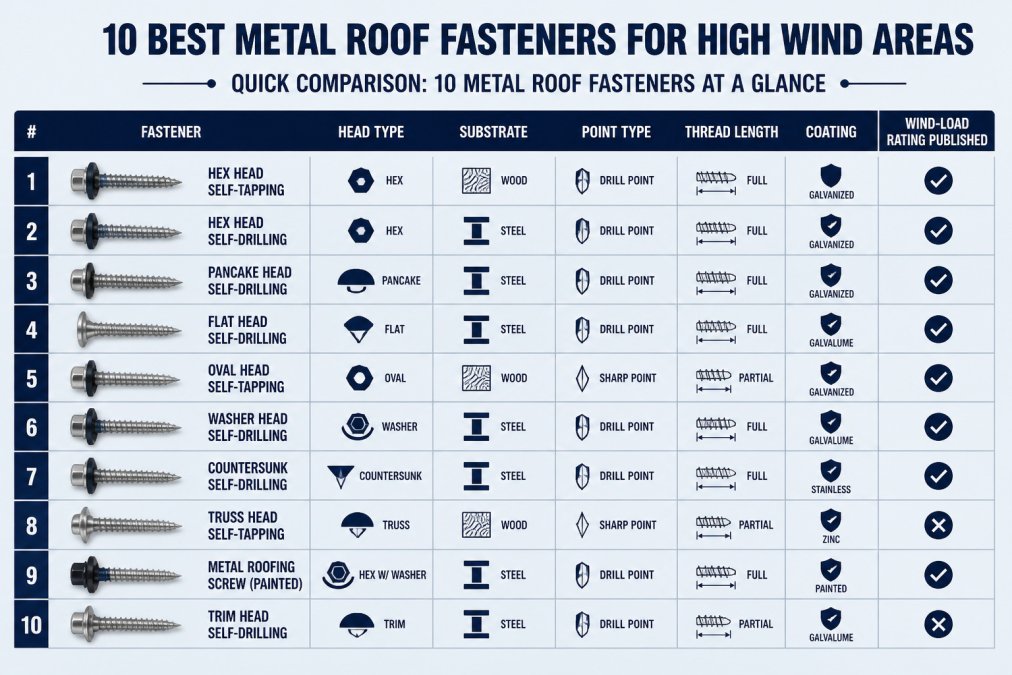
| Fastener | Substrate | Point Type | Thread or Size Notes | Wind-Load Rating Published? |
|---|---|---|---|---|
| Hurricane Fastener Metal Roofing Screws | Wood and framing | Self-drilling | #14 x 2.5-inch; 2-inch and 2.5-inch lengths | Not specified in sources |
| ST Fastening Maxx SteelBinder #12 | Steel purlins | Self-drilling | Drills steel up to 0.210 inch | Not specified in sources |
| Sealtite Metal Roofing and Pole Barn Screws | Wood and steel (varies by listing) | Varies | Dimensions not specified | Not specified in sources |
| ST Fastening ZXL WoodBinder #10 | Wood | Varies | Dimensions not specified | Not specified in sources |
| KwikSeal WoodBinder #10 | Wood | Varies | Positioned as budget-friendly | Not specified in sources |
The 10 Best Metal Roof Fasteners for High Wind
Several products in this category were covered with limited published detail. We list only the characteristics our sources support.
1. Hurricane Fastener Metal Roofing Screws (#14 x 2.5-inch)
Best for: replacement fastening in coastal or high-wind roofing projects.
Skip if: you need a published, tested wind-load rating, since the sources we reviewed did not provide one.
2. ST Fastening Maxx SteelBinder #12 for Steel Purlins
Best for: fastening metal panels to steel purlins.
Skip if: your deck is wood, since this screw is designed for steel framing.
3. Sealtite Metal Roofing and Pole Barn Screws
Best for: shoppers looking for metal-roofing or pole-barn screws from a single supplier.
Skip if: you need documented high-wind performance before purchase.
Metal Roof Wind Uplift Ratings: What the Numbers Actually Mean
Wind uplift ratings describe how a complete roof assembly resists wind pulling it off the structure. A rating applies to a tested system, not a single screw, the most important distinction before comparing fasteners, because most high-wind claims attach to the screw while the number that matters attaches to the assembly.
The three ways a metal roof fails in wind
Uplift does not pull a roof straight up. It creates negative pressure over the field and concentrated suction at edges, corners, and ridges. When a fastener system fails, it usually does so in one of three modes:
- Pull-out (withdrawal): the screw pulls out of the deck or purlin along its axis. This is governed by thread engagement, substrate thickness, and substrate material, a #14 screw in 1/2-inch plywood and the same screw in 16-gauge steel behave nothing alike.
- Pull-over: the screw head and washer tear through or deform the panel. This is governed by washer diameter, head bearing area, panel gauge, and whether the washer is flat or conical.
- Panel tear-out at the fastener hole: the panel elongates or tears around the screw under repeated wind cycling, even when the screw itself holds. This is where oversized washers and correct drive depth matter most.
A fastener strong in withdrawal can be weak in pull-over, and vice versa. A single "wind rating" on a screw listing tells you almost nothing on its own.
What a real assembly rating includes
When a manufacturer publishes an uplift rating for a metal roof system, the rating is tied to a specific tested build-up. Ask for the documentation and confirm it names all of the following:
- Panel profile and gauge
- Deck or purlin type and thickness
- Fastener make, model, diameter, and length
If any of those variables change, the rating does not automatically carry over. A screw tested in a 24-gauge standing-seam clip on steel purlins is not validated for the same panel on wood decking at wider spacing.
The standards and approvals to look for
In the U.S., metal roof assemblies are commonly evaluated against wind-uplift test methods published by ASTM and UL, and code officials typically look for an evaluation report or listing that ties the assembly to a recognized test standard. Two practical checkpoints:
- An evaluation report or listing that identifies the panel, fastener, and substrate combination, not just the fastener.
- A code evaluation service report (for example, an ICC Evaluation Service report) or a UL classification that references the specific assembly.
A screw data sheet that lists pull-out values from a lab test is useful engineering data, but it is not the same as an assembly rating. Treat the two as different documents.
How to read a wind-speed claim
When a roof is advertised as rated for a given wind speed, the number usually comes from an assembly test or an engineering calculation tied to a building code wind map, not the fastener alone. Match the fastener to the tested assembly, and do not substitute a different screw, washer, or spacing and assume the rating still applies.
Metal Roofing Fastener Spacing and Attachment Pattern in Wind Zones
Spacing and pattern are often more important than the fastener brand. Spacing is often as important as the fastener brand, because wind pressure concentrates at edges, corners, and ridges and changes with roof pitch, building height, and exposure.
Why the pattern matters more than the count
Wind uplift on a low-slope or gable roof is highest at the perimeter and corners and lowest in the field. See how metal roofs handle snow and weather loads in cold climates. That is why attachment patterns are usually described in zones rather than as a single spacing number:
- Field of the roof: the interior area, where uplift is lowest and spacing is widest.
- Edge zones: along eaves and rakes, where uplift rises sharply and fasteners are typically closer.
- Corner zones: where two edge zones meet, uplift is highest and spacing is tightest.
A common pattern tightens spacing in edge and corner zones relative to the field and adds fasteners at panel ends and ridge caps. Exact dimensions depend on the panel manufacturer's instructions and the site's code wind design, so the pattern should come from the installation manual, not a generic rule of thumb.
What determines the spacing you can use
The spacing a roof can carry is a function of the whole assembly, not just the screw:
- Panel gauge and profile: thinner panels and wider ribs deflect more between fasteners and need closer spacing or a concealed-clip system.
- Substrate: screws into wood decking rely on thread engagement in the wood; screws into steel purlins rely on the screw's drill capacity and thread pitch. The same spacing is not interchangeable between the two.
- Washer diameter: a larger washer spreads the load and reduces pull-over, which can allow wider spacing in some assemblies, but only if the manufacturer's testing supports it.
Installation failure modes to inspect for
The most common high-wind failures are installation errors, not product defects. A practical inspection checklist:
- Overdriven screws: the washer is crushed or the panel is dimpled around the head, which destroys the seal and reduces pull-over capacity. The correct drive leaves the washer just compressed against the panel, not flattened.
- Underdriven screws: the washer does not contact the panel, so it cannot seal and the screw can back out under vibration.
- Missed framing: a screw that lands beside the purlin or rafter instead of in it has almost no withdrawal capacity. Check that every screw in the pattern is actually engaged in framing.
Matching the pattern to the panel system
Exposed-fastener systems (corrugated and most through-fastened panels) rely on the screw pattern itself for uplift resistance, so spacing and drive quality are the whole game. Concealed-fastener systems (standing seam) move attachment to clips, making clip spacing and panel-to-clip engagement the critical variables. In either system, the manufacturer's installation manual controls, and local code can tighten it further.
Self-Drilling Metal Roofing Screws: Point Types, Washers and Coatings
Self-drilling screws penetrate steel without a pilot hole, speeding installation on metal purlins. Self-tapping screws need a pilot hole in some substrates and suit wood or pre-drilled metal.
The EPDM or rubber washer seals the penetration and compresses to hold the panel. Check that the washer is intact and the coating, galvanized steel or a zinc-aluminum finish, suits the environment.
Metal Roof Screw Replacement: When and How to Swap Failing Fasteners
Signs fasteners need attention include backed-out screws, cracked or hardened washers, rust streaks, and panels that lift or rattle in wind. Replace the fastener rather than over-tightening, since over-driving crushes the washer and weakens the seal.
A homeowner comfortable with roof work can swap individual screws, but a failing pattern across a roof usually calls for professional assessment. Learn how to hire a metal roofing contractor if you decide the job needs a qualified crew. Get a residential roof restoration quote in seven steps to see what that assessment involves.
Frequently Asked Questions
What type of fasteners are best for a metal roof in high winds?
Self-drilling screws with an EPDM or rubber sealing washer, matched to the substrate (wood or steel purlins), are the usual starting point for high-wind metal roofs. Stainless steel or coated carbon steel with zinc-aluminum protection resists corrosion better than plain galvanized fasteners. Choose fasteners that the manufacturer states are designed for metal-to-metal or metal-to-wood roofing, and confirm any wind rating against the roof assembly rather than the screw alone.
How far apart should metal roof screws be in high-wind areas?
Fastener spacing is set by the panel manufacturer's installation instructions and the wind design requirements for your building, not by a single universal number. In high-wind zones, edges, corners and ridges usually need tighter spacing than the field of the roof. Ask a licensed roofer or your local building department to confirm the pattern for your exact panel profile and wind speed before installation.
Can you replace metal roof screws without replacing the panels?
In many cases, yes. Backed-out or corroded screws can be removed and replaced with larger or properly rated fasteners, provided the holes have not stripped and the panels are not cracked. Use the correct diameter and length for the substrate, and add a new sealing washer. If holes are enlarged or the purlins or deck are damaged, the fastening point needs repair before a new screw will hold.
Are longer screws better for metal roofing?
Not automatically. The screw must penetrate the supporting structure far enough to develop full holding power, but excessive length can overdrive the screw or reach through the substrate. For wood decks, thread length should bite into solid wood; for steel purlins, the point must drill through the steel thickness rated for that screw.
Sun Flex Home Improvement is a BBB Accredited Business serving Montana and Northern Wyoming. For a free estimate on your metal roof, contact our team.