 listicle
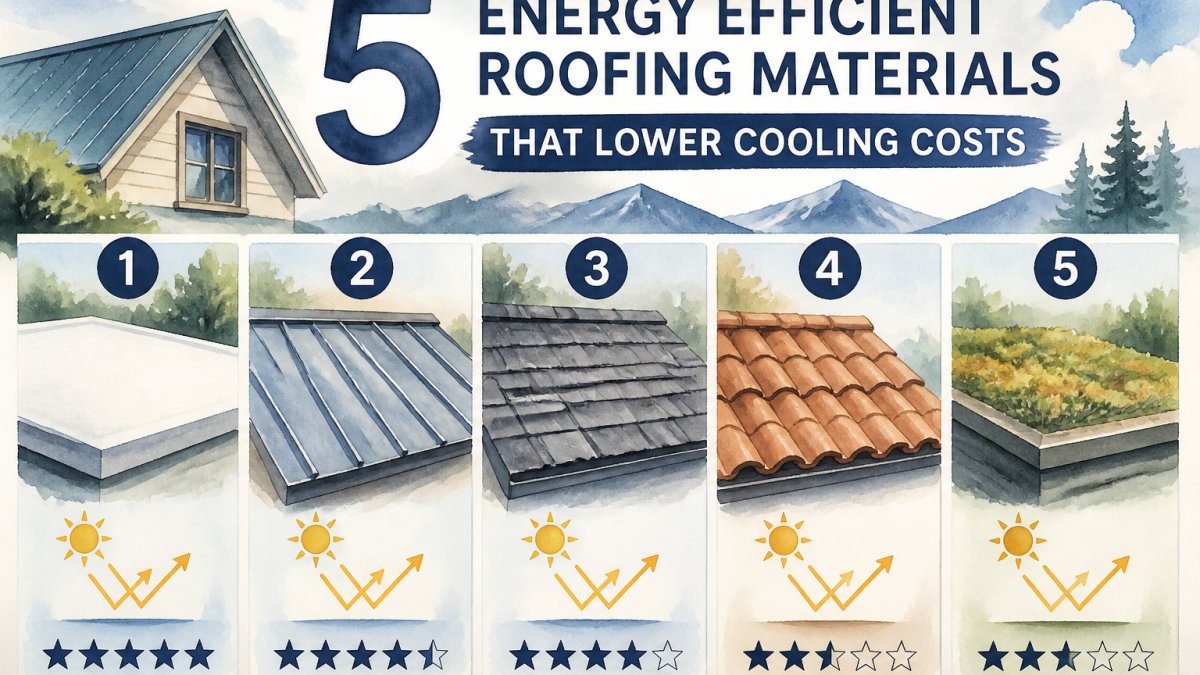
5 Energy Efficient Roofing Materials That Lower Cooling Costs
Last Updated: October 25, 2026
Quick Summary
Energy efficient roofing materials reduce heat absorption and lower cooling costs through high solar reflectance or thermal mass. The top five options are metal roofing, cool roof coatings, cool asphalt shingles, clay/concrete tile, and spray foam roofing, each offering different reflectance rates, lifespans, and cost profiles.
- Metal roofing reflects 60-90% of solar radiation and lasts 40-70 years, making it ideal for long-term energy savings.
- Cool roof coatings achieve 65-85% solar reflectance and offer the fastest payback, typically within 8 years for commercial properties.
- Cool asphalt shingles cost $4-$7 per square foot and reflect 25-35% of solar radiation, providing budget-friendly efficiency gains.
- Clay and concrete tile last 50+ years and use thermal mass to moderate temperature swings, working especially well in hot climates.
- Spray foam roofing costs roughly half of full replacement while delivering 60-75% solar reflectance and extending roof life 20-30 years.
Table of Contents
- Quick Comparison of the Top 5 Energy Efficient Roofing Materials
- Metal Roofing: High Solar Reflectance and Durability
- Cool Roof Materials and Reflective Coatings
- Cool Asphalt Shingles with Reflective Granules
- Clay and Concrete Tile Roofing for Long-Term Efficiency
- Spray Foam Roofing Energy Efficiency and Restoration Benefits
- Energy-Efficient Commercial Roofing Materials and System Performance
- Roofing Materials Cost and Lifespan: What to Expect
- Frequently Asked Questions
Quick Comparison of the Top 5 Energy Efficient Roofing Materials
When cooling costs climb, your roof becomes your first line of defense. Energy efficient roofing materials reduce heat absorption, lower cooling demand, and cut utility bills. The right choice depends on climate, budget, lifespan, and whether you're restoring or building new.
We've analyzed the five most practical energy efficient roofing materials for homeowners and commercial property owners. Here's how they compare.
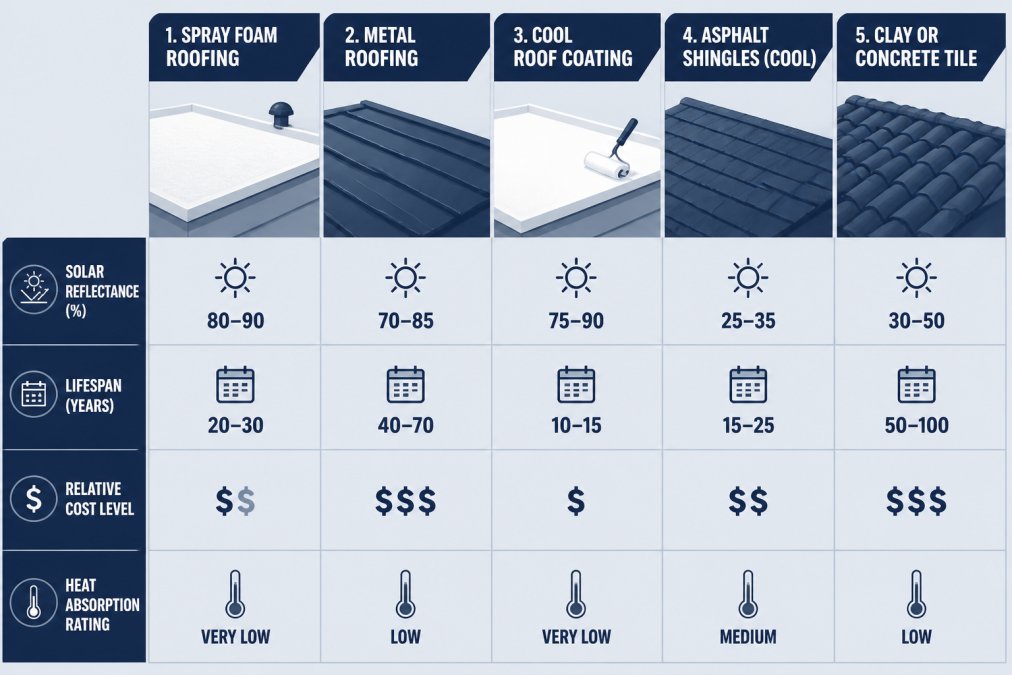
| Material | Solar Reflectance | Lifespan | Relative Cost | Best For |
|---|---|---|---|---|
| Metal Roofing | 60-90% | 40-70 years | Higher upfront | Long-term energy savings |
| Cool Roof Coatings | 65-85% | 10-20 years | Lower upfront | Quick efficiency gains |
| Cool Asphalt Shingles | 25-35% | 20-30 years | Moderate | Budget-conscious homeowners |
| Clay/Concrete Tile | 40-60% | 50+ years | Higher upfront | Hot climates, durability |
| Spray Foam Roofing | 60-75% | 20-30 years | Moderate | Existing roof restoration |
Metal Roofing: High Solar Reflectance and Durability
Metal roofing reflects 60 to 90% of solar radiation, making it one of the most effective energy efficient roofing materials available. For a detailed comparison of how metal roofing performs against spray foam and other alternatives, see how cost and lifespan stack up.
High solar reflectance means less heat penetrates your building, translating to lower air conditioning demand in hot climates.
Metal roofing works for residential and commercial applications, cutting cooling costs across large roof areas.
Watch out: Metal roofing requires professional installation. Improper sealing or fastening can compromise the watertight barrier and negate efficiency gains. Installation quality matters as much as material choice.
Best for: Property owners planning to stay in place for 20+ years and willing to invest upfront for long-term energy savings.
Skip if: Budget constraints make higher initial cost prohibitive, or you need a quick, temporary efficiency fix.
Cool Roof Materials and Reflective Coatings
Cool roof coatings reduce heat absorption by reflecting sunlight before it reaches the roof structure, typically achieving solar reflectance of 65 to 85%, rivaling metal roofing.
Cool roof materials include reflective membranes (TPO and PVC), elastomeric coatings, and acrylic finishes. Applied over existing roofing, they extend your current roof's life while cutting cooling costs immediately.
For commercial roofing, cool roof coatings offer rapid payback, a warehouse with high cooling expenses can see measurable utility bill reductions within the first season.
Reflective coatings need occasional cleaning to maintain reflectance but don't require the specialized care metal roofing demands. Learn more about commercial roof coating systems to explore reflective coating options that enhance energy efficiency.
Best for: Commercial property owners seeking quick efficiency gains without full roof replacement.
Skip if: You need durability beyond 15-20 years or prefer a single permanent solution.
Cool Asphalt Shingles with Reflective Granules
Cool asphalt shingles incorporate reflective granules, raising solar reflectance to 25 to 35%, lower than metal or coatings, but a practical middle ground between cost and efficiency.
Standard asphalt shingles absorb more heat, raising cooling demand.
Asphalt shingles remain the most affordable residential roofing material.
Installation is straightforward, most roofers are familiar with asphalt shingles, keeping labor costs predictable, and the material integrates with standard framing and ventilation.
Best for: Residential homeowners seeking energy efficiency without premium material costs.
Skip if: You're in a mild climate where cooling costs are already low, or you prioritize maximum reflectance.
Clay and Concrete Tile Roofing for Long-Term Efficiency
Clay and concrete tiles reflect 40 to 60% of solar radiation and last 50+ years.
Concrete tile is more affordable than clay but performs similarly.
Tile roofing suits residential and commercial applications alike, delivering lower cooling costs and exceptional durability with minimal maintenance.
Watch out: Tile is heavy and requires structural assessment before installation. Existing framing may need reinforcement, adding to project cost.
Best for: Property owners in hot climates who value durability and can accommodate structural requirements.
Skip if: Your climate is mild or your building cannot support tile's weight without significant structural work.
Spray Foam Roofing Energy Efficiency and Restoration Benefits
Spray foam roofing delivers solar reflectance of 60 to 75% when coated with a reflective finish.
Energy efficient roofing through spray foam works by eliminating air leaks and thermal gaps.
For property owners facing replacement costs, spray foam restoration costs roughly half of a complete replacement while delivering comparable efficiency gains.
At Sun Flex Home Improvement, we specialize in spray foam roofing restoration across Montana and Northern Wyoming.
Commercial buildings benefit significantly. A warehouse or office building with aging roof systems can restore functionality and efficiency through spray foam application. Explore detailed cost and performance information for spray foam roofing to understand financial and efficiency benefits specific to this material.
Best for: Property owners seeking cost-effective roof restoration with immediate energy efficiency gains.
Skip if: You prefer traditional replacement or need a permanent solution lasting 50+ years.
Energy-Efficient Commercial Roofing Materials and System Performance
Commercial roofing demands durability, weather resistance, and measurable energy performance. TPO (thermoplastic polyolefin) and PVC (polyvinyl chloride) single-ply membranes dominate low-slope applications, but the membrane alone doesn't determine energy performance. The whole roof system does.
Membrane specifics that matter. TPO membranes are commonly specified at 60, 80, or 115 mil; thicker membranes resist punctures and foot traffic better. PVC offers similar reflectance plus superior chemical and grease resistance, common over commercial kitchens.
Verified performance metrics. When comparing commercial products, look past marketing claims and read the ratings:
- Solar reflectance (albedo): the fraction of sunlight reflected, from 0 to 1 (or 0-100%). Higher is better for cooling.
- Thermal emittance: the ability to release absorbed heat as infrared radiation. High emittance helps at night.
- Solar Reflectance Index (SRI): a combined score that accounts for both reflectance and emittance, scaled so a standard black roof is 0 and a standard white roof is 100. Higher SRI means a cooler roof.
- CRRC listing: the Cool Roof Rating Council maintains a public directory of rated products. Specify products with a current CRRC rating so the numbers are third-party verified rather than manufacturer-reported.
- ENERGY STAR and code pathways: many commercial projects use ENERGY STAR qualified roof products or code compliance paths (such as ASHRAE 90.1 and the International Energy Conservation Code) that set minimum reflectance and insulation requirements. Confirm which pathway your jurisdiction enforces.
Whole-roof system performance. A reflective membrane over inadequate insulation still produces a hot building. Commercial property owners should evaluate the complete assembly:
- Insulation R-value: above-deck rigid insulation is the single largest lever on heating and cooling load. Higher R-value reduces both.
- Air sealing: penetrations, curb flashings, and membrane seams are common leak paths. Sealing them preserves the efficiency the membrane is supposed to deliver.
- Ventilation and moisture management: low-slope roofs rely on proper vapor retarders and drainage to avoid trapped moisture that degrades insulation performance.
- Roof color and coating: white or reflective membranes reduce solar heat gain; darker membranes may be preferred where heating dominates.
- Installation quality: seams, terminations, and flashings determine whether the system performs as rated.
Cost and payback framing. Commercial membrane roofs vary in installed cost, depending on thickness, attachment, insulation, and tear-off. Payback depends on utility rates, operating hours, and climate.
Discover broader sustainable roofing solutions for commercial applications to explore how energy-efficient materials integrate into comprehensive building strategies.
Roofing Materials Cost and Lifespan: What to Expect
Energy efficient roofing materials vary significantly in upfront cost, service life, and long-term value.
| Material | Typical Installed Cost (per square foot) | Expected Service Life | Annual Energy-Bill Effect | Maintenance Profile | Payback Caveat |
|---|---|---|---|---|---|
| Metal roofing (standing seam) | $8-$16 | 40-70 years | Modest to moderate cooling savings in hot climates; small heating benefit with proper underlayment | Low; occasional fastener/sealant checks | High upfront cost means payback often exceeds 10-15 years unless cooling loads are high |
| Cool roof coatings | $1.50-$4 | 10-20 years | Immediate cooling savings; reapplication resets the clock | Moderate; cleaning to preserve reflectance | Fastest payback of the five, but savings fade as coating ages |
| Cool asphalt shingles | $4-$7 | 20-30 years | Small to modest cooling savings versus standard shingles | Low; standard shingle maintenance | Payback depends on cooling-season length; weakest in mild climates |
| Clay/concrete tile | $10-$18 | 50+ years | Moderate cooling savings via reflectance plus thermal mass | Low; individual tile replacement | Structural reinforcement can add significant cost on older framing |
| Spray foam roofing (restoration) | $3-$7 | 20-30 years | Moderate savings from air sealing plus reflective coating | Low; recoat every 10-15 years | Often roughly half the cost of full replacement, but recoat costs must be budgeted |
How to calculate payback. Divide the net installed cost (after any utility rebates or federal tax credits) by the estimated annual energy savings.
Lifespan and total cost of ownership. A material that costs more upfront but lasts twice as long can deliver a lower cost per year of service.
Climate changes the math. Hot climates see the largest cooling-cost reductions from reflective materials. Mild climates see modest savings. Cold climates see little cooling benefit and should weigh heating performance, snow shedding, and insulation instead.
Learn specific financial benefits of spray foam roofing to understand energy savings and cost comparison with other materials.
Frequently Asked Questions
Which roofing material is the most energy efficient?
Metal roofing typically ranks highest for energy efficiency, reflecting 60-90% of solar radiation and reducing cooling demand significantly. Cool asphalt shingles with reflective granules and spray foam roofing systems are close alternatives. The best choice depends on your climate, roof structure, and budget. Metal suits hot climates and commercial buildings, while spray foam works well for existing roofs needing restoration without full replacement.
How much can an energy-efficient roof reduce cooling costs?
Energy-efficient roofing can reduce cooling costs, depending on climate, roof color, insulation, and current system efficiency. Metal roofs with high solar reflectance and cool roof coatings deliver significant savings in hot, sunny regions. Spray foam roofing adds insulation value, improving overall system performance. Savings appear within the first year on utility bills, and the payback period depends on local energy rates.
What is the difference between a cool roof and a green roof?
A cool roof uses reflective materials or coatings to bounce sunlight away, lowering surface temperature and reducing heat absorption. A green roof uses vegetation and soil to absorb water, provide insulation, and reduce the urban heat island effect. Cool roofs are simpler, cheaper, and more common for residential and commercial buildings. Green roofs offer environmental benefits but require structural support, drainage systems, and ongoing maintenance. Both reduce cooling costs, but cool roofs are faster to install and maintain.
Do metal roofs make a building more energy efficient?
Yes. Metal roofing reflects 60-90% of solar radiation, significantly reducing heat gain and cooling demand. Metal's reflectivity, combined with proper attic ventilation and insulation, creates an efficient roofing system. Metal roofs also have long lifespans (40-70 years), reducing replacement waste and long-term costs. The energy efficiency benefit is most pronounced in hot climates. In colder regions, metal roofs can slightly increase heating costs, but the durability and overall system efficiency still make them a strong choice.
Are cool roofs worth the investment?
Cool roofs are worth the investment if you live in a hot climate or have high cooling costs. Energy savings can offset the installation cost. Cool asphalt shingles cost slightly more than standard shingles but deliver immediate cooling benefits. Cool roof coatings applied to existing roofs cost less than replacement and extend roof life. For commercial buildings with large roof areas, the payback can be faster. If your roof is nearing end of life, replacing it with a cool-roof material is more cost-effective than coating an old roof.