 how-to
Spray Foam Roof Warranty Details: Coverage & Exclusions
Table of Contents
- What Spray Foam Roof Warranty Coverage Actually Includes
- Spray Foam Roof Warranty Length and Lifetime Protection Claims
- Common Spray Foam Roof Warranty Exclusions and Limitations
- How Spray Foam Roofing Warranty Differs from Shingle Warranties
- Steps to Verify Your Spray Foam Roof Warranty Before Installation
- Spray Foam Roofing Warranty Claim Checklist and Documentation
- Maintenance Requirements to Preserve Your Warranty
- Frequently Asked Questions
Last Updated: October 9, 2026
What Spray Foam Roof Warranty Coverage Actually Includes
A spray foam roof warranty is a manufacturer or contractor guarantee covering defects in materials and workmanship for a specified period.
Spray foam roofing warranties fall into two categories: manufacturer warranties (covering the foam and its thermal performance) and workmanship warranties (covering installation).
These warranties only cover what they explicitly list, so understanding coverage limits before installation saves frustration later.
Spray Foam Roof Warranty Length and Lifetime Protection Claims
Spray foam roof warranty periods vary by manufacturer and product line.
Here's what you need to know about warranty duration:
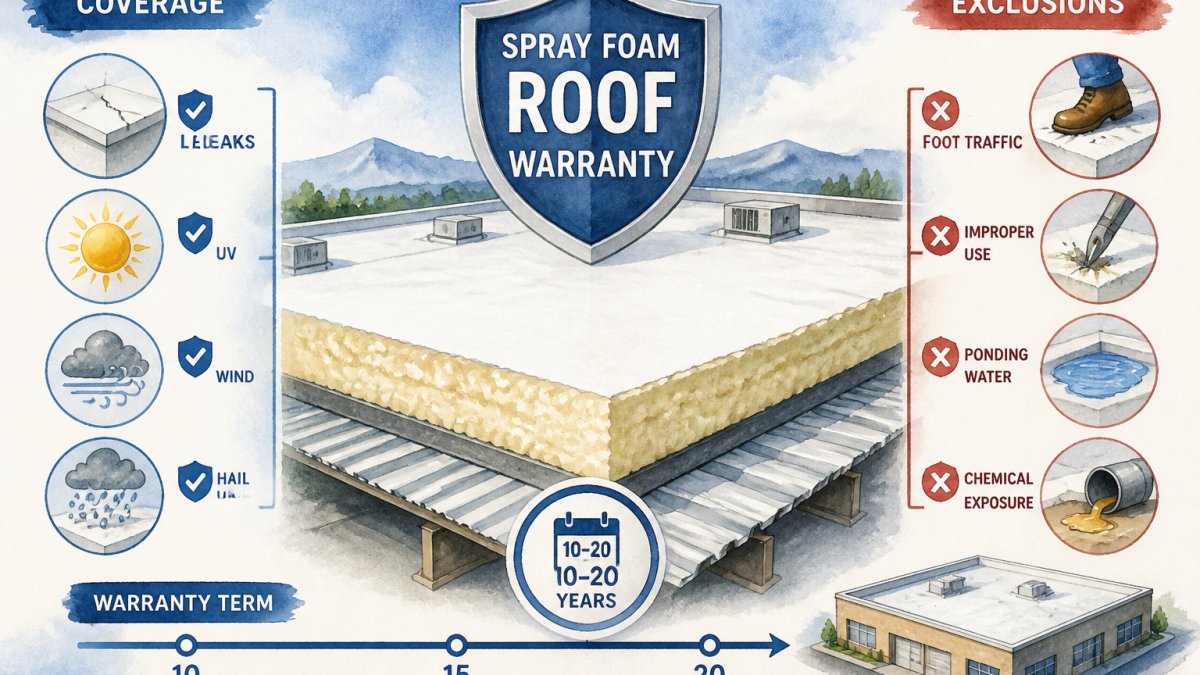
- Standard manufacturer warranties: 10 to 20 years for material performance
- Extended warranties: 25 to 30 years available from select manufacturers
- Lifetime warranty claims: Often conditional on maintenance, proper installation, and regular inspections
"Lifetime warranty" usually means as long as you own the property, not forever, and is often tied to maintenance requirements; skipping inspections or required maintenance may void it.
When comparing spray foam roof warranty options, ask for the exact warranty document before signing; the written terms define what "lifetime" means for your roof.
Common Spray Foam Roof Warranty Exclusions and Limitations
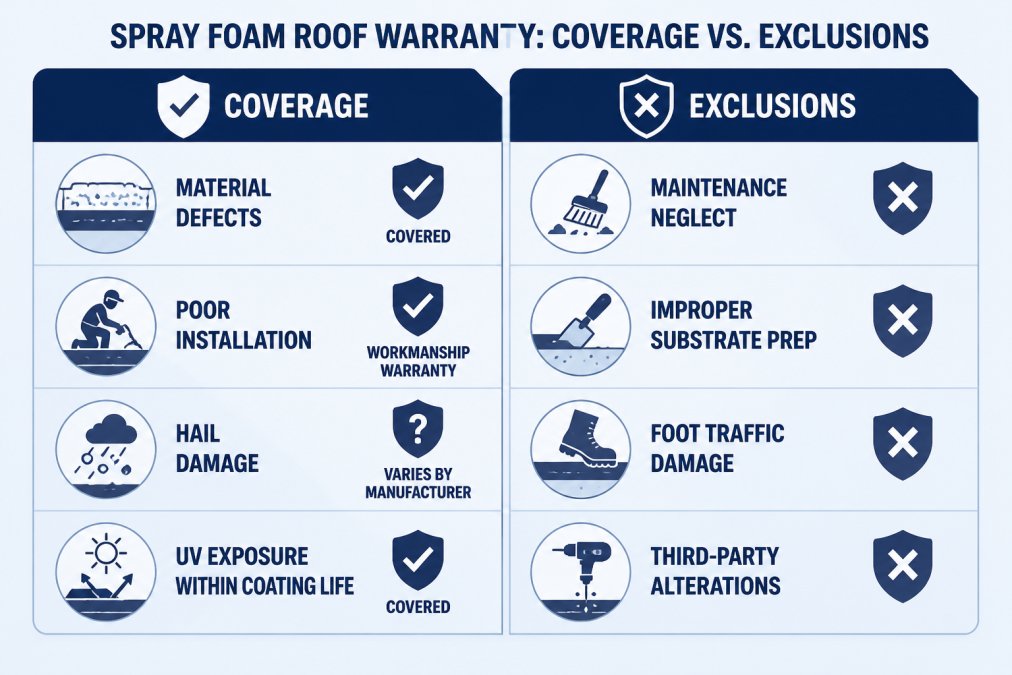
Exclusions are where warranties actually live: coverage language is short, while exclusions and conditions run for pages. Most denials trace back to a few recurring patterns.
The Two Warranties Behind Every Claim
Before looking at any exclusion, identify which warranty you are claiming against, because the exclusions differ.
- Manufacturer material warranty: Covers defects in the foam and coating as supplied. Excludes anything caused by installation, maintenance, or external damage.
- Contractor workmanship warranty: Covers installation errors such as inadequate thickness, missed seams, poor substrate prep, or improper coating application. Excludes material defects and owner-caused damage.
Naming the wrong warranty is a common reason for denial. If the foam is fine but the coating was applied too thin, that is a workmanship claim; if the coating was applied correctly but failed prematurely, that is a material claim.
Exclusions That Show Up in Most Spray Foam Roof Warranties
- Failure to perform required maintenance. Most warranties specify an inspection cadence, often annual, and a recoating cycle, often every 10 to 15 years. Miss either and the manufacturer has grounds to deny.
- Improper substrate preparation. If the deck was not cleaned, dried, or primed per the manufacturer's written instructions, defects traced to that prep are excluded.
- Damage from foot traffic or equipment. Foam and coating are not designed to be walked on without protection. Damage from HVAC service, satellite installs, or routine traffic is typically excluded.
Claim-Denial Scenarios You Can Avoid
These patterns most often end in a denied claim, along with what prevents them.
Scenario 4: The undocumented install. Without the original warranty document, installer certification, or completion inspection, the manufacturer cannot verify the installation met its standards.
Scenario 5: The wrong-party claim. The owner files a material claim for an installation defect, or vice versa, and the claim bounces between parties while time passes.
Limitations That Are Not Exclusions
Some limits function like exclusions without being framed as such:
- Proration. Some material warranties pay a declining percentage of the original cost as the roof ages. A 20-year prorated warranty may pay very little in year 18.
- Labor. Many material warranties cover the replacement material but not the labor to install it. Labor can exceed material cost on a foam roof.
- Single-source obligations. Some warranties require that all materials, including coating, come from the same manufacturer. Substituting a different coating can void coverage.
Read the limitations section as carefully as the exclusions; together they define what you actually have.
How Spray Foam Roofing Warranty Differs from Shingle Warranties
Three warranties get tangled together in most spray foam conversations, and mixing them up leads property owners to assume coverage they do not have. Sort your project into one of these buckets first:
- Spray foam roofing warranty: The foam is the finished roof surface, topped with a protective coating. The warranty covers the foam-and-coating assembly as a roof system.
- Spray foam insulation warranty: The foam is hidden inside an attic, wall cavity, or under an existing roof deck. The warranty covers thermal performance and material integrity, not watertightness.
- Existing shingle warranty: A separate policy issued by the shingle manufacturer that governs the shingles already on your roof. Spray foam work does not transfer into this warranty, and it can affect it.
If you cannot say which applies to your project, confirm it in writing before signing anything.
Spray Foam Roofing vs. Spray Foam Insulation Warranties
These are not interchangeable, even when the same contractor installs both.
A spray foam roofing warranty is a system warranty covering adhesion to the substrate, coating integrity, UV resistance, and the watertight seal.
A spray foam insulation warranty is a performance warranty covering settled thickness, R-value retention, and off-gassing or shrinkage defects.
Property owners often read 'lifetime' on an insulation warranty and assume their roof surface is covered for life.
Spray Foam Roofing vs. Asphalt Shingle Warranties
Asphalt shingle warranties and spray foam roofing warranties are built on different assumptions.
A typical asphalt shingle warranty covers the shingles against manufacturing defects such as cracking, curling, or premature granule loss.
A spray foam roofing warranty covers the roof as an assembly: the foam, the coating, and the seams and transitions the installer details.
The trade is different: shingle warranties are narrower but lighter on maintenance, while spray foam roofing warranties are broader but heavier on maintenance.
Does Spray Foam Void an Existing Shingle Warranty?
The honest answer depends on the shingle manufacturer and how the foam is applied.
Three outcomes are common:
- The shingle warranty stays intact. Some manufacturers allow foam applied over their shingles if specific conditions are met, such as a compatible primer, a minimum foam thickness, and installation by an approved applicator. In these cases the shingle warranty may remain in force for the shingles themselves, even though the foam is now the weathering surface.
- The shingle warranty is voided for the covered area. Many manufacturers treat any covering applied over their shingles as an alteration that voids the warranty on the affected sections. The rest of the roof may remain covered.
- The shingle warranty is unaffected because it already expired or was never registered. If the original warranty lapsed, there is nothing left to void, and the question becomes moot.
There is no universal rule. Read the shingle manufacturer's written warranty and, if unclear, request written confirmation before work begins; verbal assurances from a contractor are not a substitute.
Look up your shingle manufacturer's written warranty terms
What to Confirm in Writing Before Foam Goes Over Shingles
If you are considering foam over an existing shingle roof, get these four items documented before the first spray:
- The shingle manufacturer's written position on foam applied over their product, including any conditions.
- The foam manufacturer's written confirmation that their roofing warranty can be issued over a shingle substrate.
- The contractor's workmanship warranty, in writing, covering the foam application and any prep work on the shingles.
If any of those four cannot be produced in writing, treat the warranty as unverified, not an automatic reason to walk away, but a reason to price the risk into your decision.
Steps to Verify Your Spray Foam Roof Warranty Before Installation
Before committing to a spray foam roofing project, verify exactly what warranty coverage you'll receive. This process protects your investment and prevents misunderstandings.
Step 1: Request the full warranty document in writing. Do not rely on verbal promises or marketing materials.
Step 2: Identify the manufacturer and product line. Coverage terms differ by manufacturer.
Step 6: Get a written estimate that references the warranty. It should specify warranty length, coverage type, and conditions, creating a record if disputes arise later.
Spray Foam Roofing Warranty Claim Checklist and Documentation
When filing a spray foam roof warranty claim, documentation determines whether it succeeds or gets denied. Follow this checklist to preserve your coverage.
Before a problem occurs:
- Keep all warranty documents and contractor invoices in a safe place
- Photograph your roof after installation and annually thereafter
- Document all inspections, maintenance, and repairs with dates and descriptions
When you discover a problem:
- Take clear photographs of the damage from multiple angles
- Document the date you discovered the problem
- Note weather conditions or events that may have caused the damage
When filing the claim:
- Provide the warranty document and proof of coverage
- Submit photographs and detailed descriptions of the damage
- Include documentation of all maintenance you performed
- Provide copies of inspection reports and service records
After submitting the claim:
- Request written confirmation that the claim was received
- Follow up if you don't hear back within the specified timeframe
- Document all communications with the warranty provider
- Do not authorize repairs until the claim is resolved
The most successful claims include thorough maintenance documentation and a clear timeline of when the problem appeared; vague descriptions or missing records make claims harder to prove.
Maintenance Requirements to Preserve Your Warranty
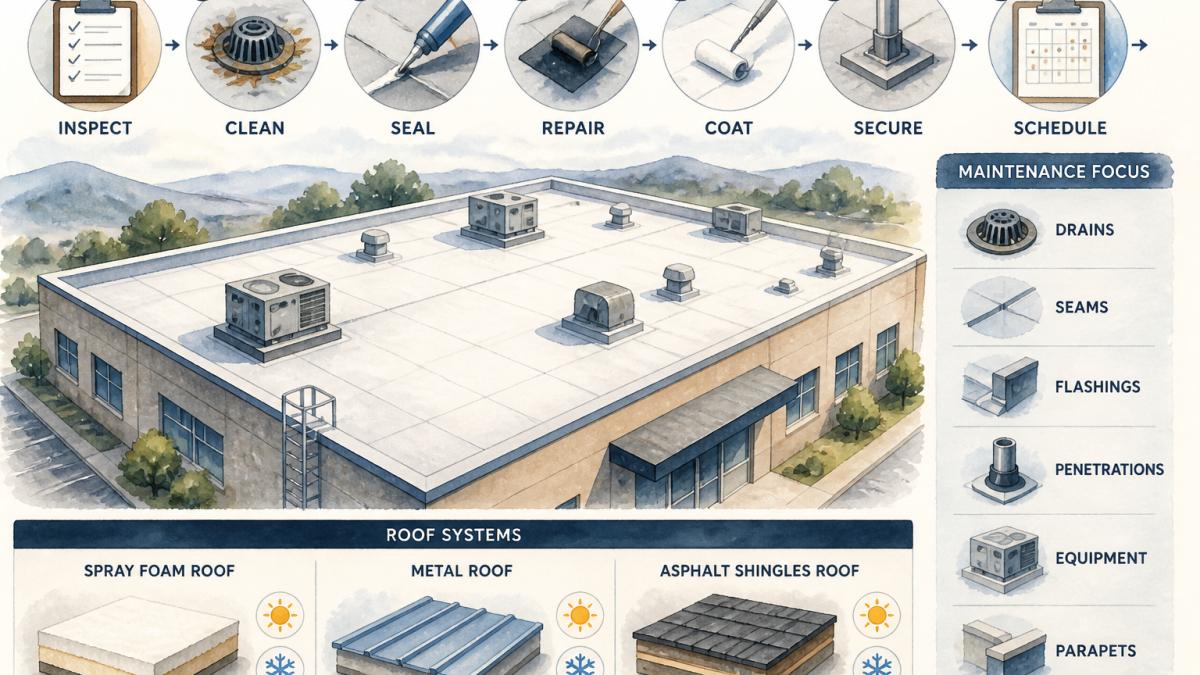
Typical requirements include annual inspections, debris removal, and fixing small problems before they grow. Most spray foam roof warranties require:
Annual inspections: Schedule a professional inspection yearly to catch early wear, coating degradation, or moisture intrusion. Problems caught early are usually covered; ignored ones may void the warranty.
Debris removal: Keep leaves, branches, and standing water off the roof.
Protective coatings: Many spray foam roofs require recoating every 10 to 15 years.
Regular maintenance extends your roof's life and protects your warranty investment.
Protecting your spray foam roof warranty requires understanding coverage details, following maintenance schedules, and documenting everything.
Our team has over 25 years of experience installing spray foam roofing systems that stay protected.
Frequently Asked Questions
Does spray foam void an existing shingle roof warranty?
Spray foam roofing applied over existing shingles can void the original shingle manufacturer's warranty if the installation alters the roof structure or ventilation. However, the spray foam roof warranty covers the new system. Before installation, confirm in writing with your contractor and the foam manufacturer whether the existing shingle warranty will be affected. Some systems are designed to work with shingles intact; others require complete removal. Always get warranty documentation before work begins.
What does a spray foam roof warranty typically cover?
Spray foam roof warranties typically cover material defects, workmanship errors, and performance failures related to water infiltration and thermal performance. Most cover the spray polyurethane foam (SPF) material itself, the protective coating, and sealing against leaks under normal use. Coverage usually includes defects in R-value retention and adhesion failure. Exclusions commonly include damage from hail, improper maintenance, UV exposure beyond the protective coating's lifespan, and installation errors caused by failure to follow manufacturer specifications or incorrect substrate preparation.
How long does a spray foam roof warranty last?
Spray foam roof warranties typically range from 10 to 20 years for material and workmanship coverage, depending on the manufacturer and system chosen. Some manufacturers offer renewable warranties that can extend coverage up to 30 years or longer if maintenance inspections and recoating schedules are followed. Lifetime warranties exist but usually require annual inspections and maintenance duties. Always verify the exact warranty period and any renewal conditions in your contract before installation to understand the full duration of protection.
What voids a spray foam roof warranty?
Common warranty voiding factors include failure to perform required maintenance inspections, improper roof substrate preparation before installation, installation by non-approved contractors, neglecting to repair damage promptly, applying incompatible coatings or sealers, and exposure to conditions outside the system's design parameters. Hail or severe storm damage may be excluded depending on the warranty type. Altering the roof assembly, failing to maintain proper attic ventilation, or allowing mold and moisture issues to persist can also void coverage. Review exclusions carefully and keep maintenance records to preserve your warranty eligibility.