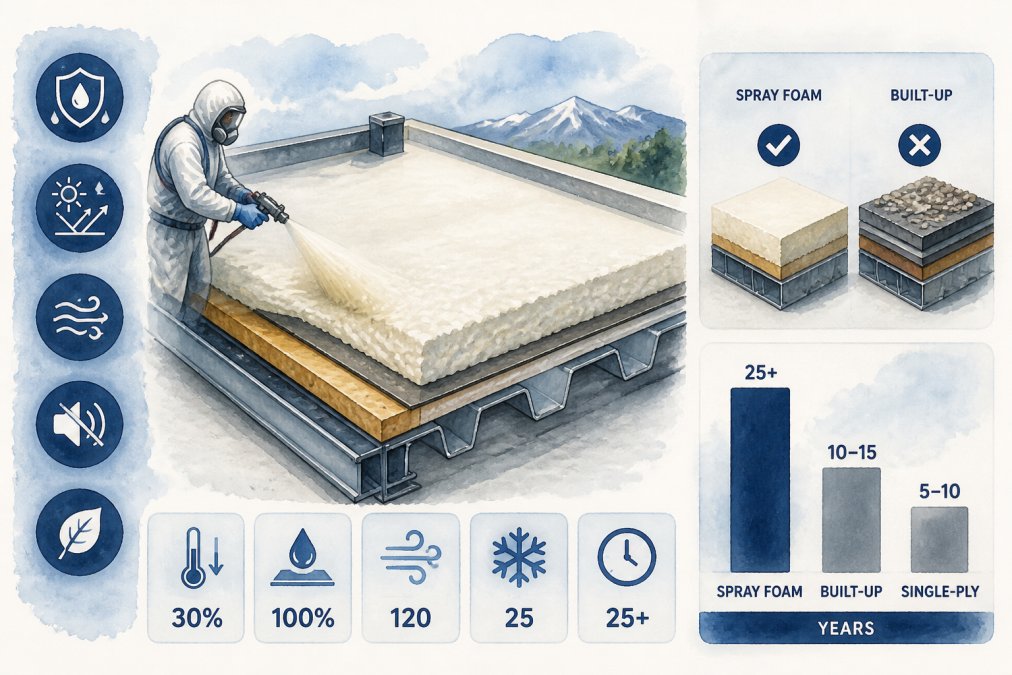
 ultimate-guide
Is Spray Foam Roofing Durable? 2026 Guide
Table of Contents
- How Durable Is Spray Foam Roofing? A Direct Answer
- Spray Foam Roof Lifespan: What to Expect
- Spray Foam Roofing Maintenance Schedule
- How to Clean Spray Foam Roof Coating
- Durability Factors: Wind, Hail, and UV Resistance
- Cost vs. Replacement: A Comparative ROI Analysis
- DIY vs. Professional Installation Risks
- Frequently Asked Questions
Last Updated: September 23, 2026
How Durable Is Spray Foam Roofing? A Direct Answer
Spray foam roofing is highly durable. Properly installed and recoated on schedule, a spray polyurethane foam system can protect a building for decades, outlasting many traditional roof membranes. This guide from Sun Flex Home Improvement breaks down what determines that durability, from hail and wind uplift to UV exposure and maintenance.
Spray Foam Roof Lifespan: What to Expect
A spray foam roof lifespan typically runs 20 to 30 years, and often longer, when the coating is maintained on a regular cycle. The foam itself does not "wear out" like shingles; what ages is the top coating that shields it from sunlight.
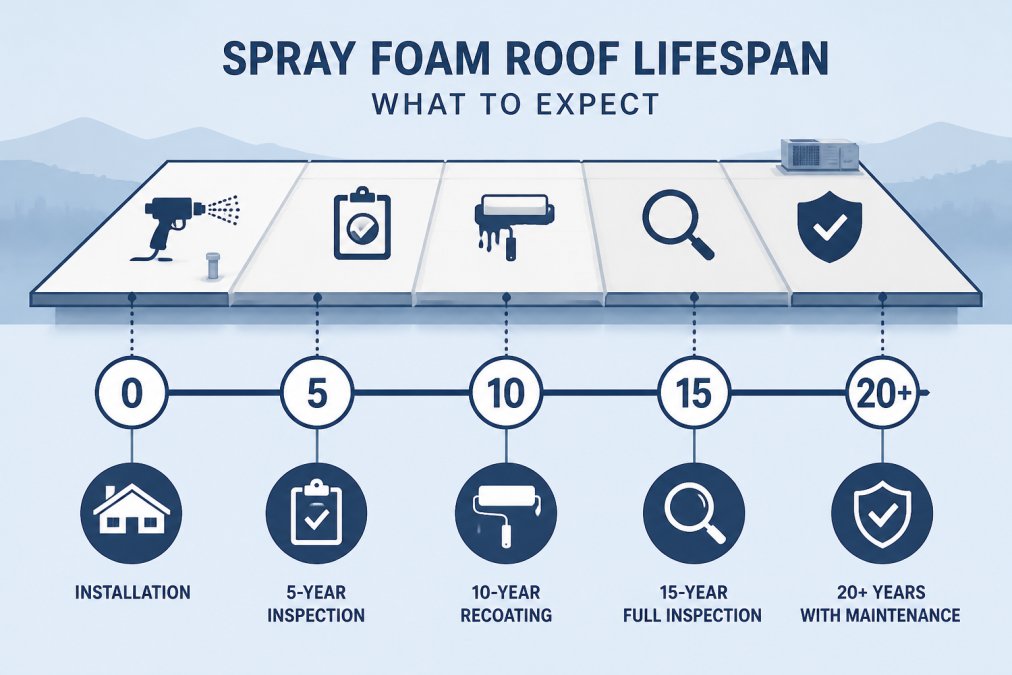
Here is how a well-maintained system progresses:
| Milestone | What Happens | Why It Matters |
|---|---|---|
| Initial installation | Foam applied, base coat and top coat added | Seals the substrate and blocks moisture |
| 5-year inspection | Coating checked for thinning, blistering, or ponding | Catches small issues before foam exposure |
| 10-year recoating | Fresh elastomeric coating applied | Restores UV resistance and reflective properties |
| 15-year full inspection | Full system review, flashing and seams checked | Confirms structural integrity holds |
| 20+ years | Continued recoat cycle | Extends service life well past most membranes |
Spray Foam Roofing Maintenance Schedule
A practical spray foam roofing maintenance schedule combines annual visual checks with recoating on a cycle driven by coating thickness, UV load, and foot traffic, not a fixed calendar. A roof in a high-UV, hail-prone region needs recoating sooner than one in a mild, low-traffic climate, even at the same specification.
| Interval | Action | What to Check |
|---|---|---|
| Annually | Visual inspection and drain clearing | Coating cracks, thinning, blisters, ponding, exposed foam, debris in drains and scuppers |
| Every 3 to 5 years | Professional coating-thickness assessment | Dry-film thickness (DFT) readings, seam and flashing integrity, substrate adhesion |
| Every 10 to 15 years | Full recoat | Apply a fresh elastomeric layer to restore UV resistance and reflectivity |
| After any major storm | Damage inspection | Hail bruising, punctures, lifted flashing, displaced gravel or debris |
Why the Recoat Interval Varies by Climate
A single national recoat interval is misleading. The two variables that move the schedule most are UV intensity and thermal cycling:
- Hot, high-UV climates: Acrylic coatings can chalk and thin faster under sustained sun, so recoating may land closer to the 10-year mark. Silicone coatings generally hold up longer under UV but can attract dirt, which reduces reflectivity over time.
- Cold, freeze-thaw climates: The coating and foam expand and contract with temperature swings. That cycling stresses the coating at flashings, penetrations, and parapet edges first, so those details deserve a closer look at every inspection.
- Hail-prone regions: Impact bruising can compromise the coating without an obvious leak. A post-storm inspection is the only reliable way to catch it before water reaches the foam.
What Actually Happens During a Recoat
Recoating is not cosmetic. The process typically involves:
- Cleaning the existing coating to remove dirt, chalk, and contaminants that would prevent adhesion.
- Repairing any blisters, cracks, or exposed foam with compatible patching material.
- Reinforcing flashings, seams, and penetrations with fabric or mesh embedded in the coating.
- Applying a new elastomeric topcoat at the manufacturer's specified thickness, often with a reflective or cool-roof formulation.
Because the foam is not removed, recoating avoids tear-off, disposal, and landfill costs, the same reason restoration is cheaper than replacement.
Maintenance Cost Reality
Recoating costs a fraction of a full roof replacement, but it is not free. Pricing depends on roof size, coating type (acrylic vs. silicone), surface preparation, and local labor rates. Most contractors quote per square foot, typically well below the per-square-foot cost of a tear-off and new membrane. The only reliable number is a site-specific estimate after an inspection.
The Renewable Roof Advantage
A maintained SPF roof is often called a renewable roofing system because each recoat extends service life without removing the existing assembly. Over 30 years, an owner may recoat two or three times instead of replacing the roof once or twice. That is the durability case: the foam is the structural and insulating layer, and the coating is the sacrificial wear layer you renew on schedule.
How to Clean Spray Foam Roof Coating
Cleaning a spray foam roof coating is straightforward: remove debris, wash with mild detergent and water, and rinse thoroughly, avoiding harsh chemicals and high-pressure settings that damage the coating. The goal is to protect the coating, not scrub it bare.
Steps for cleaning:
- Clear leaves, branches, and debris from drains and low spots.
- Sweep or gently blow off loose dirt.
- Wash with a mild, coating-safe cleaner and a soft-bristle brush.
- Rinse with low pressure so you do not lift or tear the coating.
- Inspect afterward for any spots that need touch-up.
Durability Factors: Wind, Hail, and UV Resistance
Three forces decide how long a spray foam roof lasts: wind uplift, hail impact, and UV exposure. Spray foam handles all three well when specified correctly, but each has limits.
Cost vs. Replacement: A Comparative ROI Analysis
Spray foam restoration usually costs less than a full tear-off and replacement, but the more useful question is how the two compare over a 20- to 30-year horizon. That is where the ROI case lives.
The Three Cost Buckets
A fair comparison has to account for more than the invoice at installation:
| Cost Category | Spray Foam Restoration | Full Tear-Off and Replacement |
|---|---|---|
| Upfront installation | Foam applied over prepared substrate; no tear-off | Removal, disposal, new membrane, and labor |
| Disposal and landfill | Minimal, existing roof stays in place | Tear-off debris hauled and disposed |
| Maintenance over life | Recoat every 10-15 years | Repairs, then eventual full replacement |
| Energy demand | Seamless insulated layer reduces thermal bridging and air leakage | Depends on insulation and membrane type |
| End-of-life | Recoat again or spot-replace | Another full tear-off |
How to Think About Payback
Rather than quoting a single savings percentage, the more honest approach is to model payback in three steps:
- Establish the replacement baseline. Get a written quote for a full tear-off and new membrane, including disposal.
- Get a restoration quote. A spray foam restoration quote should specify foam thickness, coating type, and the recoat schedule assumed.
- Add energy savings. A seamless, insulated SPF layer reduces thermal bridging and air leakage. Actual savings depend on climate, building envelope, and HVAC system, so treat any figure as an estimate until a qualified contractor models it for your building.
Where the Numbers Get Compelling
Three building profiles tend to see the strongest ROI case:
- Large, low-slope commercial roofs where tear-off labor and disposal scale with square footage.
- Buildings with existing insulation that is still serviceable, since foam can be applied over a prepared substrate without disturbing it.
- Facilities with high cooling demand, where a reflective coating and reduced air leakage cut peak load.
What the ROI Case Does Not Cover
A fair analysis should also name the trade-offs:
- Coating maintenance is mandatory. The ROI assumes recoating on schedule. Skip it and the lifecycle math collapses.
- Substrate condition matters. If the existing roof deck or insulation is saturated or failing, restoration may not be viable, and replacement becomes the correct call.
- Not every building qualifies. Structural capacity, slope, and code requirements can rule out a foam overlay.
U.S. Department of Energy guidance on roofing and insulation
DIY vs. Professional Installation Risks
Spray foam roofing is not a DIY project. The equipment, safety requirements, and precision needed to apply foam at the correct thickness and ratio make professional installation the only realistic path to durability.
The risks of going it alone are concrete:
- Improper mixing produces foam that never cures to full compressive strength.
- Uneven thickness leaves thin spots that fail first under UV and impact.
- Poor substrate prep means the foam does not fully adhere, creating moisture paths.
- No warranty on a self-applied system, so any failure is entirely your cost.
OSHA standards for roofing and fall protection
Frequently Asked Questions
What are the disadvantages of a spray foam roof?
Spray foam roofing requires professional installation and regular maintenance to maintain its durability. It can be damaged by prolonged UV exposure if not properly coated, and some insurance companies have specific requirements for spray foam roofs. Additionally, while the initial cost may be higher than some alternatives, it often saves money over time by extending the roof's life and improving energy efficiency.
How long does spray foam last on a roof?
A properly maintained spray foam roof can last 20 to 30 years or more. The lifespan depends on factors like climate, maintenance frequency, and the quality of the initial installation. Regular inspections and timely recoating with an elastomeric coating are key to maximizing durability. In harsh climates with extreme temperature swings, hail, or heavy snow, more frequent maintenance may be needed to protect the foam and coating.
Is spray foam roofing a cost-effective solution for commercial buildings?
Yes, spray foam roofing is often a cost-effective solution for commercial buildings. It can extend the life of an existing roof by 20 years or more, avoiding the high cost of a full tear-off and replacement. The seamless, fully adhered foam also improves thermal insulation, which can reduce heating and cooling costs. For property managers, the ROI comes from both avoided replacement costs and ongoing energy savings.
What maintenance is required to ensure spray foam roof durability?
To ensure spray foam roof durability, schedule annual inspections to check for damage, debris, and coating wear. Clean the roof gently with water and a soft brush to remove dirt and debris. Reapply elastomeric coating every 10 to 15 years or as needed to protect against UV damage. Address any punctures or tears immediately to prevent moisture intrusion. Following a consistent maintenance schedule is essential for long-term performance.