 comparison
Roofing Solutions for Agricultural Buildings: 2026 Guide
Table of Contents
- Roofing Solutions for Agricultural Buildings: What Matters Most
- Comparison of Roofing Systems for Farm Structures
- Metal Roofing for Pole Barns and Large Agricultural Structures
- AG Panel Roofing: Cost-Effective Coverage for Farm Buildings
- Spray Foam Roofing for Agricultural Buildings: Restoration Without Replacement
- Farm Building Roof Insulation and Climate Performance
- Total Cost of Ownership: Initial Investment vs. Long-Term Durability
- Installation, Retrofit Compatibility, and Building-Specific Selection
- Frequently Asked Questions
Last Updated: October 7, 2026
Roofing Solutions for Agricultural Buildings: What Matters Most
Choosing the right roofing solution for agricultural buildings is one of the most consequential decisions a farm owner makes. The wrong choice costs thousands in repairs, energy waste, and premature replacement; the right one protects your investment for decades.
At Sun Flex Home Improvement, we've spent over 25 years helping property owners across Montana and Northern Wyoming select roofing solutions for agricultural buildings that deliver. Metal roofing still dominates, but spray foam restoration and membrane systems are now serious contenders where full replacement isn't feasible.
This guide breaks down the real differences between major roofing systems for agricultural buildings: what works for pole barns, what handles harsh regional weather, what saves money long-term, and what fits your budget.
Comparison of Roofing Systems for Farm Structures
Metal Roofing vs. Spray Foam vs. Membrane Systems
The three dominant roofing solutions for agricultural buildings each solve different problems: metal wins on durability and upfront cost-effectiveness, spray foam on restoration and energy efficiency, and membrane systems (TPO and EPDM) serve flat or low-slope structures.
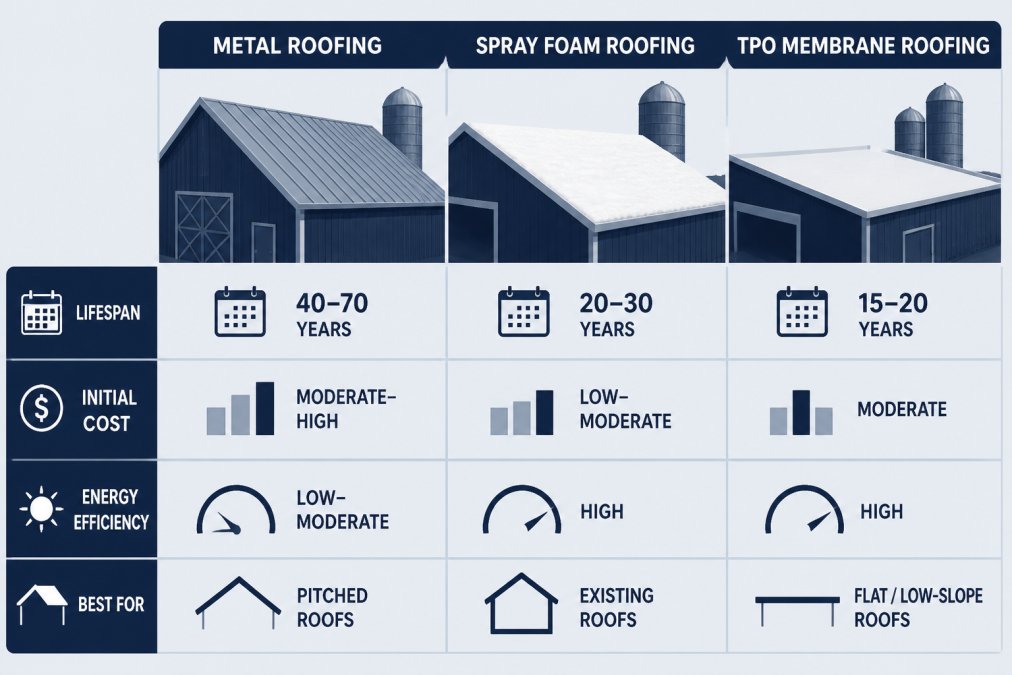
Metal roofing has been the agricultural standard for good reason: galvanized steel panels resist corrosion, handle snow, wind, and hail better than most alternatives, and install easily on new construction or retrofits.
Spray foam roofing solves a different problem: if your roof is aging but structurally sound, it creates a seamless, watertight barrier without tearing off the old roof, saving up to half the cost of a new roof with substantial energy efficiency gains.
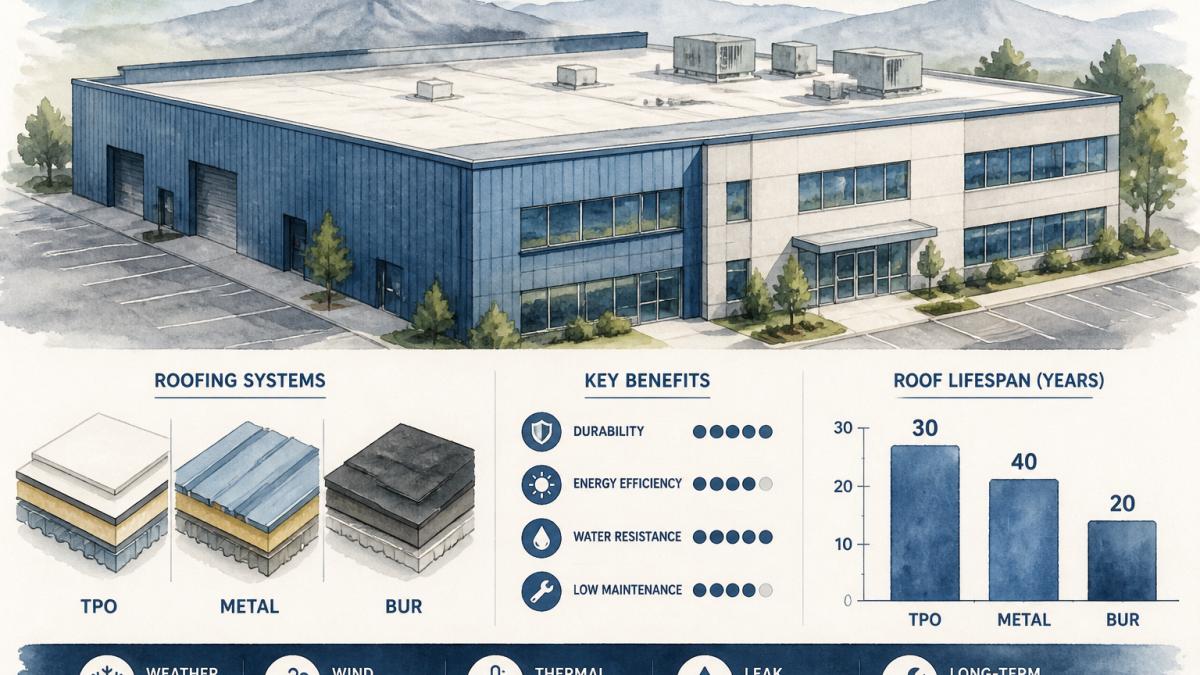
Membrane systems like TPO work best on flat or low-slope agricultural buildings. They're reflective, reducing cooling costs, and heat-welded seams create a watertight seal, but they require professional installation and don't handle steep pitches well.
| System | Lifespan | Initial Cost | Energy Efficiency | Best For |
|---|---|---|---|---|
| Metal Roofing | 40-70 years | Moderate-High | Low-Moderate | Large barns, pitched roofs |
| Spray Foam | 20-30 years | Low-Moderate | High | Existing roof restoration |
| TPO Membrane | 15-20 years | Moderate | High | Flat/low-slope structures |
| Asphalt Shingles | 15-25 years | Low | Low | Small sheds, secondary buildings |
Metal Roofing for Pole Barns and Large Agricultural Structures
Steel Panel Profiles and Durability
Metal roofing for pole barns comes in profiles designed for specific load and weather demands: 5V crimp panels have a V-shaped corrugation that increases load-bearing capacity, while standing seam panels overlap vertically and fasten along the seams, reducing fastener exposure.
Panel gauge matters more than most property owners realize. 26-gauge steel is standard for agricultural applications, thick enough to handle snow loads and wind pressure without excessive flexing. 29-gauge is lighter and cheaper but sacrifices durability in extreme weather, so 26-gauge is worth the investment in heavy snow or hail regions.
The real advantage of metal roofing for pole barns is predictable performance: engineered for rapid installation on large spans, a typical roof goes on in days, not weeks, with minimal maintenance.
Galvanized Steel and Corrosion Resistance
Galvanized steel is the industry standard for agricultural roofing. A zinc coating applied during manufacturing protects the steel from rust and corrosion, degrading over 20-40 years depending on climate exposure but buying decades of reliable performance.
In salt-exposure regions, galvanized coatings degrade faster and aluminized steel offers better corrosion resistance at higher cost, but for most agricultural applications in Montana and Northern Wyoming, galvanized steel delivers excellent value.
Galvanizing quality varies by manufacturer.
Corrosion resistance becomes critical in buildings housing livestock or storing fertilizers. Ammonia and other agricultural chemicals accelerate corrosion. Ensure your panel choice includes adequate coating thickness if chemical exposure is a factor.
AG Panel Roofing: Cost-Effective Coverage for Farm Buildings
Corrugated Metal Panels and Load-Bearing Capacity
Load-bearing capacity depends on panel profile, gauge, and span distance. Verify the snow load rating for your region before selecting panels, since Northern Wyoming and Montana winters make load capacity a direct factor in whether your roof survives the season.
Installation labor costs are lower with corrugated panels than standing seam systems, making AG panel roofing attractive for large buildings where material and labor add up fast.
The trade-off is aesthetic. Corrugated panels look utilitarian, fine for barns and storage buildings but industrial for structures near residential areas. If appearance matters, standing seam or other metal profiles offer a more finished look.
Spray Foam Roofing for Agricultural Buildings: Restoration Without Replacement
Energy Efficiency and Seamless Protection
Spray foam roofing transforms an aging roof into a seamless, insulated envelope without removing the existing structure.
Energy efficiency gains are substantial. Spray foam has an R-value of roughly 6-7 per inch, so a 2-inch application adds R-12 to R-14 directly to the roof deck (Spray Polyurethane Foam Product Types | Safer Choice).
The seamless design eliminates the most common source of roof leaks: fastener holes and seam failures. Traditional systems rely on sealants that fail over time, while spray foam creates a monolithic surface water cannot penetrate.
Sun Flex Home Improvement specializes in spray foam roofing restoration for agricultural buildings across Montana and Northern Wyoming. The process takes 1-2 days for most structures versus weeks for full replacement, and property owners can continue operations with minimal disruption.
Extending Roof Life and Avoiding Full Replacement
Most property owners don't need a new roof; they need their current roof to last another decade or two while they save for eventual replacement. Spray foam roofing delivers exactly that.
A typical spray foam roof lasts 20-30 years before re-coating or replacement. The original roof structure remains intact underneath, so when the foam eventually needs attention, the underlying roof is still sound.
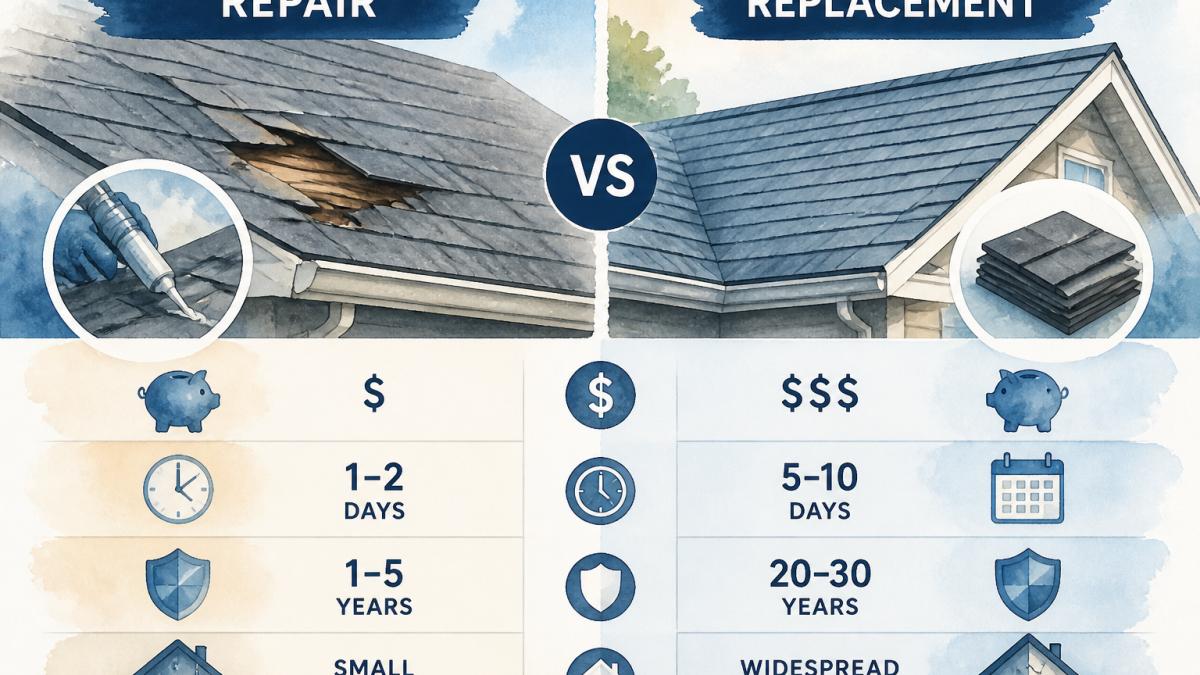
Avoiding full replacement matters financially and operationally: a complete roof replacement on a large agricultural building costs tens of thousands of dollars, disrupts operations, requires temporary closures, and adds disposal costs. Spray foam restoration eliminates these headaches for two decades.
The common objection is durability in harsh climates, but spray foam handles Northern Wyoming and Montana hail, wind, and temperature extremes well. The foam is impact-resistant, and the protective topcoat adds another layer.
Farm Building Roof Insulation and Climate Performance
Weather Resistance in Harsh Regional Conditions
Agricultural buildings in Montana and Northern Wyoming face heavy snow, wind gusts exceeding 60 mph, hail, and temperature swings from -20°F to 95°F. Roofing solutions must handle all of these without failure.
Metal roofing handles snow load well. The smooth surface lets snow slide off rather than accumulate, reducing structural stress and preventing ice dams.
Wind resistance depends on fastening: properly fastened metal panels resist winds exceeding 150 mph, and undersized or incorrect fasteners are the most common cause of wind failure.
Hail protection is a legitimate concern in Northern Wyoming. Large hail can dent metal panels but rarely creates leaks, while spray foam and membrane systems are more vulnerable to puncture.
According to the National Weather Service severe weather database, agricultural regions in Montana and Northern Wyoming experience hail events averaging 2-3 times per year.
Ventilation, Condensation, and Livestock Protection
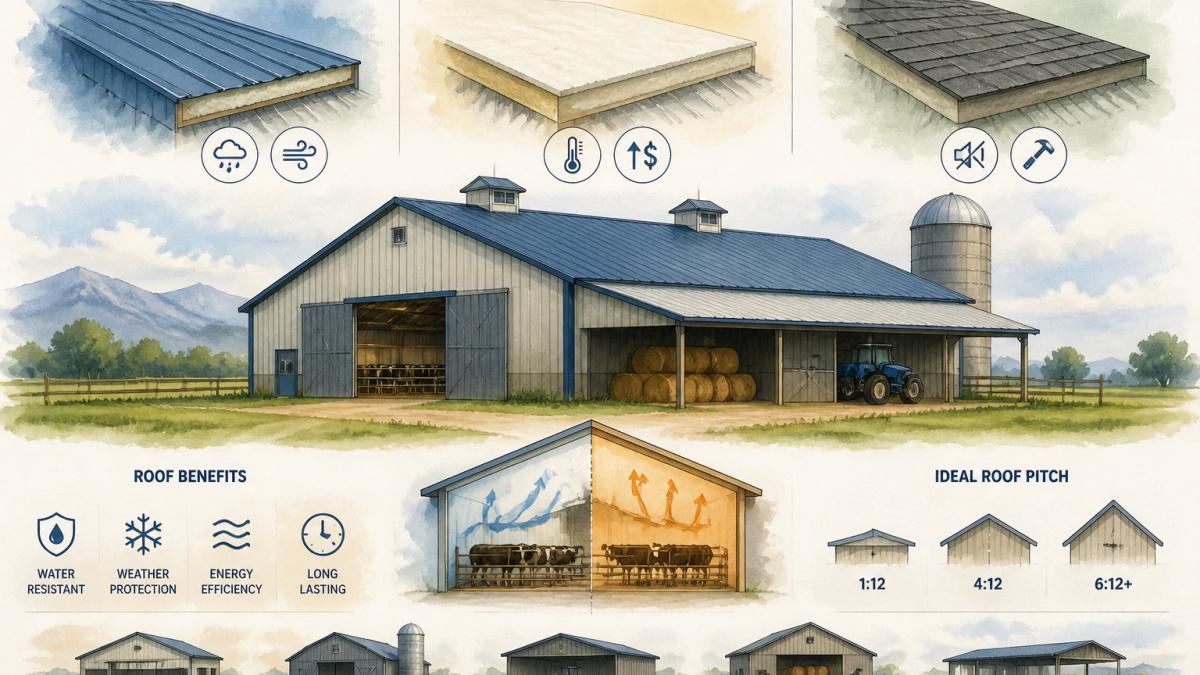
Livestock buildings present unique roofing challenges. Moisture from animal respiration, manure decomposition, and water use creates humid conditions inside. Without proper ventilation, it condenses on the roof and drips back in, promoting mold, disease, and structural rot.
Ventilation design must work with the roofing system, not against it: metal roofing allows ventilation channels between roof and insulation, spray foam creates a sealed envelope requiring ventilation designed into the structure separately, and TPO membranes suit low-slope buildings where ventilation is already limited.
Condensation control is critical for livestock health. Moisture promotes respiratory disease in cattle and poultry. A properly ventilated building with adequate air exchange prevents condensation buildup. The roofing system should support, not hinder, this ventilation.
For dairy barns, poultry houses, and other livestock structures, metal roofing with proper ventilation design is preferred: its durability handles the corrosive environment of animal operations.
Total Cost of Ownership: Initial Investment vs. Long-Term Durability
Service Life and Maintenance Requirements
The cheapest roofing material upfront is rarely the cheapest over time. Asphalt shingles cost less to install but require replacement every 15-25 years. Metal roofing costs more initially but lasts 40-70 years with minimal maintenance. Over a 50-year building lifespan, metal roofing is dramatically cheaper.
Maintenance costs vary by system: metal roofing needs occasional inspection and fastener checks, spray foam needs re-coating every 10-15 years (far cheaper than replacement), and membrane systems need regular seam inspection and patching.
Manufacturer service life projections are conservative. Real-world performance in agricultural settings often exceeds published estimates: metal roofing installed 30 years ago on Montana farms is still performing, while asphalt shingles from the same era are long gone.
The decision framework is simple: calculate total cost over your expected building lifespan, not just installation cost. A $50,000 metal roof lasting 60 years costs $833 per year.
Installation, Retrofit Compatibility, and Building-Specific Selection
New Construction vs. Existing Metal Roof Retrofit
Retrofitting existing metal roofs presents different constraints: the existing structure determines what's possible.
Compatibility matters more than most property owners realize.
Metal roofing retrofit requires removing the old roof. It's labor-intensive and disruptive but gives a clean slate, letting the new roof be designed optimally for the building's use and climate.
TPO membrane retrofit works on existing low-slope roofs if the deck is sound, installed over the existing roof like spray foam.
For agricultural buildings, building type determines the best approach.
The research from the Agricultural Building Research Council indicates that roofing failure is the leading cause of structural damage in agricultural buildings. Proper material selection and installation prevent this outcome entirely.
Choosing roofing solutions for agricultural buildings requires balancing durability, cost, climate performance, and building-specific needs.
Sun Flex Home Improvement has helped property owners across Montana and Northern Wyoming select and install the right roofing system for their buildings. We specialize in spray foam roofing restoration, which can save property owners up to half the cost of a new roof while extending roof life and improving energy efficiency.
Frequently Asked Questions
What is the best roofing material for a pole barn?
Metal roofing and AG panel systems dominate pole barn applications because they handle large spans without interior support, resist severe weather, and last 40-60 years. Spray foam roofing works well if you're restoring an existing metal roof and want to improve energy efficiency without full replacement. The choice depends on your climate, budget, and whether you're building new or retrofitting an existing structure.
Can spray foam roofing be applied over an existing metal roof?
Yes. Spray foam roofing for agricultural buildings bonds directly to existing metal roofs, creating a seamless, waterproof membrane. This approach extends the life of your current roof by 15-20 years, eliminates the cost and disruption of removal, and improves insulation. The existing metal roof becomes the structural base, and the foam fills gaps, seals seams, and provides a protective topcoat.
How much can spray foam roofing save compared to full roof replacement?
Spray foam restoration typically costs 40-50% less than complete roof replacement because you avoid removal, disposal, and structural work. Actual savings depend on your roof size, condition, and labor costs in your region. Contact Sun Flex Home Improvement for a free estimate on your specific building to get an accurate comparison for your property.
What is an AG panel roof, and when should I use it?
AG panel roofing refers to corrugated or 5V crimp metal panels engineered specifically for agricultural structures. These panels offer excellent load-bearing capacity for snow and wind, resist corrosion with galvanized or coated finishes, and install quickly on large barns and storage buildings. AG panels are ideal for new construction or full replacement when you need durability, affordability, and rapid installation.
Will spray foam roofing handle hail damage in harsh climates?
Spray foam roofing provides impact resistance through its closed-cell density and flexibility, but extreme hail can still cause damage. However, minor hail dents in foam are less problematic than punctures in single-ply membranes because the foam seals itself. Discuss your local weather patterns with a roofing specialist to select the best option for your climate.