 comparison
Ampco Construction vs Big Horn Roofing: 2026 Comparison
Table of Contents
- Ampco Construction vs Big Horn Roofing: Side-by-Side Comparison
- Service Areas and Regional Licensing
- Materials and Workmanship: Cold Roof vs Shingle Installation
- How to Evaluate Roofing Contractor Estimates
- Signs of a Reputable Roofing Company
- Warranty, Guarantee, and Customer Reviews
- Which Contractor Fits Your Project?
- Conclusion
- Frequently Asked Questions
Last Updated: September 21, 2026
Ampco Construction vs Big Horn Roofing: Side-by-Side Comparison
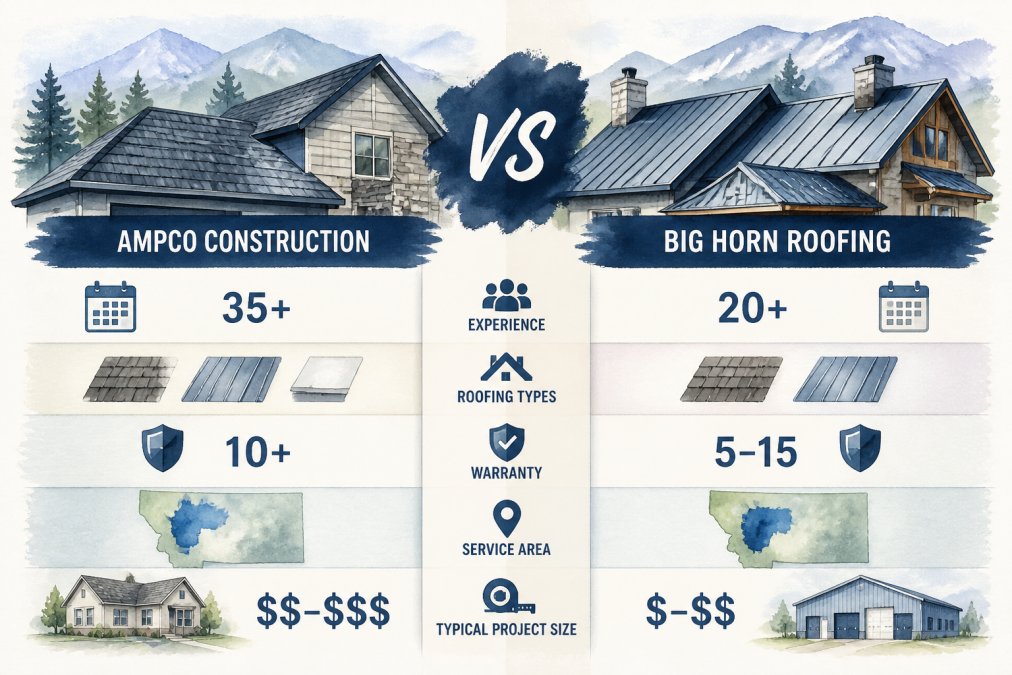
The two names sound interchangeable in a search bar, but they are not the same kind of company. Ampco Construction is a Western Montana roofing contractor whose public positioning centers on cold roof installation and storm damage restoration. Big Horn Roofing is a locally owned and operated roofing company that emphasizes personalized service and bundled incentives, such as gutter work added to a replacement. Neither is a national franchise, and neither publishes a multi-state footprint, so the practical question is which one matches your building, your climate, and your timeline.
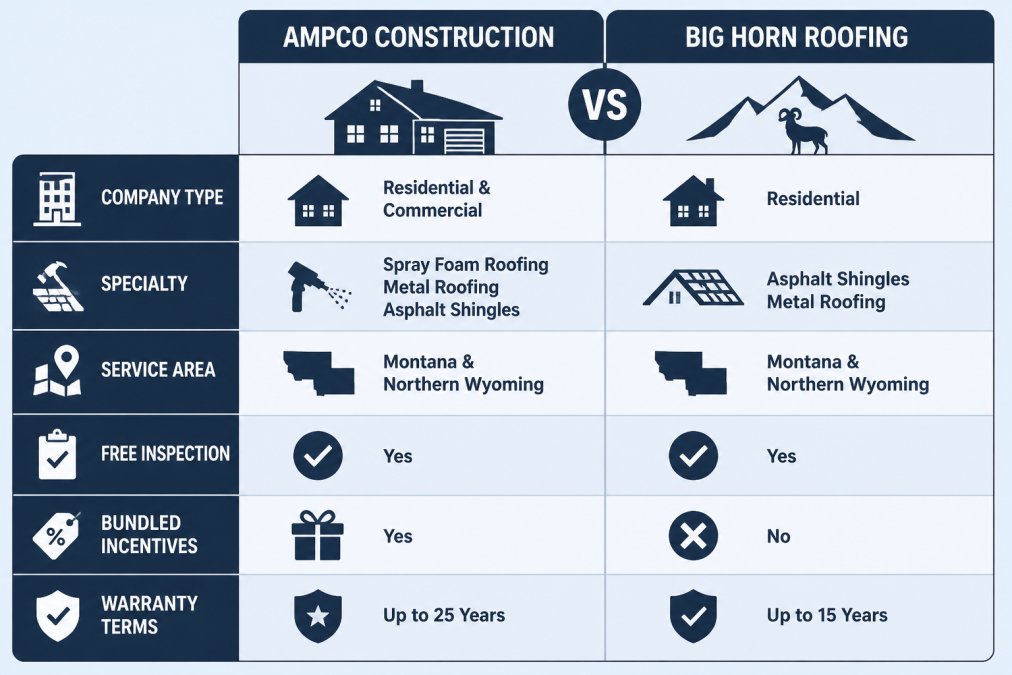
| Feature | Ampco Construction | Big Horn Roofing |
|---|---|---|
| Company type | Regional roofing contractor | Locally owned and operated roofer |
| Stated specialty | Cold roof installation, storm damage restoration | Residential installation and repair |
| Service area | Western Montana | Local/regional footprint, not multi-state |
| Free inspection | Yes | Not published |
| Bundled incentives | Not published | Gutter and exterior add-ons with replacement |
| Warranty terms | Not published | Not published |
| Best fit | Snow-country roofs that need ice-dam prevention | Homeowners who want a local, relationship-driven roofer |
How to read this table
Two columns of "not published" are not a knock on either company, most regional roofers simply do not post warranty language or inspection policies online. Treat the blanks as questions to ask on the first call, not as red flags. The cells that matter most are company type and stated specialty, because those determine whether the crew that shows up has actually built the roof system your building needs.
The third option worth pricing
If your goal is to avoid a full tear-off, spray foam roofing restoration is a category neither of the two companies above is positioned around. It reseals an existing roof deck rather than replacing it, which is why property owners in snow and hail country often price it alongside a traditional replacement bid. Get quotes from all three paths, cold roof, shingle replacement, and restoration, before you commit.
Service Areas and Regional Licensing
Ampco Construction serves Western Montana. Big Horn Roofing operates as a locally owned business without a published multi-state footprint. If your property sits outside those boundaries, neither may be able to help, and that is the first thing to confirm, because a roofer who has to travel across a state line to reach you will price the drive into the bid.
What "licensed" actually means for a roofer
Roofing licensing is handled at the state and local level, and the rules are not uniform. In many states, a general contractor registration or a residential contractor license covers roofing work; in others, roofing is a separately endorsed trade. Some jurisdictions require only a business registration and proof of insurance, with no trade exam at all. That patchwork is why "we're licensed" is not a complete answer, you need to know which credential, issued by whom, and whether it is current for your address.
A credential checklist you can run in ten minutes
This is the due-diligence step most comparison pages skip. Work through it before you sign anything:
- License or registration number. Ask for the number, not just a yes/no. Then look it up in your state's contractor licensing database or your county/city building department registry.
- General liability insurance. Request a certificate of insurance (COI) naming the policy limits and effective dates, and call the carrier to confirm it is active.
- Workers' compensation. Ask whether the crew is covered by the company's policy or whether subs carry their own. If a worker is injured on your property and there is no coverage, the exposure can land on you.
- Physical local presence. A verifiable business address and a phone number that reaches a person, not just a lead-capture form, are basic signals.
- Permit history. Ask who pulls the roofing permit. A contractor who routinely asks the homeowner to pull it is shifting liability onto you.
Why the state line matters
A contractor authorized in one state is not automatically authorized in the next. If your property sits near a border, confirm the license is valid for the specific address where the work happens, not just for the company's home office. This is the single most common gap homeowners miss when comparing two similarly named regional roofers.
FTC guidance on hiring a contractor covers the consumer-protection side, large upfront deposits, same-day pressure, and other red flags to weigh alongside the credential check.
Materials and Workmanship: Cold Roof vs Shingle Installation
Ampco Construction specializes in cold roof systems built for high-snow environments. Big Horn Roofing focuses on residential shingle installation and repair. Neither is a wrong choice, but the material should match your climate and budget.
Cold roof design keeps the roof deck cold so snow does not melt and refreeze at the eaves.
Benefits of Metal Roof Snow Shedding
Metal roofing lets snow slide off in sheets instead of accumulating. That reduces the load on your structure and lowers the risk of ice dams. The tradeoff is that snow can drop suddenly, so you need guards over walkways and doors.
How to Evaluate Roofing Contractor Estimates
A good roofing estimate is itemized, written, and specific. It should list materials, labor, disposal of old roofing, and a timeline. If a bid is a single number on a business card, walk away.
Ask these questions before you compare quotes:
- What roofing materials are specified, and why?
- Is debris removal and disposal included?
- What is the payment schedule, and is a deposit required?
- Does the estimate include flashing repair and underlayment replacement?
- What happens if hidden damage is found once work begins?
Signs of a Reputable Roofing Company
A reputable roofer carries proper licensing, provides written estimates, and can show references from recent local jobs. They inspect before they quote. They explain the difference between a repair and a replacement instead of pushing the bigger job.
Watch for these signals:
- They offer a free inspection and put findings in writing.
- They carry current liability and workers' compensation insurance.
- They provide a workmanship warranty in addition to a manufacturer warranty.
- They have a physical local presence and verifiable reviews.
- They never demand full payment before work starts.
Warranty, Guarantee, and Customer Reviews
Warranties fall into two categories. A manufacturer warranty covers the roofing materials. A workmanship warranty covers installation errors, which is where most leaks originate. Ask for both in writing and confirm what voids them.
Which Contractor Fits Your Project?
Pick Ampco Construction if you need a specialized cold roof system in Western Montana and want a contractor focused on snow-country performance. Pick Big Horn Roofing if you want a locally owned roofer with bundled incentives like gutter installation on a replacement.
Conclusion
Every roofing decision comes with a tradeoff between upfront cost and long-term protection. The right contractor is the one whose specialty matches your climate, your building type, and your budget. Sun Flex Home Improvement brings over 25 years of experience, spray foam restoration that can cut costs by up to half versus replacement, and a watertight barrier designed for Montana and Northern Wyoming weather.
Frequently Asked Questions
What should I look for when comparing local roofing contractors?
Check service area, licensing, insurance, and material options. Ampco Construction serves Western Montana with cold roof systems, while Big Horn Roofing operates locally with bundled gutter offers. Sun Flex Home Improvement covers Montana and Northern Wyoming with spray foam and metal roofing. Verify each contractor's credentials and ask for references from projects similar to yours. A free inspection helps clarify which contractor's approach fits your roof's condition and climate.
How do I verify the licensing and insurance of a roofing company?
Ask for the contractor's license number and proof of general liability and workers' compensation insurance. In Montana and Wyoming, you can check with the state contractor licensing board or the Secretary of State's office. BBB accreditation is another indicator. Sun Flex Home Improvement is a BBB Accredited Business. Always request a certificate of insurance directly from the insurer, not just a photocopy, to confirm coverage is active.
What are the benefits of metal roof snow shedding in high-altitude climates?
Metal roofs shed snow faster than shingles, reducing the risk of ice dams and structural overload. In Montana and Northern Wyoming, where snow loads are heavy, this can prevent leaks and extend roof life. Metal panels also reflect heat, improving energy efficiency. However, snow shedding requires proper snow guards to protect gutters and walkways. Ask your contractor about snow guard placement and whether metal or spray foam better suits your building's pitch and use.
How do I determine if a roofing quote is fair and accurate?
Compare line items: materials, labor, tear-off, disposal, and permits. A fair quote specifies underlayment, flashing, and ventilation details. Be wary of estimates that are vague or much lower than others. Ask for a written scope and timeline. Sun Flex Home Improvement offers free estimates, and you can use their quote as a baseline. Check if the quote includes a workmanship warranty and whether it covers code compliance.
What questions should I ask before hiring a residential roofing contractor?
Ask about their experience with your roofing material, local building codes, and how they handle storm damage restoration. Request references from recent projects in your area. Confirm they carry insurance and offer a written warranty. Ask if they perform free inspections and provide a detailed estimate. For spray foam or metal roofing, ask about ventilation and snow shedding. Sun Flex Home Improvement has over 25 years of experience and serves Montana and Northern Wyoming.