 comparison
Is Metal Roofing Fire Resistant? What Ratings Mean
Last Updated: November 4, 2026
Quick Summary
Metal roofing is generally noncombustible, so the panels themselves do not burn, but the true fire resistance of metal roofing fire resistant performance depends on the complete tested assembly. Roofs earn Class A, B, or C ratings based on standardized fire tests of the whole system, including underlayment, decking, and fasteners.
- Metal panels are noncombustible, meaning they do not ignite or add fuel to a fire.
- Class A offers the highest external fire protection, Class B moderate, and Class C the least.
- Ratings apply to the complete roof assembly, not the panel alone, so confirm the listing matches your job.
- Substituting a cheaper underlayment can change the rating you paid for; verify every component.
Table of Contents
- Is Metal Roofing Fire Resistant by Default?
- How Fire Ratings for Roofing Are Defined: Class A, B, and C
- Panel Rating vs. Complete Roof Assembly Rating
- How Roofing Materials Are Tested for Fire Performance
- Best Fire Resistant Roofing Material: How Metal Compares
- Best Class A Fire Rated Roofing Material and Are Asphalt Shingles Fire-Resistant?
- What a Metal Roof Costs and How Fire Performance Affects Value
- Next Steps: Getting a Fire-Rated Roof Assessment for Your Property
- Frequently Asked Questions
Is Metal Roofing Fire Resistant by Default?
Metal roofing is generally considered noncombustible, which is why many homeowners ask whether metal roofing fire resistant performance holds up in practice. Property owners across Montana and Northern Wyoming often ask this question while weighing their options. The short answer is that metal itself does not burn, but the full answer depends on how the roof is built and rated.
Noncombustible means the material does not ignite or contribute fuel to a fire. Steel and aluminum panels fit that description. That said, a roof is more than its covering. Decking, underlayment, and the way the system is installed all affect how it performs when exposed to flames, embers, or radiant heat.
Fire resistance also varies by product. Some metal roofing systems are sold with Class A fire-rated assemblies, while others are rated only as part of a specific tested configuration. Asking whether metal is fire resistant is a good start, but the more useful question is whether the complete system has been tested to the standard that matters for your property.
How Fire Ratings for Roofing Are Defined: Class A, B, and C
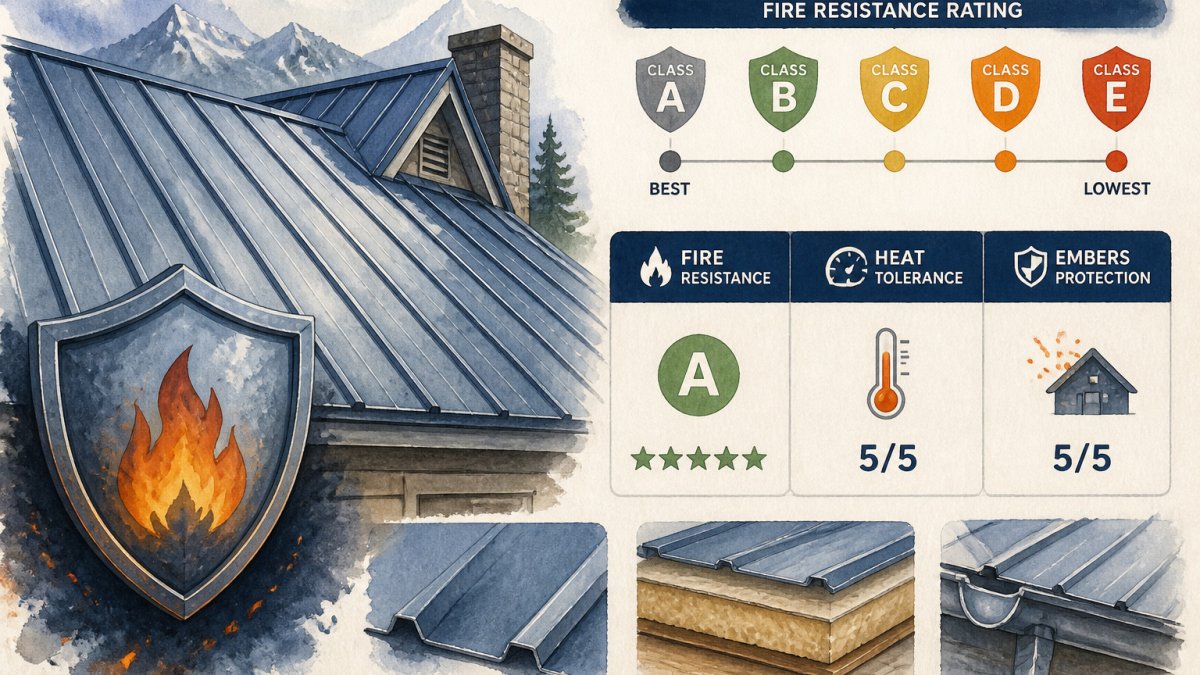
Roof fire ratings are grouped into three classes: A, B, and C. Class A offers the highest level of protection against external fire exposure, Class B offers moderate protection, and Class C offers the least. These ratings describe how a roof covering performs under standardized fire tests, not how long a roof will last in an actual wildfire.
A Class A rating generally means the roof resists severe fire exposure, including flying brands, and limits flame spread across the surface. Many metal roofing products can achieve Class A when installed as part of a tested assembly. Class B and C ratings indicate less resistance, so they call for more caution in high-risk areas.
Ratings are not always obvious from the product name. Check the documentation for the specific assembly and the test standard it references. A product labeled "fire resistant" without a class designation may not offer the protection you expect.
Panel Rating vs. Complete Roof Assembly Rating
A panel rating describes how one component performs in isolation. A complete roof assembly rating describes how the entire system performs when installed together, including the underlayment, decking, and approved fasteners. For fire protection, the assembly rating is the one that matters most.
This distinction is where many buyers get confused. A metal panel can be noncombustible on its own, yet the assembly may fall short if it is installed over a combustible deck without the approved components. Some manufacturers list a Class A rating only when specific underlayments or substrates are used.
Before buying, ask your contractor for the tested assembly listing and confirm that every component on the job matches it. Substituting a cheaper underlayment can quietly change the rating you paid for.
How Roofing Materials Are Tested for Fire Performance
Roof fire ratings come from specific laboratory tests, and knowing which test produced a rating tells you what that rating actually measures. Most metal roofing listings reference one of a few well-known standards, and each answers a different question.
External fire exposure (ASTM E108 / UL 790). This is the test behind the Class A, B, and C ratings most homeowners see. A test assembly is subjected to three separate exposures: a burning brand placed on the surface, a spread-of-flame test with a controlled flame along the roof, and an intermittent flame exposure. The assembly passes a class only if it withstands all three without sustained flaming, structural collapse, or fire penetrating to the deck.
Flame spread (ASTM E84 / UL 723). This is the Steiner tunnel test, which measures how far flame spreads across a material's surface and how much smoke it produces. Results are reported as a flame spread index and a smoke developed index.
Ignition and combustibility (ASTM E136). This test determines whether a material is noncombustible. Metal passes; asphalt, wood, and most polymer underlayments do not. A noncombustible panel is a good starting point, but it does not by itself earn a Class A assembly rating.
Ember and radiant heat exposure. Wildfire research organizations and standards bodies have increasingly focused on ember intrusion, because most home ignitions in wildland-urban interface fires start from embers rather than a flame front. No single roof-covering class captures this; it depends on how the roof is detailed at ridges, valleys, vents, and eaves. A Class A roof covering installed with open gaps or unapproved vents can still admit embers.
Watch out: a product data sheet may cite a Class A rating from ASTM E108 while the actual installed system uses a different underlayment or deck than the one tested. The rating belongs to the tested assembly, not to the panel alone, so ask for the listing that matches your job.
If you want to interpret a rating rather than just read the letter, look up the standard cited on the listing and confirm which test it refers to. A Class A from ASTM E108 and a low flame spread from ASTM E84 describe different performance, and both can appear on the same product sheet.
Best Fire Resistant Roofing Material: How Metal Compares
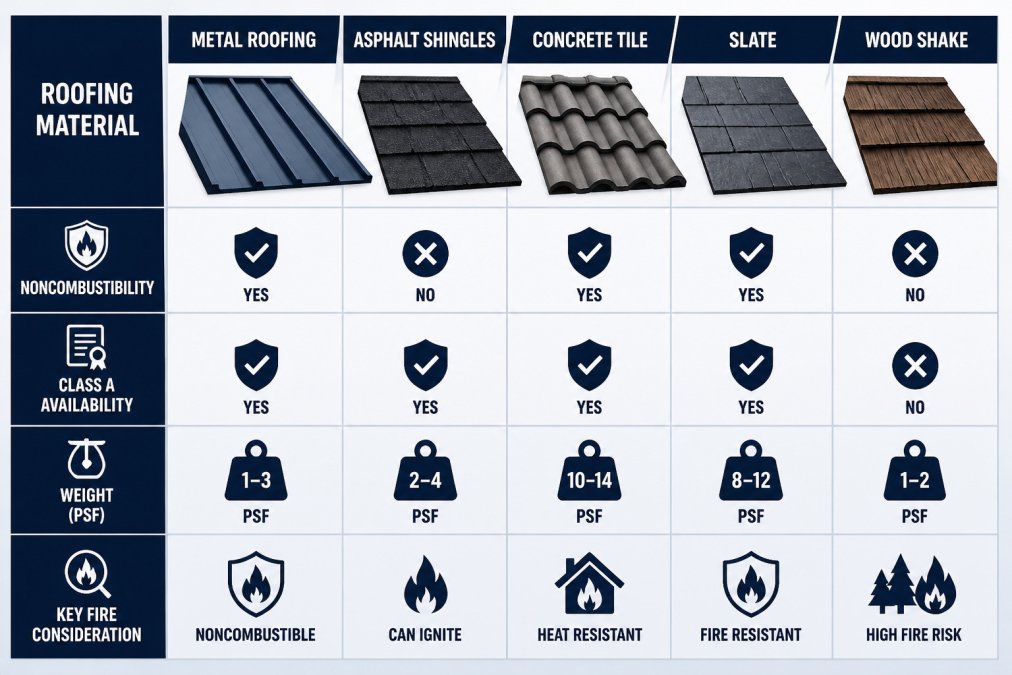
Metal is not the only roofing material that can earn a Class A rating, so the useful comparison is not 'metal versus everything else' but how each option performs on fire safety alongside the trade-offs that affect the rest of the project. The table below summarizes the common categories, followed by the context the table cannot hold.
| Roofing Material | Noncombustible | Class A Available | Typical Weight | Key Fire Consideration |
|---|---|---|---|---|
| Metal (steel or aluminum) | Yes | Yes, in tested assemblies | Light to moderate | Assembly and detailing must match the listing |
| Asphalt shingles | No | Yes, with specific products | Light | Combustible; rating depends on product and underlayment |
| Concrete or clay tile | Yes | Often Class A | Heavy | Structure must support weight; broken tiles expose underlayment |
| Slate | Yes | Often Class A | Very heavy | Structural framing and attachment are the limiting factors |
| Wood shake | No | Rarely without treatment | Light | Highest fire risk; treatments fade over time |
Metal. The advantage is that the covering itself will not ignite or add fuel, so fire performance does not depend on a chemical treatment that can wear off. The trade-off is that metal costs more upfront than asphalt, and the fire rating still depends on the underlayment, deck, and fasteners matching a tested assembly.
Asphalt shingles. Many asphalt products carry Class A ratings, and they are the least expensive common option. The limitation is that asphalt is combustible, and performance varies widely by product and by the underlayment beneath it.
Concrete and clay tile. These are noncombustible and often Class A, and they are common in warm climates. The trade-offs are weight and fragility: the roof structure must be engineered for the load, and cracked or slipped tiles can expose the underlayment to embers and water. Tile also costs more to install and repair than metal in many markets.
Slate. Slate is noncombustible and can be Class A, with a very long service life. The limiting factors are weight, cost, and the availability of contractors who can install and repair it. On many homes the framing must be upgraded to carry it.
Wood shake. Wood shake is combustible and rarely earns a Class A rating without a fire-retardant treatment, and those treatments can diminish over time. It is the highest-fire-risk option in the table and is increasingly restricted in wildfire-prone areas.
A common pattern is that the material category matters less than the tested assembly and the detailing around it. A Class A asphalt system installed correctly can outperform a metal roof installed with open gaps at the ridge and unapproved vents.
Best Class A Fire Rated Roofing Material and Are Asphalt Shingles Fire-Resistant?
Many asphalt shingles carry a Class A rating, so they are not automatically unsafe in wildfire-prone areas. However, asphalt is combustible, and its fire performance depends heavily on the specific product and installation. Metal offers a noncombustible covering that does not depend on additional treatments to resist ignition.
When comparing the best Class A options, look at the complete assembly, the installation requirements, and the maintenance the roof will need. A Class A rating earned in a tested configuration is what counts, so confirm that the product on your roof matches that configuration.
What a Metal Roof Costs and How Fire Performance Affects Value
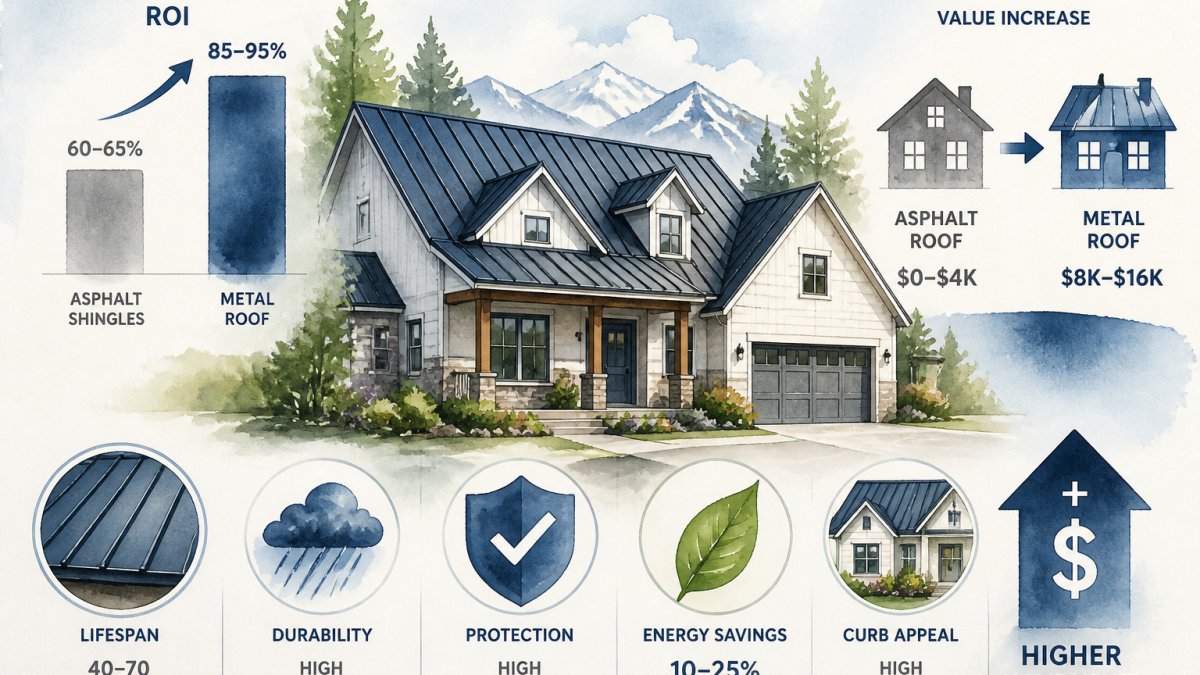
Metal roofing usually costs more upfront than asphalt shingles, but its lifespan and fire performance can change the long-term math. Pricing depends on panel type, roof size, pitch, and the complexity of the installation, so a single figure cannot fit every home. For current pricing, visit our website or request a quote for your property.
Fire performance can also affect how a home is valued and insured. Our guide on whether a metal roof increases home value covers resale considerations. Our metal roof insurance coverage guide explains how insurers treat metal roofs. Check with your insurer and review how a metal roof could affect your coverage and resale value in your area. Insurance requirements and local building codes vary, so confirm current rules with local officials before making decisions.
Next Steps: Getting a Fire-Rated Roof Assessment for Your Property
If you are considering a metal roof or want to confirm the fire rating of your existing roof, start with a professional assessment. You can request a residential roof quote in seven steps. Sun Flex Home Improvement offers a free estimate for properties across Montana and Northern Wyoming.
Sun Flex Home Improvement has over 25 years of industry experience and is a BBB Accredited Business. Read our guide to hiring a metal roofing contractor to know what to look for. The company specializes in spray foam roofing restoration, metal roofing, and asphalt shingles. Request your free estimate today to see which fire-rated solution fits your property and budget.
Frequently Asked Questions
Are metal roofs fireproof?
No roof is fireproof in the absolute sense, but metal is noncombustible, meaning it does not ignite or contribute fuel to a fire. Metal roof panels can be part of a Class A-rated roof assembly, the highest rating under standard fire tests. That rating depends on the full system, including the fire-resistant substrate, underlayment, and approved components. Ask your contractor for the tested assembly listing, not just the panel's material, before assuming a specific level of fire protection.
Does a metal roof need a fire-rated underlayment?
Often, yes. A metal panel alone does not always achieve a Class A rating; the rated assembly typically requires specific approved components beneath the panels, which can include fire-resistant underlayment and a compatible decking material. Requirements vary by product and by the test listing it was built to. Confirm the exact components in the listing and check your local building code, since jurisdictions may require particular assemblies in wildfire-prone areas.
What does a Class A roof fire rating mean?
A Class A rating is the highest classification under the standard fire tests for roof coverings, meaning the assembly resists severe external fire exposure, including flying embers and radiant heat, under test conditions. Class B and Class C ratings offer progressively lower resistance. The rating reflects a tested assembly under specified conditions, so it does not guarantee how a roof will perform in every real fire, and installation details matter.
Are asphalt shingles fire-resistant?
Many asphalt shingles carry Class A ratings when installed over the tested assembly, but the shingle itself is combustible, so the rating depends on the complete system. Fiberglass-based shingles generally perform better than older organic-mat versions. Compare the shingle's listed rating with the full assembly rating and confirm installation matches the tested configuration. Metal roofing offers a noncombustible surface that does not add fuel to a fire.