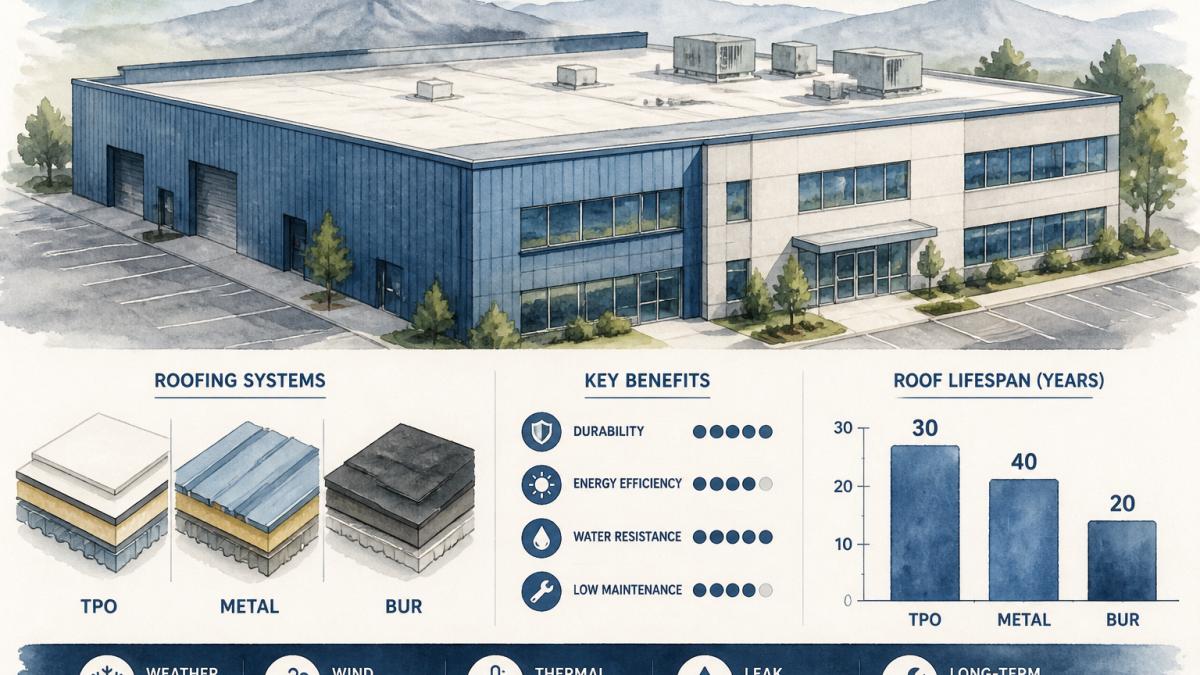
 comparison
Roofing for Industrial Office Buildings: A 2026 Guide
Table of Contents
- Roofing Systems for Industrial Office Buildings: What You Need to Know
- Commercial Roofing Materials Comparison: TPO, PVC, EPDM, and Metal
- Spray Foam Roofing Benefits for Industrial Office Restoration
- Key Factors for Selecting the Right Industrial Roofing System
- Commercial Roof Maintenance Best Practices to Extend System Life
- Retrofitting vs. Full Replacement: Cost-Benefit Analysis
- Environmental Impact and LEED Certification Considerations
- Frequently Asked Questions
Last Updated: September 30, 2026
Roofing Systems for Industrial Office Buildings: What You Need to Know
Roofing for industrial office buildings requires balancing durability, energy efficiency, and cost-effectiveness. At Sun Flex Home Improvement, we've spent over 25 years helping property owners across Montana and Northern Wyoming choose roofing solutions that match their specific operational demands and regional weather challenges.
Your roof handles extreme temperature swings, hail, UV exposure, and snow/ice loads. Industrial office buildings often combine office spaces with warehouse or manufacturing areas, meaning different zones may need different performance characteristics.
Restoration approaches like spray foam can extend your existing structure's life at a fraction of replacement cost.
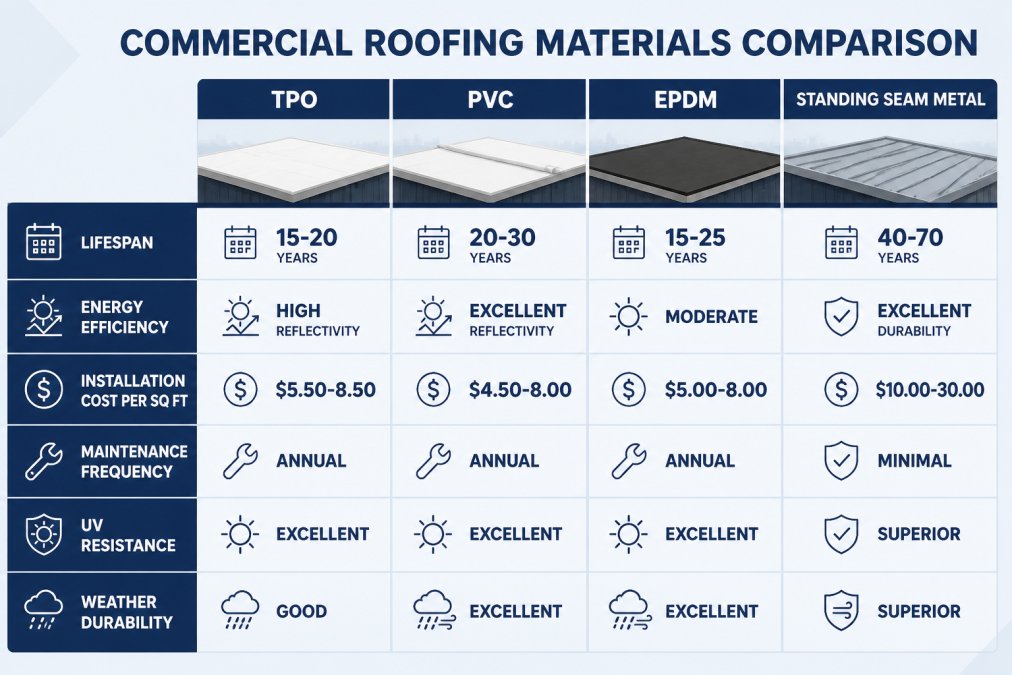
Commercial Roofing Materials Comparison: TPO, PVC, EPDM, and Metal
Industrial office buildings typically choose between four main single-ply membrane systems and metal roofing. Each has distinct strengths for different use cases and climates.
TPO Roofing: Energy Efficiency on a Budget
TPO (Thermoplastic Polyolefin) is a single-ply reflective membrane with high solar reflectivity that reduces cooling costs. Heat-welded seams create watertight bonds stronger than mechanical fastening, and the membrane resists punctures, tears, and chemical exposure from rooftop equipment or HVAC units.
TPO typically lasts 15-20 years, though harsh UV exposure can cause earlier brittleness if poorly formulated.
Pros:
- Excellent energy efficiency through solar reflectivity
- Lower installation costs than metal or PVC
- Heat-welded seams reduce leak risk
- Good chemical resistance for industrial settings
Cons:
- Shorter lifespan than metal or PVC systems
- Performance varies by manufacturer quality
- Seam quality depends on installer skill
PVC Roofing: Chemical and Fire Resistance
PVC (Polyvinyl Chloride) roofing excels when buildings handle chemicals, grease, or contaminants. The material is inherently fire-retardant and maintains structural integrity in harsh conditions.
Heat-welded seams create durable bonds, and PVC typically lasts 20-30 years. Quality formulation matters, as poor materials can become brittle under extreme temperature cycling.
Pros:
- Superior chemical and grease resistance
- Inherently fire-retardant properties
- Longer lifespan than TPO (20-30 years typical)
- Strong heat-welded seams
Cons:
- Can become brittle if poorly formulated
- Requires quality installation to avoid seam failures
- Performance heavily dependent on material quality
EPDM Roofing: Flexibility and Durability
EPDM (Ethylene Propylene Diene Terpolymer) is a synthetic rubber membrane that excels in buildings with complex roof designs or significant temperature swings. It resists ozone and weathering well and maintains flexibility across wide temperature ranges.
EPDM's critical weakness is seam performance, unlike heat-welded systems, EPDM seams rely on tape or adhesive, making installer quality crucial.
Pros:
- Highly flexible, accommodates building movement
- Excellent ozone and weathering resistance
- Cost-effective for large surface areas
- Proven track record in varied climates
Cons:
- Seams are vulnerable if not installed correctly
- Requires quality tape or adhesive maintenance
- More prone to seam failure than heat-welded systems
Standing Seam Metal Roofing: Maximum Longevity
Standing Seam Metal Roofing uses vertical panels with concealed fasteners for 40-70 year lifespans. It handles extreme weather better than membrane systems, making it ideal for regions with severe weather.
Concealed fasteners prevent leak points, and the material doesn't degrade like membranes, making it ideal for facilities where downtime is costly.
Pros:
- Exceptional durability and 40-70 year lifespan
- Concealed fasteners eliminate leak points
- Minimal maintenance requirements
- Superior performance in extreme weather
- Excellent resistance to hail and wind damage
Cons:
- Higher initial capital investment
- Installation requires specialized labor
- Expansion and contraction can require special attention in extreme climates
Spray Foam Roofing Benefits for Industrial Office Restoration
Spray foam roofing is a restoration approach that extends existing roofs without full replacement. The process involves spraying closed-cell polyurethane foam onto the existing surface, then coating it with a protective elastomeric layer, creating a seamless barrier.
Spray foam eliminates seams, the primary failure point in membrane systems. It provides thermal insulation that reduces heating and cooling costs for uninsulated roofs.
Spray foam restoration typically costs less than full replacement, making it a meaningful alternative for property owners facing high replacement costs.
Key Factors for Selecting the Right Industrial Roofing System
Your material choice should reflect three primary considerations: building code compliance, climate resilience, and energy efficiency ROI. Generic recommendations miss these specifics.
Building Code Compliance and Fire Ratings
Building codes establish minimum fire ratings (Class A, B, or C). PVC and metal roofing inherently achieve Class A; TPO and EPDM require fire-rated insulation and coatings. Codes also address wind uplift and snow load capacity. Check local requirements before selecting materials to avoid compliance problems.
Climate Resilience and Weather Protection
Montana and Northern Wyoming face intense UV, heavy snow loads, hail, and extreme temperature swings. Metal roofing's durability advantage is tangible in these conditions, hail barely marks it, and the 40-70 year lifespan outlasts multiple membrane replacements. Spray foam restoration also works well in harsh climates when the existing structure is sound.
Energy Efficiency and Long-Term ROI
TPO and PVC roofing reduce cooling costs through solar reflectivity. In climates with intense summer sun, the energy savings are measurable. A 10,000 square foot industrial office with a reflective roof can reduce summer cooling costs.
Spray foam roofing adds thermal insulation (R-5 to R-6 per inch) on top of reflectivity. For buildings with uninsulated roofs, this combination reduces both heating and cooling costs. The energy savings typically offset spray foam restoration costs.
Metal roofing offers durability rather than energy efficiency.
Commercial Roof Maintenance Best Practices to Extend System Life
Your roofing system's lifespan depends as much on maintenance as on material quality. Neglected roofs fail early. Well-maintained roofs often outlast their rated lifespan.
Retrofitting vs. Full Replacement: Cost-Benefit Analysis
The decision between restoration and replacement depends on three factors: remaining structural integrity, cost differential, and building timeline.
Retrofit when:
- The existing roof deck is sound (no rot, no significant water damage)
- The building's operational life extends 15+ more years
- Replacement cost exceeds $20,000
- Downtime during replacement would be costly
Replace when:
- The existing deck is compromised (structural damage, rot, water infiltration)
- The building's lifespan is uncertain or short-term
- Energy efficiency improvements justify replacement cost
- The existing system is incompatible with future expansion
A cost-benefit analysis should include:
- Current restoration cost vs. replacement cost
- Annual energy savings (if any)
- Maintenance costs over the system's lifespan
- Building's projected operational life
- Future expansion or modification plans
Environmental Impact and LEED Certification Considerations
Industrial office buildings pursuing LEED certification or sustainability goals should evaluate roofing systems through environmental impact and operational efficiency.
Frequently Asked Questions
What type of roof is best for industrial office buildings?
The best roofing system depends on your building's specific needs. Standing seam metal offers the longest lifespan (40-70 years) and exceptional weather resistance, making it ideal for harsh climates. TPO and PVC provide excellent energy efficiency and cost-effectiveness for large flat surfaces. EPDM works well for complex roof designs. Spray foam roofing restoration extends existing roof life at half the cost of replacement. Consult with a professional to evaluate your building's structure, local weather patterns, and budget.
How does spray foam roofing compare to metal roofing for industrial offices?
Spray foam roofing restoration applies a protective layer over existing roofs, typically extending life at less cost than full replacement. Metal roofing requires complete installation but lasts 40-70 years with minimal maintenance. Spray foam is faster to install and preserves your existing structure. Metal offers superior durability for buildings in extreme weather zones. For offices seeking cost-effective protection and energy savings without disruption, spray foam restoration is practical. For maximum long-term durability, metal roofing is the premium choice.
Which roofing materials offer the best energy efficiency for large office buildings?
TPO and PVC membranes are the most energy-efficient single-ply options, featuring reflective surfaces that reduce cooling costs by reflecting solar heat. Metal roofing with reflective coatings also improves energy performance. Spray foam roofing adds thermal insulation directly to your existing roof, improving the building envelope's R-value significantly. For industrial offices with high cooling demands, reflective membranes combined with proper insulation deliver the best energy savings and utility bill reductions.
What is the difference between commercial and industrial roofing?
Commercial roofing typically covers office buildings, retail spaces, and standard business structures with conventional flat or low-slope designs. Industrial roofing serves factories, warehouses, and production facilities exposed to harsher conditions: chemical exposure, extreme temperature fluctuations, heavy equipment vibration, and severe weather. Industrial roofing systems prioritize durability, chemical resistance, and structural integrity over aesthetics. Materials like PVC excel in industrial settings due to chemical resistance. Metal roofing handles impact and thermal stress better. Both require professional assessment to meet building codes and operational demands.
How often should commercial roofs be maintained to prevent leaks and extend lifespan?
Commercial roofs should be inspected twice annually (spring and fall) and after severe weather events. Regular maintenance includes clearing debris, inspecting seams and flashing, checking for pooling water, and addressing minor damage immediately. TPO and PVC membranes need annual inspections; metal roofing requires checking fasteners and coatings every 2-3 years; EPDM needs seam checks annually. Spray foam roofs benefit from annual coating inspections and touch-ups. Preventive maintenance can extend lifespan and prevent costly emergency repairs.