 how-to
Can Spray Foam Roofing Go On Wet Surfaces?
Last Updated: November 3, 2026
Quick Summary
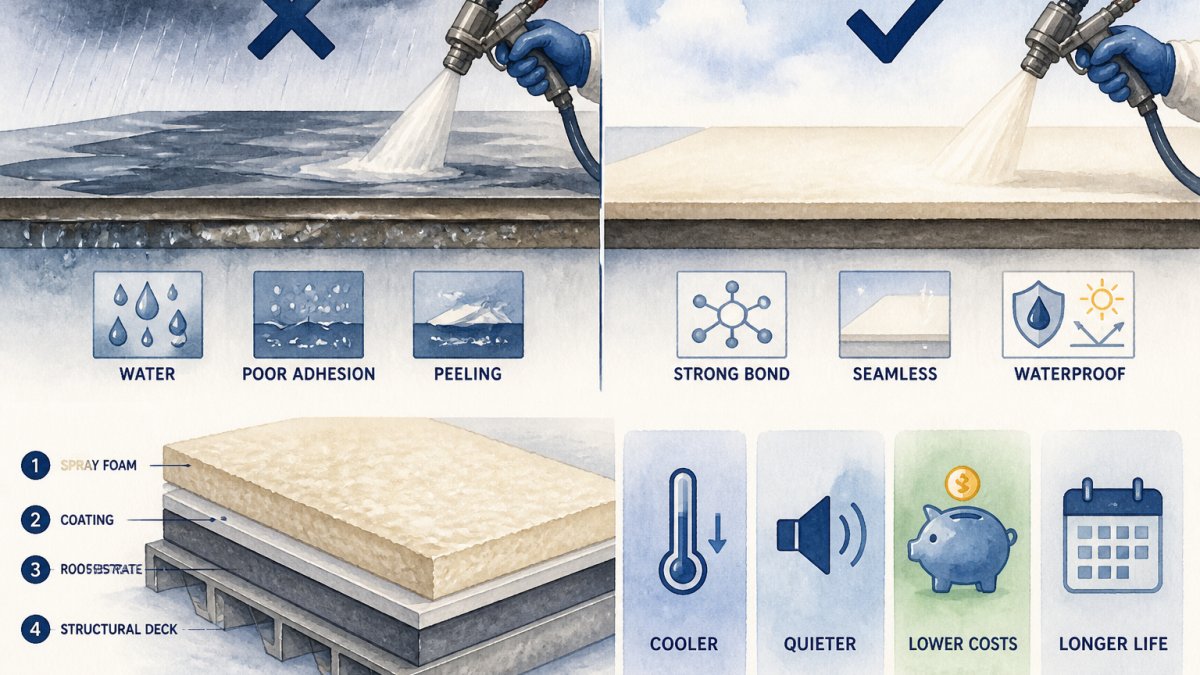
No, spray foam roofing cannot be applied over wet surfaces because the foam's chemical reaction needs a clean, dry substrate to bond properly. Water trapped between the foam and roof deck causes poor adhesion, blisters, and delamination. The roof deck must be dry, clean, and within the manufacturer's moisture threshold before any foam goes down.
- Measure moisture content at several points on the roof deck and compare each reading to the manufacturer's stated threshold.
- A pin-type moisture meter gives you a number in seconds when pressed into bare wood, not old coating or debris.
- Wet insulation is a removal problem, not a drying problem, and foam cannot fix saturated material underneath it.
- After rain, stop application, remove standing water, let the deck dry, and re-measure moisture at the same test points.
- Manufacturers commonly exclude failures caused by moisture or poor substrate preparation from warranty coverage.
Table of Contents
- Why Spray Foam Roofing and Wet Surfaces Do Not Mix
- Spray Foam Roofing Moisture Requirements You Must Meet First
- How to Tell Damp Substrate From Wet Insulation or a Wet Roof Deck
- How to Dry Roof Decking Before Spray Foam Application
- What Happens With Spray Foam Over Wet Roof Decking
- After Rain or Unexpected Wetting: Your Recovery Steps
- Schedule a Moisture Assessment Before Your Foam Goes On
- Frequently Asked Questions
Why Spray Foam Roofing and Wet Surfaces Do Not Mix
No.
At Sun Flex Home Improvement, we have spent more than 25 years working on roofs across Montana and Northern Wyoming.
Here is the part most guides skip: the damage is often invisible for months. The foam looks fine.
The Oak Ridge National Laboratory building envelope research makes the same point about moisture movement in roofing assemblies. Water finds a way.
Spray Foam Roofing Moisture Requirements You Must Meet First
Spray foam roofing moisture requirements are simple to state and strict to meet: the roof deck must be dry, clean, and within the manufacturer's moisture threshold before any foam goes down.
So what does a go/no-go check look like in practice?
- Measure moisture content at several points on the roof deck
- Compare each reading to the manufacturer's stated threshold
- Dry and re-test if any reading comes in high
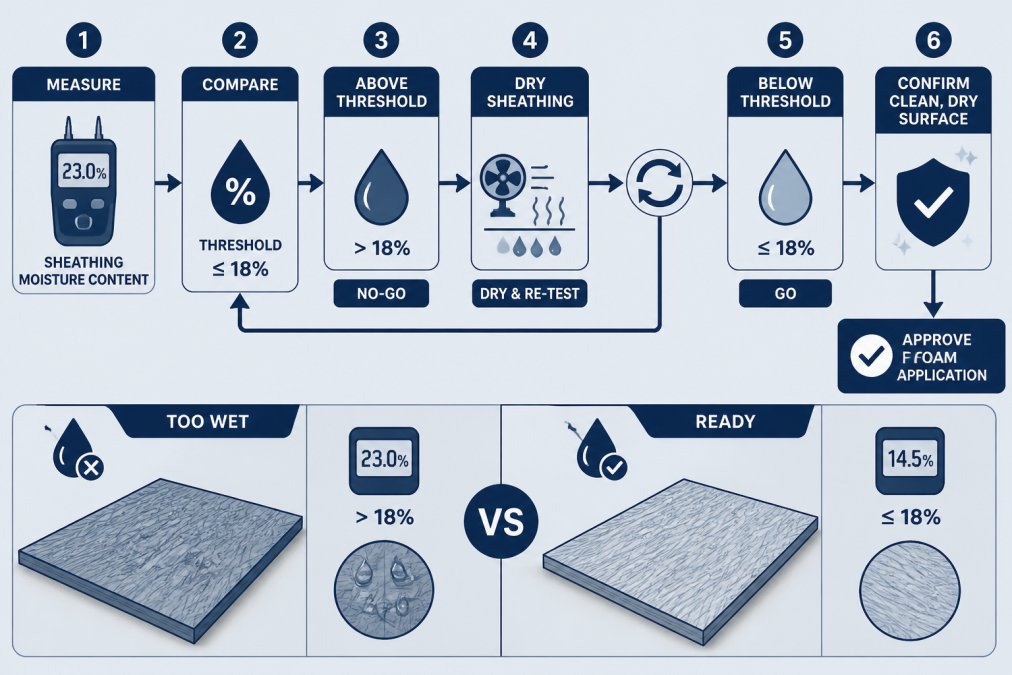
Reading a Moisture Meter on Roof Sheathing
A pin-type moisture meter gives you a number in seconds. Press the pins into bare wood, not old coating or debris. Take readings in several spots per roof section, and pay extra attention to low areas, valleys, and anywhere staining is visible.
Wet insulation is a separate issue. Foam cannot fix saturated material underneath it. That material has to come out first.
A Practical Go/No-Go Procedure
A defensible moisture check is a procedure, not a single reading. Here is the sequence we build into every estimate:
- Map the roof into test zones. Divide the roof into test zones, and treat valleys, drains, penetrations, and north-facing slopes as their own zones. A single average hides the wet corner that will fail first.
- Take baseline readings on bare wood. Use a moisture meter suited to the wood on the deck. Readings through old coating, membrane, or debris are meaningless.
- Record every reading by zone. Write down the number, location, and time. A photo of the meter display next to a zone marker is faster than a handwritten log and harder to dispute.
- Flag inconsistent readings. If one zone reads 11% and the adjacent zone reads 22%, the high zone is the answer. Re-test after a drying period and do not approve until every zone is below the manufacturer's threshold.
- Re-test after any wetting event. Rain, overnight dew, or a pressure-washing crew nearby can push surface readings up without soaking the deck. Re-test the same zones at the same points.
- Sign off in writing. The go/no-go decision should be documented with the threshold, the readings, and the name of the person who approved the surface.
A common pattern is for crews to test the sunny, easy-to-reach half of the roof and approve the job on those numbers. The shaded half, the area under the HVAC curb, and the low corner by the drain are where the water actually sits.
When Readings Disagree With What You See
A dry-looking board that meters high usually has moisture deeper in the assembly or wicking up from below. A wet-looking board that meters low is often surface staining from an old leak that has since dried. Do not average the two signals, investigate before approving. If insulation sits below the deck, a small core sample or a look from the interior will tell you where the moisture is.
What the Manufacturer's Data Sheet Actually Says
Product data sheets vary more than most property owners expect. Some list a maximum substrate moisture content by percentage; others specify equilibrium moisture content or defer to the sheathing manufacturer. Some require a primer or specific surface profile, and some restrict application when substrate temperature is near the dew point. Read the data sheet for the specific product going on the roof, and match the crew's test method to the number it states.
How to Tell Damp Substrate From Wet Insulation or a Wet Roof Deck
- Damp substrate: surface moisture on the sheathing. Often dries with airflow and sun.
- Wet insulation: saturated material that holds water and loses R-value. Usually must be removed.
- Wet roof deck: the structural wood itself is soaked. Needs drying and often repair.
The distinction matters because foam over wet insulation traps the water against the deck. The insulation never recovers, and the deck starts to rot.
Here is how we tell them apart on site:
- Sound test: soft or spongy spots point to damaged wood
- Visual check: dark staining and peeling coating suggest long-term water intrusion
- Meter readings: high numbers across a wide area mean the deck itself is wet
If you want the full picture of how foam handles water once it is installed, read our guide on whether spray foam roofing is waterproof.
Three different moisture problems can look alike on a roof, and each calls for a different response.
| Problem | What it is | What it means |
|---|---|---|
| Damp substrate | Surface moisture on the sheathing | Often dries with airflow and sun |
| Wet insulation | Saturated material that holds water and loses R-value | Usually must be removed |
| Wet roof deck | The structural wood itself is soaked | Needs drying and often repair |
How to Dry Roof Decking Before Spray Foam Application
Drying roof decking before spray foam takes time, airflow, and patience. There is no shortcut worth taking.
Step one is to remove the source. Fix the leak, clear the drains, and get standing water off the roof.
Watch out: crews sometimes dry the top of the deck and skip the edges and penetrations, which is exactly where water hides.
How long does drying take? It depends on weather, deck thickness, and how long the water has been there.
Drying by Material and Assembly
Not every wet roof dries the same way, and the material under the foam changes the timeline:
- Bare wood sheathing (plywood or OSB): dries fastest with sun and cross-ventilation. OSB holds water longer than plywood and swells at the edges, so a swollen edge is a sign the panel may need replacement.
- Wood sheathing under an existing membrane: the membrane has to be opened or removed over the wet area, or the moisture has nowhere to go. Foam over a trapped wet membrane is the classic trapped-moisture failure.
- Insulation below the deck: saturated insulation is a removal problem, not a drying problem. Rigid board and batt insulation lose R-value when wet and generally do not recover.
Verifying the Deck Is Actually Dry
Re-testing is the only proof. A dry-looking surface is not evidence, wood can read dry on top and wet a half-inch down. The verification sequence we use:
- Re-test the same zones at the same points used in the original moisture check, so the before-and-after numbers are comparable.
- Test the edges and penetrations separately. These dry slowest and are the most common source of callbacks.
- Check the interior side where accessible. A look at the underside of the sheathing confirms whether the deck itself is dry or just the surface.
- Confirm the forecast. Do not approve a deck that will be rained on before the foam cures.
- Document the final readings alongside the original ones, the pair is what shows the drying actually happened.
When Drying Stalls
Sometimes a deck will not dry no matter how long it sits. That is a signal, not a delay. Common causes are a hidden leak that was never fixed, moisture wicking up from below, or an assembly with no path for vapor to escape.
For flat roof projects, our spray foam roofing guide for flat roofs walks through the full application sequence.
What Happens With Spray Foam Over Wet Roof Decking
Foam over a wet roof deck fails in a predictable order. First, adhesion suffers. Second, trapped moisture heats up in the sun and pushes upward, causing blisters and delamination. Third, the deck itself starts to decay under a surface that looks intact.
The repair is expensive because the foam has to come off to reach the problem: removal, drying, deck repair, and a fresh application. See what drives the cost of spray foam roofing.
Warranty coverage can also be affected. Manufacturers commonly exclude failures caused by moisture or poor substrate preparation, so checking the data sheet and warranty terms before application is advisable. Our spray foam roof warranty guide explains what is typically covered.
After Rain or Unexpected Wetting: Your Recovery Steps
Rain during a project is not a disaster. Skipping the re-test after rain is. Here is the recovery sequence we follow:
- Stop application immediately and cover exposed areas
- Remove standing water and clear all drains
- Let the deck dry with airflow and sun exposure
- Re-measure moisture at the same test points as before
- Document new readings before the crew restarts
- Reschedule rather than rush if readings stay high
A common mistake is assuming a sunny afternoon fixed everything. Wood holds water longer than the surface suggests. Test, do not guess.
According to FEMA guidance on roof moisture and storm damage, wet roofing materials that stay wet invite mold and structural decay. That is a strong reason to slow down.
Schedule a Moisture Assessment Before Your Foam Goes On
Every spray foam roofing project should start with a moisture assessment, not a spray gun.
A moisture check is an important part of evaluating any spray foam roofing project. Spray foam roofing offers improved energy efficiency, a watertight barrier against harsh weather, and an extended roof lifespan. We are a BBB Accredited Business.
If your roof leaks every spring, do not let foam hide the problem. Start with a moisture check and get the facts. See the benefits of spray foam roofing before you decide, then call us for a free estimate.
Frequently Asked Questions
Can you put spray foam on a wet surface?
No. Spray foam roofing needs a clean, dry substrate to bond properly. Moisture on the surface or trapped in the wood interferes with the chemical reaction that cures the foam, which can cause poor adhesion, blistering, and delamination. Even a damp surface that looks dry to the touch can fail a moisture meter reading. Always confirm the roof deck is dry before any foam application begins.
How dry does a roof need to be before spray foam is applied?
The roof sheathing and substrate must be dry to the touch and pass a moisture meter reading within the manufacturer's specified range for the product being used. Wood that reads elevated moisture content needs more drying time, even if the surface feels dry. Your contractor should document the readings before application. If recent rain or snowmelt has wet the deck, reschedule rather than risk a failed bond.
What happens if spray foam is applied over wet roof decking?
Foam applied over a wet roof deck can trap moisture against the wood, leading to adhesion failure, blistering, and delamination. Trapped moisture may also cause rot in the sheathing and roof deck damage that is expensive to fix. In many cases the failed foam has to be removed before the roof can be repaired properly. This is why a moisture check before application matters more than speed.
Can spray foam be applied over water-damaged wood?
Water-damaged wood should be evaluated before any coating goes on. Soft, rotted, or delaminated sheathing needs repair or replacement first, because foam bonds to the substrate and will not fix structural weakness. Once damaged sections are replaced and the deck is dry, spray foam roofing can proceed. A roof inspection that identifies water-damaged wood is a required first step, not an optional one.
Water trapped under new foam is one of the most avoidable roofing failures we see. If you want the job done once, Sun Flex Home Improvement brings over 25 years of experience, spray foam restoration expertise, and a documented moisture assessment to every project. Get started with Sun Flex Home Improvement and protect your roof with a watertight barrier built on a dry, verified deck.