 how-to
How to Identify Early Signs of Roof Ice Damming
Last Updated: October 28, 2026
Quick Summary
Early signs of roof ice damming include icicles along the eaves, a solid ice ridge at the roof edge, and water pooling behind that ridge. Inside the home, look for new ceiling or wall stains, wet attic insulation, and frost on roof boards. Check after each significant snowfall or warm spell.
- Look for a solid ice ridge at the eave, not just separate icicles.
- Water pooling on the roof behind the ice ridge signals trapped meltwater.
- Check attic insulation and roof boards for moisture or frost.
- Photograph the eave and note dates to track changes over time.
- Never stand on a snow-covered roof or chip ice with metal tools.
Table of Contents
- What Roof Ice Damming Is and How It Forms
- Icicles Versus a Developing Ice Dam: How to Tell the Difference
- Visible Warning Signs Along the Roof Edge and Eaves
- Interior Clues: Attic, Ceiling and Wall Damage
- Telling Ice Dam Leaks Apart From Other Roof Leaks
- A Step-by-Step Early Detection Checklist and Safe Inspection Rules
- When to Call a Professional and How Metal Roofs Handle Snow
- Frequently Asked Questions
Ice dams can cause winter roof problems in Montana and Northern Wyoming. Catching them early can help limit damage such as ceiling stains, soaked insulation and rotting roof decking.
This guide walks through how to identify early signs of roof ice damming, what those signs mean and what to do next. The goal is to help you act while the problem is still small.
What Roof Ice Damming Is and How It Forms
Roof ice damming is a ridge of ice that builds up at the edge of a roof and traps melted snow behind it.
Dams form because of uneven roof temperatures. Heat escaping from the living space warms the upper roof, melting snow from below. That meltwater runs down toward the eave, which stays cold because it sits outside the warm zone.
The freeze-thaw cycle and uneven roof temperatures
The freeze-thaw cycle drives the problem. Daytime sun can melt snow even when the air is below freezing. At night, the meltwater freezes again. Over days and weeks, this repeated cycle slowly grows the ice ridge.
- Snow cover acts like an insulator and holds in heat
- Poor attic insulation or ventilation lets more heat reach the roof
- Eaves stay near the freezing point of 32 degrees Fahrenheit
Good attic insulation and ventilation can help keep the roof surface cold and even.
Icicles Versus a Developing Ice Dam: How to Tell the Difference
Icicles are common and often harmless. A few icicles hanging from the gutter line usually mean snow is melting and refreezing, but they do not always mean water is backing up under the roof.
A developing ice dam looks different. Watch for these signs:
- A thick, solid ridge of ice along the eave, not just separate drips
- Ice that builds up at the roof edge and stays put for days
- Water that pools on the roof behind the ice ridge
Watch out: Do not knock icicles off with a hammer or a shovel from the ground or a ladder. Falling ice and ladder falls cause far more injuries than the ice itself.
Visible Warning Signs Along the Roof Edge and Eaves
Your roof edge often shows the first clues. Walk the perimeter after a snowfall and check these areas:
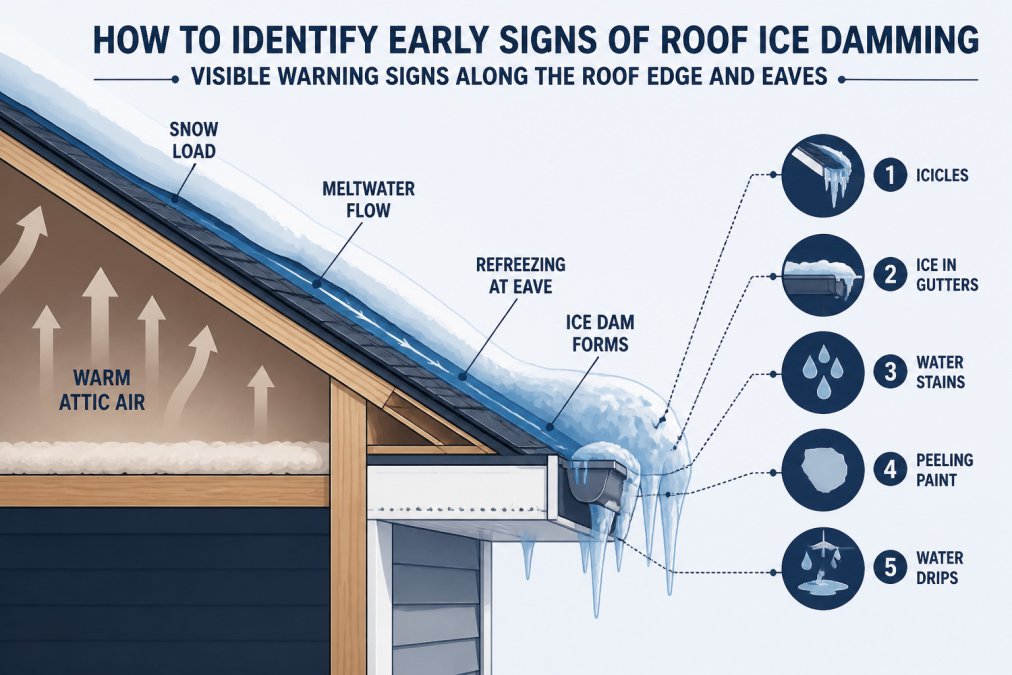
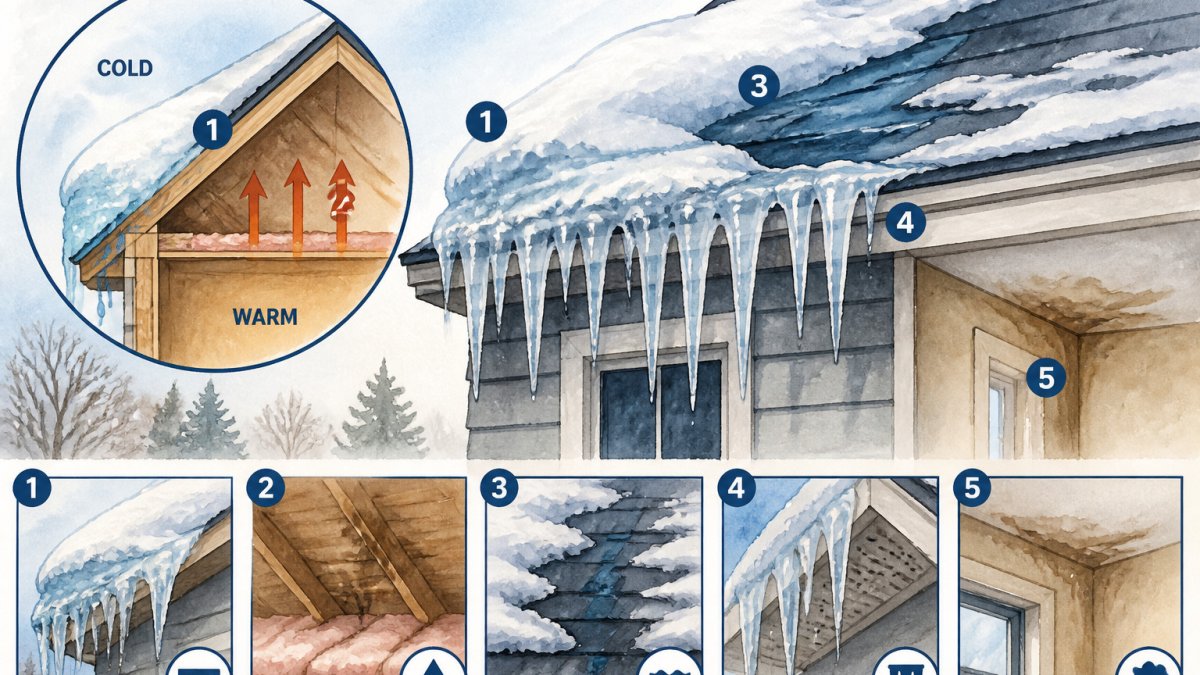
- Icicles hanging from gutters or rooflines. Many long icicles in one spot can point to a dam forming behind them.
- Ice buildup or ridges at the roof edge. A solid bead of ice running along the eave is a strong warning sign.
- Water pooling or ice puddles near eaves and valleys. Standing water on the roof means meltwater is trapped.
- Water dripping from siding, eaves, or the underside of roof overhangs. Drips on the siding or soffit suggest water is getting past the roof edge.
- Damaged or lifted shingles near the eave. Water pushing under shingles can lift them or leave them cracked.
!Infographic diagram of a cross-section roof edge showing warm attic air, snow load, meltwater flow, refreezing at the eave, and where the ice dam forms, labeled with the five visible warning signs
Interior Clues: Attic, Ceiling and Wall Damage
Some of the most important signs appear inside the home. Check these areas after each heavy snow or thaw:
- Water stains on ceilings and walls, especially along exterior walls
- Peeling paint or bubbling wallpaper near the top of a wall
- Damp spots or musty smells in upper rooms
If you see staining that is new or growing, it is a sign that water is already moving through the roof structure.
Telling Ice Dam Leaks Apart From Other Roof Leaks
Not every winter leak is an ice dam. Rain, failed flashing, a cracked boot around a vent pipe or a worn chimney seal can produce stains that look identical on your ceiling. If you are unsure whether a leak calls for repair or full replacement, compare your options first.
Use the clues below to narrow it down before you call anyone. Once you have identified the source, you can follow practical repair steps to stop water from entering the building.
Timing clues
- Ice dam leaks show up during cold snaps, mid-winter thaws, or the first sunny day after a heavy snow. They often appear when outdoor temperatures climb above freezing for a few hours and then drop again.
- Rain-driven leaks follow precipitation, regardless of season, and typically show up within hours to a day of a storm.
- Flashing and vent leaks can appear in any weather but often worsen in wind-driven rain, when water is pushed sideways against a penetration.
Location clues
- Ice dam leaks cluster along exterior walls, the top floor, and the lower edge of the roof slope. Stains often appear near the eave line or directly above a soffit.
- Flashing leaks cluster near chimneys, skylights, vent stacks, and roof-to-wall intersections, because those are the points where the roof plane is interrupted.
- Condensation shows up as frost, beads of water on cold surfaces, or damp sheathing in the attic, usually with no clear stain pattern on the ceiling below.
Pattern clues
- Ice dam leaks repeat. If the same spot stains every winter and dries out in spring, the cause is almost certainly meltwater backing up at the eave.
- Rain leaks can be intermittent and may only appear with certain wind directions or storm intensities.
- Condensation is chronic and diffuse. It tends to dampen a broad area of insulation or sheathing rather than concentrate in one stain.
A quick decision test
Ask yourself three questions:
- Did the stain appear during or right after a thaw, with snow still on the roof? If yes, suspect an ice dam.
- Is the stain near an exterior wall or the eave line rather than near a chimney or vent? If yes, suspect an ice dam.
- Has this same spot leaked in previous winters? If yes, suspect an ice dam.
If two or more answers point the same way, an ice dam is one possible cause. If the stain appeared after heavy rain with no snow on the roof, flashing and penetrations are other possible sources.
A roofer can inspect the eave, the attic side of the roof deck, and the flashing details to help assess the source. You can compare roofing materials that perform best in local snow and cold conditions in Best Roofing for Montana Winters.
A Step-by-Step Early Detection Checklist and Safe Inspection Rules
Use this checklist after each significant snowfall or warm spell:
- Look at the eaves from the ground for icicles or ice ridges
- Check gutters for ice blocking the flow of water
- Inspect ceilings and upper walls for new stains
Safe inspection rules:
- Inspect from the ground with binoculars whenever possible
- Never stand on a snow-covered or icy roof
- Use a ladder only on firm ground, with a helper holding it
Actions to avoid:
- Do not chip ice with metal tools, which can damage shingles
- Do not use salt, which can harm roofing and landscaping
- Do not hack at the dam, because that can tear shingles and force water deeper
Start with the attic check. It can provide clues about whether heat is escaping.
Use these checks after each significant snowfall or warm spell, and follow the safety rules below.
| Check | What to look for | How often |
|---|---|---|
| Eaves | Icicles or a solid ice ridge at the roof edge | After each significant snowfall or warm spell |
| Gutters | Ice blocking the flow of water | After each significant snowfall or warm spell |
| Ceilings and upper walls | New stains | After each significant snowfall or warm spell |
| Attic | Wet insulation or frost on roof boards | After each significant snowfall or warm spell |
| Records | Date, location and size of any new problem | Every time a problem appears |
When to Call a Professional and How Metal Roofs Handle Snow
Most homeowners wait too long because they are not sure whether a symptom is urgent. Use the tiers below to decide how fast to act. The rule of thumb: water inside the structure is a reason to consider contacting a professional.
Tier 1: Monitor and document
Signs:
- A few icicles at the gutter line with no ice ridge at the eave
- Light snow cover with no standing water on the roof
- No interior stains, no attic moisture
Action: Photograph the eave from the ground, note the date, and recheck after the next thaw. No call needed yet, but keep watching.
Tier 2: Schedule an inspection soon
Signs:
- A solid ice ridge along the eave that persists for several days
- Water pooling behind the ice ridge
- Damp insulation or frost on the roof boards in the attic
Action: Consider contacting a roofing professional.
Tier 3: Act promptly
Signs:
- Active dripping into a living space
- A stain that is visibly growing day to day
- Soft spots or sagging in the ceiling or roof deck
Action: Call a professional promptly and document the damage with photos and dates. Move valuables and electronics away from the drip zone, and place a bucket or towel to protect the floor. Do not climb onto the roof to investigate.
Tier 4: Treat as an emergency
Signs:
- Water near electrical fixtures, outlets, or a ceiling fan
- A bulging ceiling that feels soft or sounds hollow
- Water reaching a finished lower level
Action: Shut off power to affected circuits if it is safe to do so, keep people out of the area, and call a professional immediately. Water and electricity are a dangerous combination, and a sagging ceiling can fail.
What a professional will actually check
An inspection may cover more than the visible ice. A roofer may look at the eave from the ground, inspect the attic side of the roof deck for moisture and frost, check insulation and ventilation at the eaves, and check whether gutters are blocked. These observations can help assess the situation.
How metal roofs handle snow
Metal roofs are not immune to ice dams. Learn how metal roofs shed snow and reduce ice buildup before deciding.
If you are weighing a replacement, ask the contractor how the roof handles snow shedding and whether attic ventilation will be addressed as part of the job.
Sun Flex Home Improvement provides metal roofing, spray foam roofing and asphalt shingles. Contact us for a Free Estimate.
Frequently Asked Questions
What is an ice dam on a house?
An ice dam is a ridge of ice that forms at the roof edge, usually over the eaves and gutters. Snow on the roof melts from heat escaping the attic, the meltwater runs down toward the eave, and it refreezes where the overhang is colder. As the ice builds up, it traps later meltwater behind it. That water can work under shingles and into the roof deck, attic and interior walls. Catching the ridge early, while it is still small, can help you monitor the situation.
How do I know I have a roof leak caused by ice dams?
Ice dam leaks usually show up during or just after cold spells with heavy snow, and they tend to appear at the exterior walls, along the ceiling edges, or above windows rather than in the middle of a room. Look for ice ridges at the eaves, water dripping from the soffit or siding, and staining on upper walls. In the attic, check the underside of the roof deck and the insulation near the eaves for frost, wet spots or matted insulation. If the stain appears only when snow is melting, an ice dam is one possible cause.
How long can a roof leak go unnoticed after an ice dam forms?
A leak from an ice dam can go unnoticed for days or weeks, especially if the water soaks into insulation before it reaches the ceiling. Warm, sunny days can also melt the ice and hide the evidence. Check the attic and the upper walls after each major snowfall or thaw. Peeling paint, soft drywall or a musty smell can be clues to investigate.
Do insurance companies cover ice damming?
Coverage depends on your policy and on how the damage happened. Review your policy and contact your insurer to ask what your specific policy covers.