 comparison
Metal Roofing for Pole Barns Cost 2026
Table of Contents
- Metal Roofing for Pole Barns: 2026 Pricing Overview
- 26-Gauge Metal Roofing Price Per Square Foot
- Standing Seam Metal Roof Cost Breakdown
- Pole Barn Roof Replacement Cost by Building Size
- Pole Barn Roof Cost Calculator: Key Cost Drivers
- Installation vs. DIY: Labor and Material Costs
- Metal Roofing vs. Shingles: Cost and Durability Comparison
- Reskinning vs. New Construction: Which Saves Money
- Frequently Asked Questions
Last Updated: October 17, 2026
Metal Roofing for Pole Barns: 2026 Pricing Overview
Metal roofing for pole barns cost in 2026 depends on several variables: the type of metal panel you choose, your building's dimensions, whether you're installing new or replacing existing roofing, and your location. Understanding these factors helps you make an informed decision about protecting your agricultural or commercial investment.
At Sun Flex Home Improvement, we've helped property owners across Montana and Northern Wyoming evaluate metal roofing options for their pole barns.
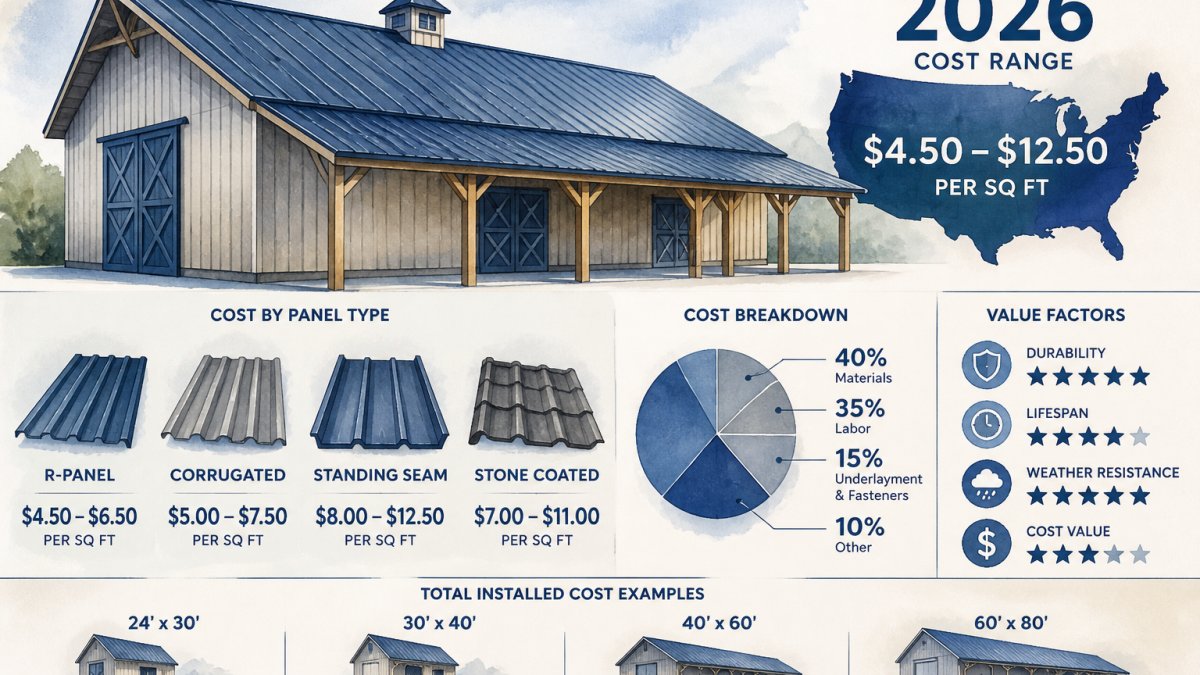
The most common metal panel options fall into two categories: exposed-fastener corrugated panels and standing seam systems. Corrugated panels typically cost less upfront but require more maintenance over time. Standing seam panels cost more initially but offer superior weather protection and a longer lifespan.
This guide breaks down 2026 pricing for metal roofing for pole barns cost by panel type, building size, and installation method. We'll also compare metal roofing to traditional shingles and explain when reskinning makes financial sense versus full replacement.
26-Gauge Metal Roofing Price Per Square Foot
The most affordable metal roofing option for pole barns is 26-gauge corrugated metal panels. These panels are lightweight, easy to install, and commonly used on agricultural buildings because they balance cost and performance.
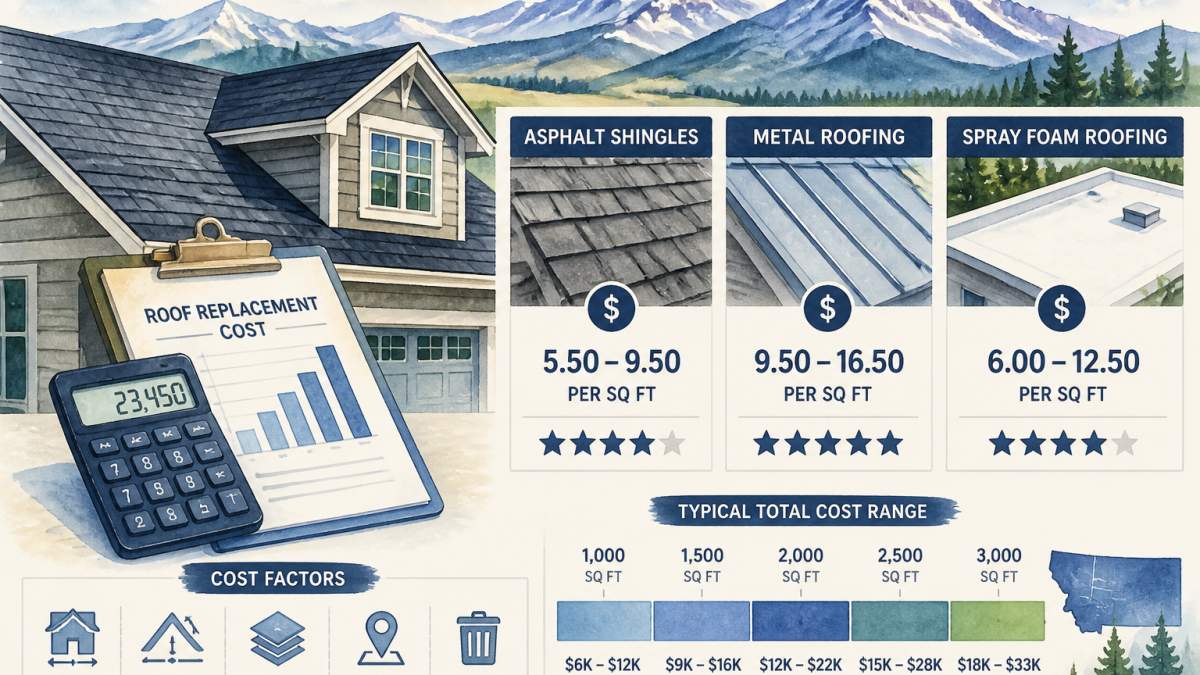
According to Western States Metal Roofing's 2026 cost guide, 26-gauge corrugated metal roofing typically ranges from $7 to $12 per square foot for materials. The exact price depends on panel profile, color options, and current steel market conditions.
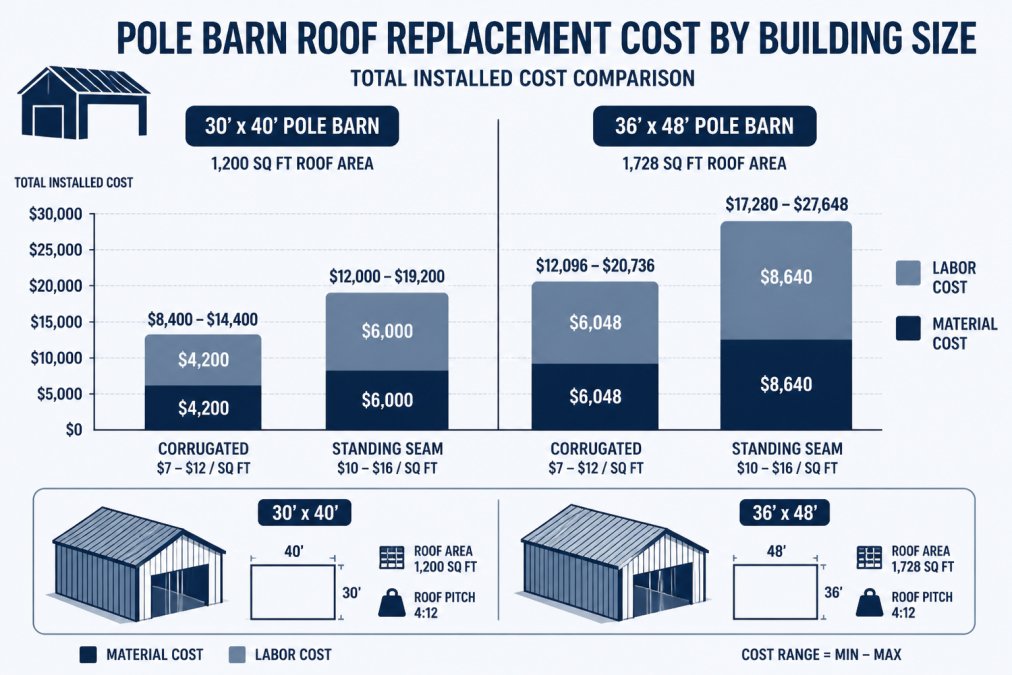
What this means in practice: a 1,200-square-foot roof (typical for a 30-by-40 pole barn) would require $8,400 to $14,400 in materials alone at 2026 rates. Labor costs add significantly to the final bill and vary by region and contractor experience.
26-gauge panels work best for pole barns in dry climates or buildings where aesthetic appearance is less critical. However, thinner panels dent more easily and may not suit properties in hail-prone regions.
One common mistake is assuming all corrugated panels are identical. Profile depth, fastener spacing, and coating thickness vary between manufacturers.
Standing Seam Metal Roof Cost Breakdown
Standing seam metal roofing represents the premium option for pole barns. These panels interlock along their edges, creating a watertight seal without exposed fasteners. The result is superior weather protection and a more finished appearance.
Standing seam metal roofing costs $10 to $16 per square foot for materials, according to Western States Metal Roofing's 2026 metal roof cost analysis. Installation labor typically runs $3 to $8 per square foot, depending on roof complexity and local rates.
For a 1,200-square-foot pole barn roof, standing seam materials alone cost $12,000 to $19,200. Add labor at $3,600 to $9,600, and your total installed cost ranges from $15,600 to $28,800.
Standing seam panels are ideal for pole barns in harsh climates, exactly the environment our clients face in Montana and Northern Wyoming. The sealed seams prevent water infiltration during heavy snow melt and ice dam formation.
The main drawback is installation complexity. Standing seam requires specialized tools and trained installers. DIY installation is impractical, so labor costs are non-negotiable. However, the longevity and minimal maintenance requirements often justify the upfront expense over a 30-year building lifespan.
Pole Barn Roof Replacement Cost by Building Size
Actual metal roofing for pole barns cost in 2026 scales directly with building footprint and roof area. A small 20-by-30 pole barn has a very different cost profile than a 40-by-60 agricultural complex.
30-by-40 Pole Barn Roofing
A 30-by-40 pole barn is one of the most common residential and light commercial sizes. The roof area depends on pitch, but a standard 4:12 pitch creates approximately 1,400 to 1,600 square feet of roofing surface.
Using corrugated panels at $7 to $12 per square foot, materials cost $9,800 to $19,200. Labor at $2 to $4 per square foot adds $2,800 to $6,400. Total installed cost: $12,600 to $25,600 for a corrugated system.
With standing seam panels at $10 to $16 per square foot, materials alone run $14,000 to $25,600. Add installation labor at $3 to $8 per square foot ($4,200 to $12,800), and your total reaches $18,200 to $38,400.
The difference between corrugated and standing seam for a 30-by-40 building is roughly $5,600 to $12,800 in additional cost. Over 30 years, standing seam often pays for itself through reduced maintenance and longer lifespan.
36-by-48 Pole Barn Roofing
A 36-by-48 pole barn is typical for agricultural operations, light manufacturing, or large equipment storage. The roof area at a 4:12 pitch reaches approximately 2,200 to 2,500 square feet.
Corrugated metal panels cost $15,400 to $30,000 in materials, plus $4,400 to $10,000 in labor. Total: $19,800 to $40,000 installed.
Standing seam for the same building runs $22,000 to $40,000 for materials, with $6,600 to $20,000 in labor. Total: $28,600 to $60,000 installed.
At this scale, the cost difference between corrugated and standing seam is substantial, roughly $8,800 to $20,000. However, larger buildings often justify premium materials because they represent significant capital assets. A 36-by-48 structure holding equipment, livestock, or inventory warrants maximum weather protection.
Pole Barn Roof Cost Calculator: Key Cost Drivers
Metal roofing for pole barns cost isn't simply a per-square-foot calculation. Several variables push your final invoice higher or lower than the baseline estimate.
Roof pitch matters significantly. A steeper pitch (8:12 or higher) increases labor costs because installers work at steeper angles and move more slowly.
Design complexity includes roof penetrations (vents, skylights, chimneys), valleys, and transitions to other roof sections. Each penetration requires custom flashing and additional labor.
Delivery and regional variation affect material costs. Remote locations in Montana and Northern Wyoming may incur higher delivery fees or require special orders, adding 5-15% to material costs.
Seasonal timing influences pricing. Spring and summer are peak roofing seasons, and contractors charge premium rates. Fall and winter projects often qualify for 10-20% discounts, though weather delays are a risk.
Labor availability in your region determines installation costs. Areas with experienced metal roofing contractors (like Billings) typically charge $4 to $6 per square foot for labor.
Existing roof condition affects replacement costs. If you're reskinning over an existing metal roof, labor is minimal.
Installation vs. DIY: Labor and Material Costs
Most property owners cannot realistically install metal roofing themselves. The work requires specialized tools, safety equipment, and experience to ensure proper sealing and fastening. However, understanding the labor component helps you evaluate contractor quotes.
Professional installation typically costs $2 to $8 per square foot, depending on panel type and roof complexity.
For a 1,500-square-foot roof, professional installation runs $3,000 to $12,000 in labor alone. That's a substantial portion of your total project cost, but it guarantees proper installation and typically includes a workmanship warranty.
DIY installation is theoretically possible for corrugated panels on simple roofs, but it carries real risks. Improper fastening leads to leaks, wind damage, and premature failure.
If you're considering DIY, be honest about your skill level and the time commitment. Metal roofing installation on a 30-by-40 pole barn typically requires 40-60 hours of skilled labor.
Sun Flex Home Improvement recommends professional installation for standing seam systems and complex roof designs. For simple corrugated panels on low-slope roofs, DIY is possible, but only if you have roofing experience and the proper equipment.
Metal Roofing vs. Shingles: Cost and Durability Comparison
The choice between metal roofing and asphalt shingles fundamentally shapes your long-term costs. While shingles cost less initially, metal roofing delivers superior value over time.
| Factor | Metal Roofing | Asphalt Shingles |
|---|---|---|
| Material Cost (per sq ft) | $7-$16 | $3-$6 |
| Installation Cost (per sq ft) | $2-$8 | $1-$3 |
| Lifespan | 20-40+ years | 15-20 years |
| Maintenance | Minimal | Regular repairs |
| Energy Efficiency | Excellent (reflective) | Moderate |
| Weather Resistance | Superior | Good |
| Hail Damage Risk | Low | High |
Asphalt shingles cost roughly half as much to install as metal roofing. For a 1,500-square-foot roof, shingles run $6,000 to $13,500 installed, compared to $13,500 to $42,000 for metal.
However, shingles require replacement every 15-20 years in harsh climates. Metal roofing lasts 30-40 years with minimal maintenance. Over a 40-year building lifespan, you'll replace shingles twice, adding $12,000 to $27,000 in additional costs (in future dollars).
Metal roofing's reflective surface also reduces cooling costs in summer, an advantage in Montana and Northern Wyoming where buildings experience wide temperature swings. Shingles absorb heat, raising interior temperatures and increasing HVAC demand.
For agricultural or commercial pole barns, metal roofing is the more economical choice over time. For temporary structures or budget-constrained residential projects, shingles make sense initially, but expect replacement sooner.
Reskinning vs. New Construction: Which Saves Money
One of the most cost-effective strategies is reskinning: installing new metal roofing directly over an existing roof structure without removing old materials. This approach saves significant labor and disposal costs.
Reskinning over an existing metal roof costs roughly $2 to $4 per square foot in labor, since no demolition is required. For a 1,500-square-foot pole barn, labor runs $3,000 to $6,000.
Full replacement with demolition costs $2 to $8 per square foot in labor, depending on what's being removed. Asphalt shingles cost more to demo than metal.
The savings from reskinning are modest if you're already removing the old roof. However, if your existing roof is still structurally sound but leaking or aging, reskinning extends its life by 20+ years without major disruption.
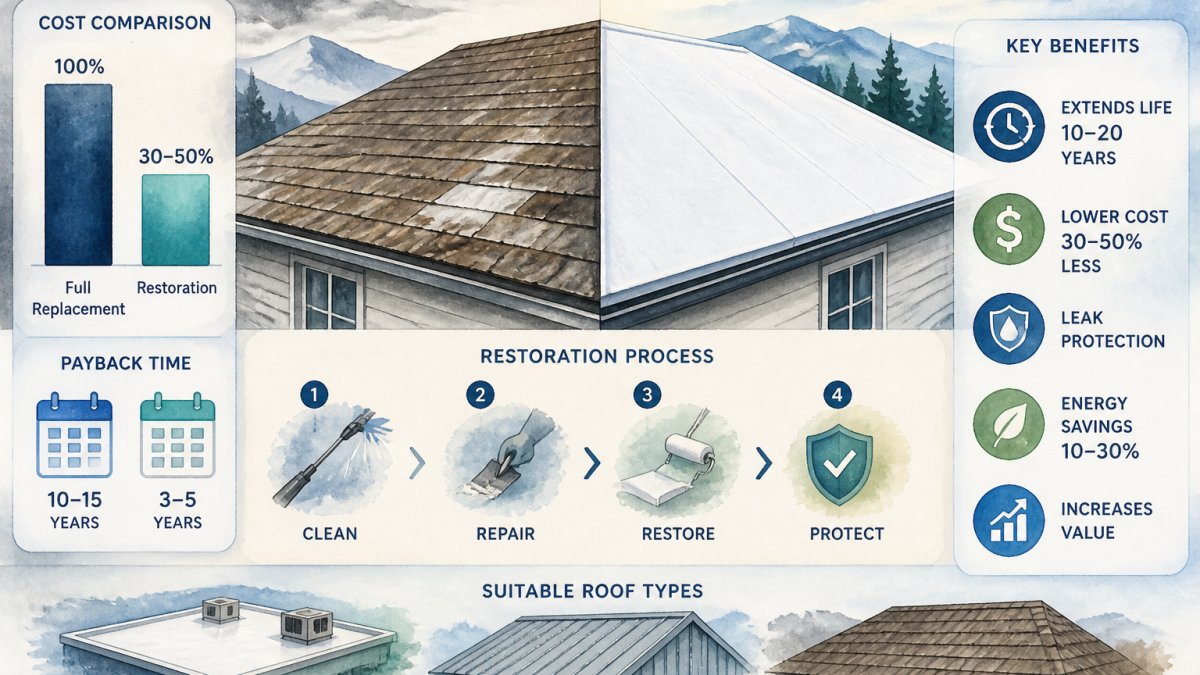
Sun Flex Home Improvement often recommends reskinning for property owners facing the choice between costly full replacement and temporary patching. Spray foam restoration combined with metal reskinning can save up to half the cost of complete replacement while delivering additional protection.
The key question: is your existing roof structure (rafters, purlins, trusses) sound? If yes, reskinning makes financial sense. If the underlying structure is rotted or compromised, full replacement is necessary.
Metal roofing for pole barns cost in 2026 ranges from $12,600 to $60,000+ depending on building size, panel type, and installation complexity.
Frequently Asked Questions
How much does metal roofing for a pole barn cost per square foot in 2026?
Corrugated metal roofing ranges from $7-$12 per square foot installed, while standing seam metal roofing costs $10-$16 per square foot. Exposed-fastener steel panels over purlins fall in the lower range. Actual costs depend on panel type, roof pitch, design complexity, location, delivery, and whether you hire a contractor or install DIY. Request a quote from a local contractor for your specific building dimensions and roof area.
What is the price of 26-gauge metal roofing per square foot?
26-gauge metal roofing typically costs $7-$12 per square foot for exposed-fastener corrugated panels. Standing seam options in 26-gauge run higher, around $10-$16 per square foot. Pricing depends on the panel profile, fastener type, regional availability, and whether installation is included. Contact local metal roofing suppliers or contractors for current quotes based on your roof area and building specifications.
How much does it cost to replace the metal roof on a 30-by-40 pole barn?
A 30-by-40 pole barn has a roof area of approximately 1,200-1,500 square feet (depending on roof pitch). Using 2026 pricing, corrugated metal roofing would cost $8,400-$18,000 installed, while standing seam would run $12,000-$24,000. These estimates include materials and labor. Actual costs vary by location, roof complexity, existing structure condition, and whether tear-off and disposal are included. Get a free estimate from a local contractor for your specific project.
Is exposed-fastener or standing-seam metal roofing cheaper for a pole barn?
Exposed-fastener metal roofing is cheaper, ranging from $7-$12 per square foot installed. Standing seam costs $10-$16 per square foot. Exposed-fastener panels work well for pole barns and agricultural buildings, though standing seam offers superior weather sealing and a cleaner appearance. Choose based on your budget, climate exposure, and long-term durability preferences. For harsh hail or extreme weather regions, the extra cost of standing seam may justify better impact resistance.
What factors affect the cost of a pole barn metal roof?
Key cost drivers include roof area and building dimensions, roof pitch and design complexity, panel type (corrugated vs. standing seam vs. Tuff Rib), material gauge (26-gauge, 29-gauge, etc.), regional location and labor rates, delivery fees, existing structure condition, tear-off and disposal requirements, and whether you hire a contractor or DIY installation. Energy-efficient coatings, custom colors, and premium panel finishes also increase costs. Use a pole barn roof cost calculator or request a detailed quote to understand your specific project's pricing.