 ultimate-guide
Commercial Roof Restoration in Billings: 2026 Guide
Table of Contents
- Why Commercial Roof Restoration Makes Sense in Billings
- Roof Restoration vs Replacement Cost: What Property Owners Should Know
- Commercial Roof Coating Benefits for Billings Buildings
- Commercial Roof Maintenance Checklist
- Spray Foam Restoration: Step-by-Step Process
- Storm Damage, Leak Repair, and Roof Longevity
- Pros and Cons of Commercial Roof Restoration
- Conclusion
- Frequently Asked Questions
Last Updated: September 23, 2026
Why Commercial Roof Restoration Makes Sense in Billings
Commercial roof restoration is the process of repairing and sealing an existing roof system instead of tearing it off and rebuilding it from the deck up. For property owners weighing commercial roof restoration in Billings, the appeal is straightforward: you keep the structure you already have, stop the leaks, and add years of service life at a fraction of replacement cost. Sun Flex Home Improvement has spent over 25 years helping property owners across Montana and Northern Wyoming make exactly this decision, and the pattern is consistent. Harsh freeze-thaw cycles, spring snowmelt, and summer hail punish every roof in the region, so the real question is rarely whether a roof needs attention. It is whether that attention should be a restoration or a full tear-off.
Most commercial buildings in the area have roofs that are structurally sound but functionally tired.
Roof Restoration vs Replacement Cost: What Property Owners Should Know
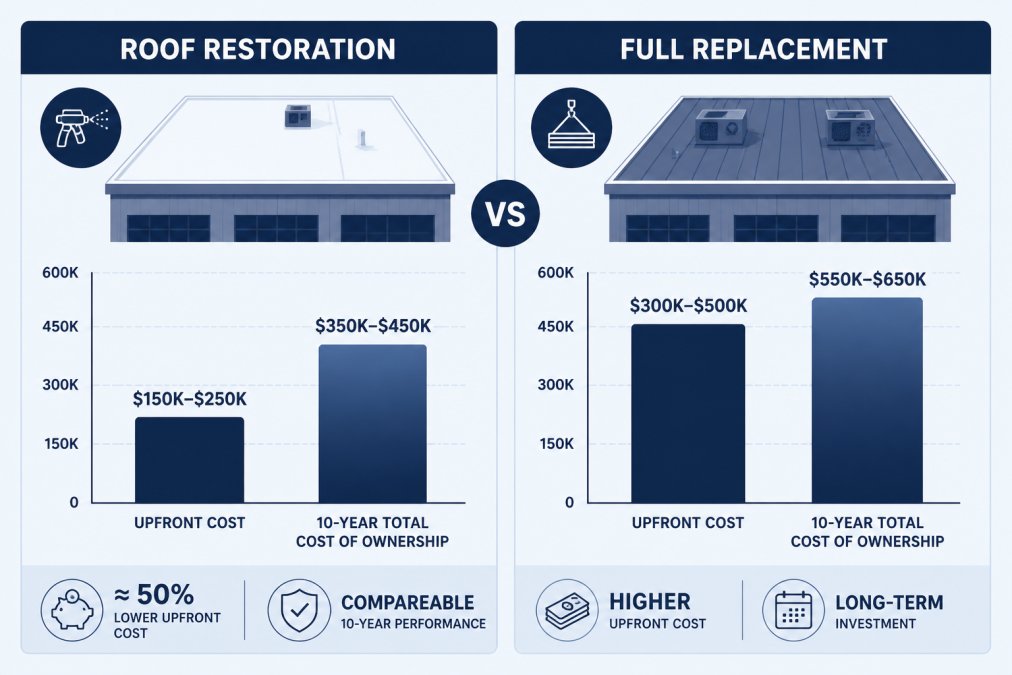
Restoration generally costs about half of what a full replacement runs, which is the single biggest reason property owners pursue it. That gap comes from labor and disposal: a tear-off means removing the old roof, paying landfill fees, and rebuilding every layer, while restoration skips most of that work. The exact numbers depend on roof size, membrane type, and how much repair the existing surface needs, so any contractor quoting a figure before inspecting your roof is guessing.
When Restoration Is the Right Call
Restoration is the right call when the roof structure is sound, the damage is surface-level, and the existing system has years of usable life left. Signs that point toward restoration include:
- Leaks confined to seams, flashing, or penetrations rather than widespread saturation
- A deck that feels solid underfoot with no soft spots or visible deflection
- Insulation that is still dry, confirmed by an inspection rather than assumption
- A roof that is less than roughly two decades old and has not been recovered before
When Full Replacement Is Unavoidable
Replacement becomes unavoidable when the problems go deeper than the surface. Wet insulation, rotted decking, structural deflection, or a roof that has already been recovered multiple times all point to a tear-off. So does widespread saturation, where water has traveled far from the visible leak and compromised the assembly underneath.
Commercial Roof Coating Benefits for Billings Buildings
Coating benefits come down to three things: they seal the roof against water, they reflect heat, and they extend the life of the existing system. A properly applied coating turns a failing membrane into a seamless, watertight surface with no seams for water to exploit. According to the U.S. Department of Energy's guidance on cool roofs, reflective roof surfaces can lower cooling demand by reducing the heat a building absorbs, which matters during Billings summers when rooftop temperatures climb well above air temperature.
Energy Efficiency and Cool Roof Performance
A cool roof reflects sunlight instead of absorbing it, which lowers surface temperature and reduces the load on your cooling equipment. For a commercial building with a large, flat roof, that surface area is a major heat source. Reflective coatings cut that heat gain, and many property owners notice the difference on summer utility bills. The savings vary by building, insulation, and how the space is used, so treat any specific percentage promise with suspicion until it is tied to your building's actual conditions.
Weather Resistance for Montana's Climate
Freeze-thaw cycles are the real enemy here. Water works into small cracks, freezes, expands, and widens the opening, then repeats. Spray foam and elastomeric coatings handle this by flexing with the substrate instead of cracking, and their seamless surface leaves no joints for ice to pry apart. Hail resistance is another factor worth asking about directly, since impact ratings vary by coating thickness and product.
Commercial Roof Maintenance Checklist
A maintenance plan is what separates a roof that lasts from one that fails early. The goal is catching small failures before they become water intrusion, and that means scheduled inspections rather than waiting for a leak to announce itself. A simple commercial roof maintenance checklist covers the items below, and the National Roofing Contractors Association publishes guidance on inspection frequency and documentation worth following.
- Inspect the roof surface for cracks, blisters, and open seams twice a year
- Check all flashing, edge metal, and penetrations for separation
- Clear drains, scuppers, and gutters of debris before spring melt and fall rains
- Look for ponding water that stays more than 48 hours after a storm
- Examine the interior ceiling and walls for new stains after heavy weather
- Document every inspection with photos and dates for warranty purposes
- Schedule a professional assessment after any significant hail or wind event
Seasonal Inspection Priorities
Timing matters as much as the checklist. In spring, the priority is drainage and any damage the winter freeze-thaw cycle opened up. Summer is the time to check for heat-related blistering and to schedule any coating work while the weather cooperates. Fall inspections focus on clearing debris before snow loads arrive, and winter is about watching for ice dams and interior leaks.
Spray Foam Restoration: Step-by-Step Process
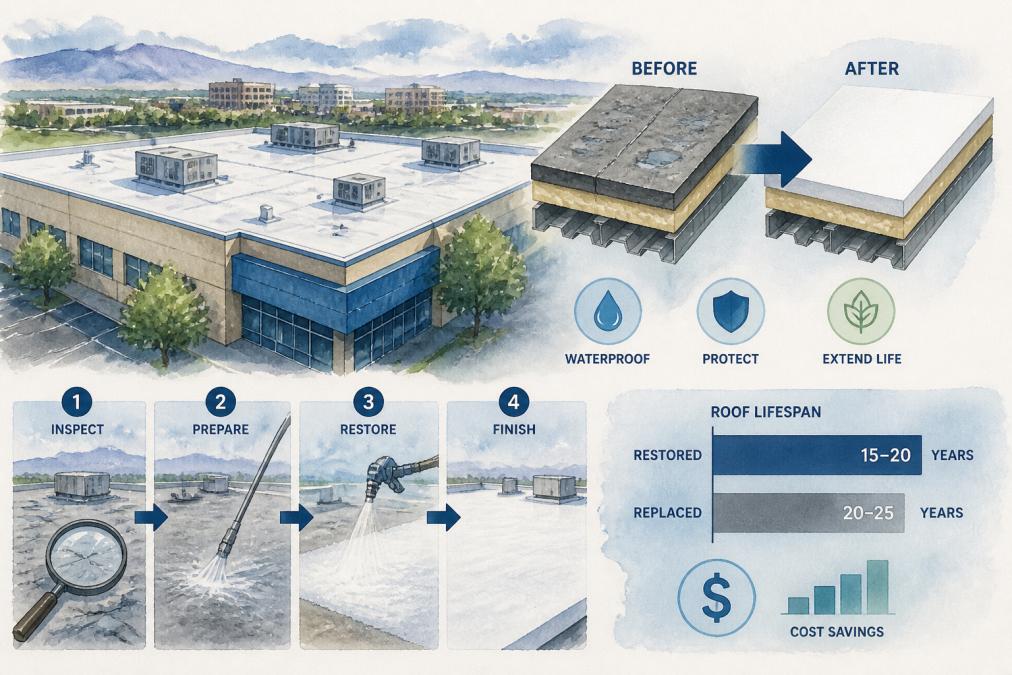
Spray foam restoration follows a defined sequence, and skipping steps is where most failed jobs go wrong. The process starts with a thorough inspection and moisture survey to confirm the roof is a candidate. From there, the crew prepares the surface, repairs the existing damage, and applies the new system in controlled stages.
- Inspection and moisture survey. The crew maps wet areas, checks the deck for soundness, and confirms restoration is appropriate.
- Surface preparation. The roof is cleaned of dirt, debris, and loose material so the new system bonds properly.
- Repairs and flashing. Open seams, blisters, and failed flashing are fixed before any coating goes down.
- Spray foam application. Foam is applied in passes to build the required thickness, filling low spots and creating slope for drainage.
- Protective coating. A reflective topcoat goes over the foam to shield it from UV and weather.
- Final inspection. The crew checks thickness, coverage, and drainage, then documents the completed work.
Storm Damage, Leak Repair, and Roof Longevity
Storm damage and leak repair are the two reasons most property owners call in the first place, and both connect directly to how long a roof lasts. Hail bruises a membrane, wind lifts edges, and the damage often hides until the next rain finds it. After any significant storm, a professional assessment catches the damage early, and FEMA's guidance on commercial roof damage after storms notes that prompt repair prevents small breaches from turning into interior water damage and mold.
Pros and Cons of Commercial Roof Restoration
Restoration is not the right answer for every roof, and pretending otherwise does property owners a disservice. Here is an honest look at both sides.
Pros:
- Costs roughly half of a full replacement in most cases
- Far less disruption to tenants and daily operations
- Adds a reflective surface that can cut cooling costs
- Avoids tear-off waste and landfill fees
- Seamless spray foam seals the leak paths patches miss
Cons:
- Not viable when the deck or insulation is structurally compromised
- Adds a layer rather than removing the old system, which limits future options
- Requires proper surface prep; shortcuts lead to early failure
- Performance depends heavily on the coating product and application thickness
| Factor | Restoration | Full Replacement |
|---|---|---|
| Upfront cost | Roughly half | Full tear-off and rebuild |
| Business disruption | Minimal | Significant downtime |
| Best for | Sound deck, surface damage | Wet insulation, structural damage |
| Lifespan added | Many years with maintenance | Full new roof cycle |
| Waste generated | Low | High tear-off volume |
Conclusion
The hardest part of this decision is trusting that a restoration will hold up when three other contractors have told you to replace. The answer is not faith in a coating; it is a proper moisture survey and an honest assessment of the deck underneath. Sun Flex Home Improvement brings over 25 years of roofing experience across Montana and Northern Wyoming, specializing in spray foam restoration that can save property owners up to half the cost of a new roof.
Frequently Asked Questions
What is the difference between commercial roof restoration and replacement?
Commercial roof restoration involves cleaning and repairing the existing roof, then applying a coating system or spray foam layer to create a new waterproof surface. Replacement means tearing off the old roof down to the deck and installing new materials. Restoration costs roughly half as much as replacement, causes less downtime, and extends roof life by 10 to 20 years when the underlying structure is sound.
How long does a restored commercial roof last?
A properly applied spray foam or coating restoration can extend the life of your roof, depending on material quality, application thickness, and maintenance. In Billings and across Montana, the freeze-thaw cycles and hail require a thicker coating and regular inspections. Many property owners recoat periodically to maintain the system and avoid full replacement.
Does commercial roof restoration qualify for tax deductions under IRS Section 179?
In many cases, roof restoration costs may be deductible as a business expense. Consult a tax professional who understands commercial property rules to confirm your specific situation.
What are the benefits of spray foam roofing for commercial buildings in Billings?
Spray foam roofing creates a seamless, watertight barrier that seals leaks, adds insulation value, and reflects sunlight to reduce cooling costs. It adheres directly to most existing roof substrates, so there is no tear-off and minimal business disruption. For Billings buildings facing hail, snow load, and temperature swings, spray foam flexes with the structure instead of cracking like rigid materials.